
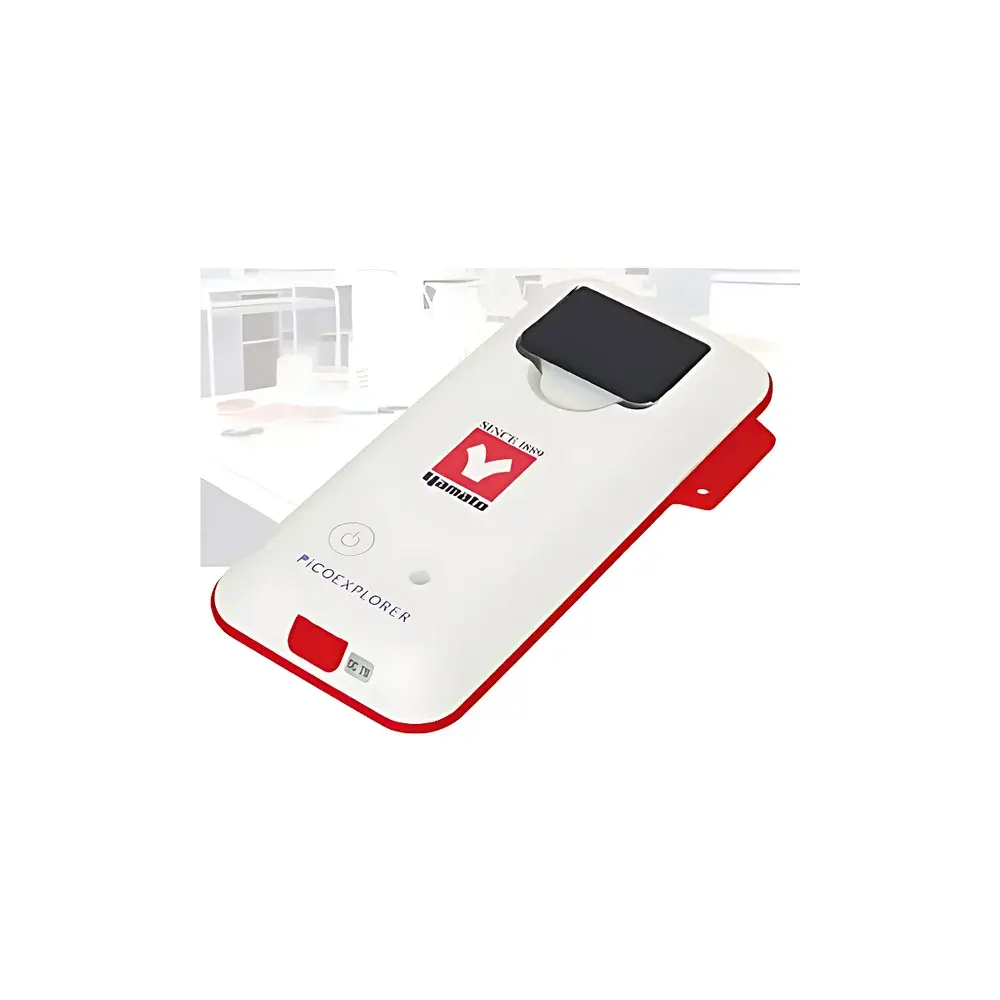
Yamato PiCOEXPLORER Portable UV-Vis Spectrophotometer
| Brand | Yamato |
|---|---|
| Model | PiCOEXPLORER |
| Origin | Japan |
| Wavelength Range | 400–660 nm |
| Sample Format | 0.2 mL PCR tube (capped) |
| Detection Mode | Absorbance (A), Concentration (mg/mL, µg/mL, cells/mL, CFU/mL), Intensity |
| Data Output | Excel-compatible CSV export via USB or Bluetooth |
| Compliance | CE-marked, ISO/IEC 17025 compatible operation environment |
| Software Interface | iOS/Android app + Windows desktop utility |
| Dimensions | 125 × 85 × 45 mm |
| Weight | <280 g |
Overview
The Yamato PiCOEXPLORER Portable UV-Vis Spectrophotometer is a compact, benchtop-grade absorbance measurement system engineered for field-deployable and point-of-use quantitative analysis in life science, environmental monitoring, and quality control laboratories. Based on fixed-wavelength LED-driven photometry with optimized optical path design using molded polymer optics (SOT—Solid Optics Technology), the instrument delivers high reproducibility in absorbance measurements across the visible spectrum (400–660 nm). Unlike traditional cuvette-based spectrophotometers, the PiCOEXPLORER employs a dedicated optical interface calibrated for standard 0.2 mL PCR tubes—eliminating alignment variability, minimizing sample volume requirements (≤100 µL typical), and reducing contamination risk. Its architecture supports direct photometric quantification without internal wavelength scanning; instead, it leverages pre-validated LED emission bands matched to common assay absorption maxima (e.g., 562 nm for BCA, 595 nm for Bradford, 600 nm for OD600 bacterial turbidity). This design prioritizes robustness, rapid thermal stabilization (<30 s), and operational independence from external power sources (USB-C powered or internal Li-ion option).
Key Features
- Ultra-compact footprint (125 × 85 × 45 mm) and sub-280 g mass enable true portability—suitable for biosafety cabinets, cleanrooms, fermentation suites, and outdoor sampling sites.
- Optimized optical train utilizing SOT (Solid Optics Technology) — injection-molded polymer lens and filter assemblies ensure long-term alignment stability and resistance to mechanical shock.
- Direct 0.2 mL PCR tube compatibility — no adapters, no pipetting into cuvettes; capped-tube measurement reduces evaporation and cross-contamination.
- Dual-mode data acquisition: real-time display on iOS/Android devices via Bluetooth Low Energy (BLE) or local USB-C tethering to Windows PCs.
- Embedded calibration traceability: factory-set baseline correction and reference blank normalization support GLP-aligned workflows; optional user-defined calibration curves stored per assay type.
- Battery-operated mode (optional) provides >4 hours continuous operation — ideal for remote labs or mobile diagnostics units.
Sample Compatibility & Compliance
The PiCOEXPLORER is validated for use with aqueous and buffered biological samples including cell lysates, culture supernatants, enzyme reaction mixtures, and environmental water extracts. It complies with CE marking requirements for electromagnetic compatibility (EMC Directive 2014/30/EU) and low-voltage safety (LVD Directive 2014/35/EU). While not a regulated medical device, its performance characteristics align with ISO/IEC 17025:2017 clause 7.2.2 (method validation) when used with documented protocols for protein quantification (BCA/Bradford), microbial density (OD600), and colorimetric assays (e.g., FRAP, DNS, ninhydrin). The instrument’s fixed-wavelength architecture avoids spectral stray light issues inherent in grating-based systems, enhancing accuracy for endpoint absorbance assays under variable ambient lighting conditions.
Software & Data Management
Data acquisition and reporting are supported through two interoperable platforms: the PiCOEXPLORER Mobile App (iOS/Android) and the PiCOEXPLORER Desktop Suite (Windows 10/11). Both tools log timestamped absorbance values, calculated concentrations (using user-loaded calibration equations), and raw intensity signals. All datasets export natively to CSV format—fully compatible with Microsoft Excel, GraphPad Prism, and Python/Pandas workflows. Audit trail functionality includes operator ID tagging, instrument serial number stamping, and version-controlled method templates. For regulated environments, the desktop software supports 21 CFR Part 11-compliant electronic signatures when deployed with network-authenticated Windows domain accounts and encrypted local storage.
Applications
- Microbial growth monitoring: OD600 tracking of E. coli, yeast, and filamentous fungi in shake flasks or microtiter plates.
- Protein quantification: BCA (562 nm), Bradford (595 nm), Lowry, and direct A280 measurements (with optional UV-enhanced module).
- Cell viability and metabolic activity assays: MTT, XTT, and resazurin reduction kinetics.
- Environmental analysis: Nitrate/nitrite (diazotization), phosphate (molybdenum blue), heavy metals (dithizone, PAR chelation), and COD estimation.
- Food and beverage QC: Glucose (GOX-PAP), fructose, antioxidant capacity (FRAP, DPPH), and Maillard reaction product screening.
- Educational labs: Teaching core photometry principles with minimal infrastructure requirements.
FAQ
Is the PiCOEXPLORER suitable for regulatory submissions (e.g., FDA, EMA)?
The instrument itself is not a Class II medical device, but its data output—when generated under validated SOPs, with documented calibration and operator training—may support analytical method development and stability studies compliant with ICH Q2(R2) and USP <1225>.
Can I use custom wavelengths outside 400–660 nm?
No. The PiCOEXPLORER uses discrete, temperature-stabilized LEDs at fixed peak wavelengths. Custom assays must align with available bands (405, 450, 492, 540, 562, 595, 600, 630, 660 nm); full spectral scanning is not supported.
How is photometric accuracy verified?
Each unit ships with NIST-traceable neutral density filters and certified liquid standards (e.g., potassium dichromate in 0.005 M H2SO4). Users perform daily verification using the built-in “Reference Check” routine per ISO 8655-7.
Does it support kinetic measurements?
Yes—time-resolved absorbance acquisition at user-defined intervals (1–300 s) up to 1,000 data points per run, synchronized with Bluetooth-connected mobile devices.
What maintenance is required?
No optical alignment or lamp replacement needed. Routine cleaning of the sample chamber aperture and periodic verification with supplied standards constitute the full preventive maintenance schedule (recommended quarterly).




