
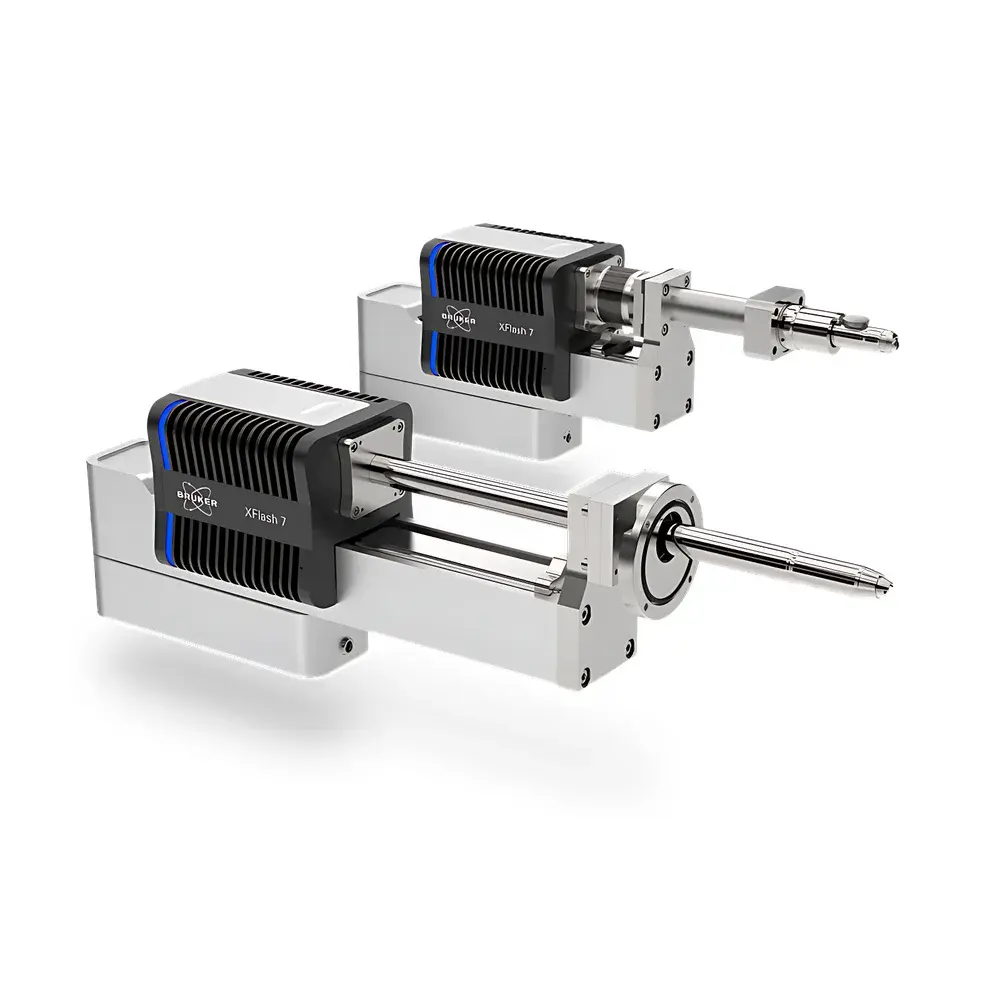
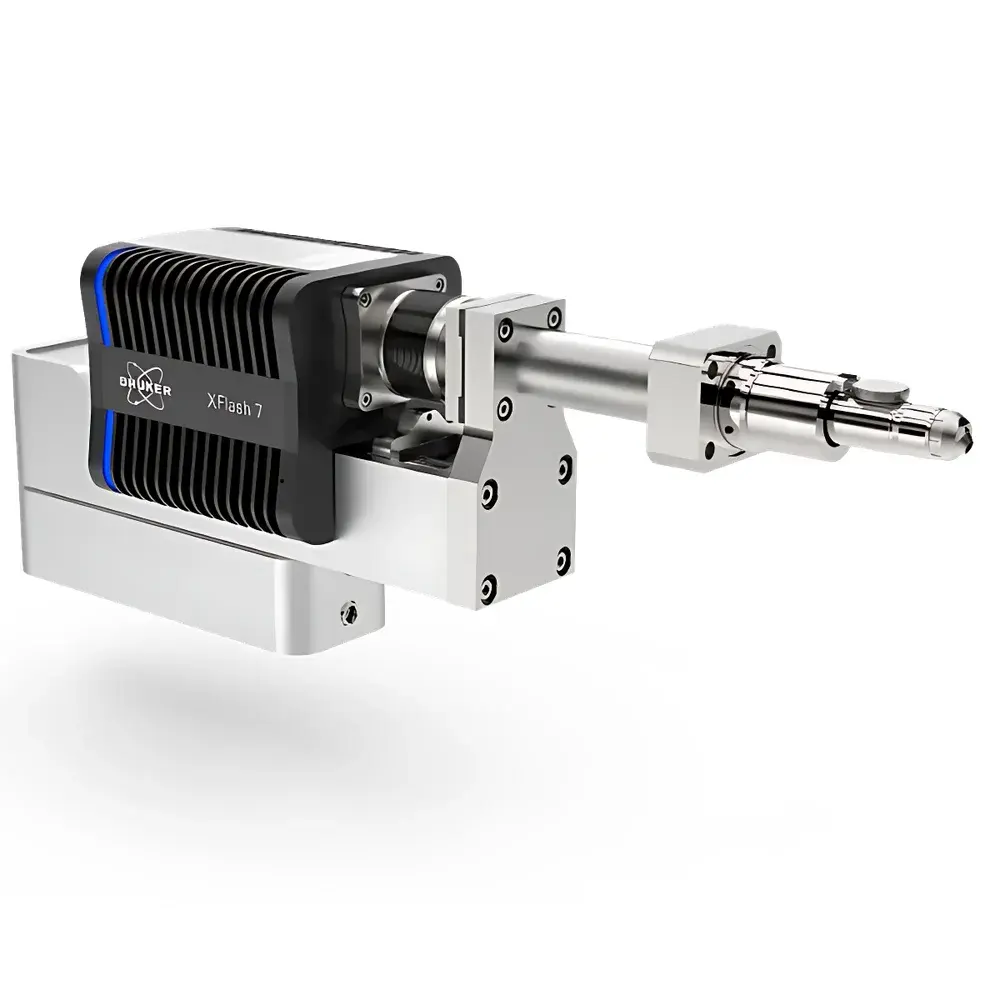
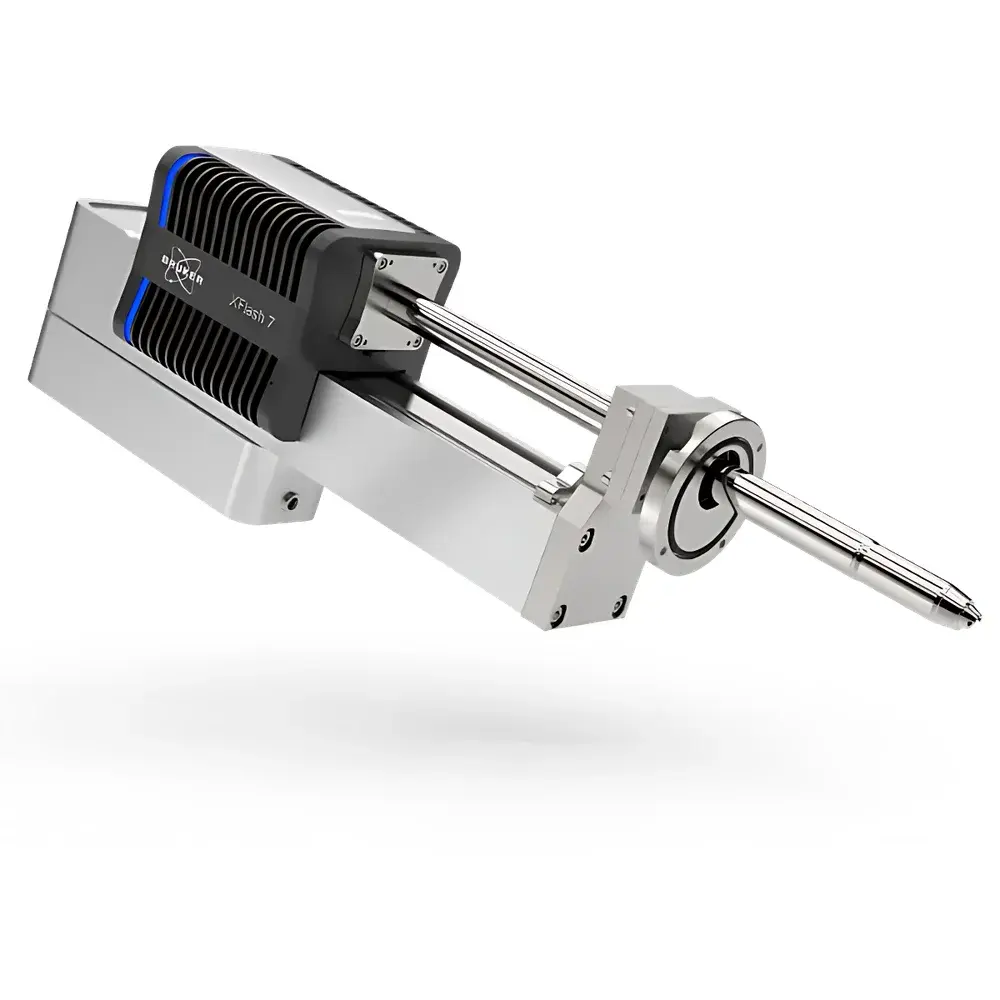
Bruker Quantax XFlash Series Energy Dispersive Spectrometer for SEM, FIB-SEM, and EPMA
| Brand | Bruker |
|---|---|
| Origin | Germany |
| Model | Quantax XFlash Series |
| Energy Resolution | <129 eV |
| Peak-to-Background Ratio | 20,000:1 |
| Maximum Count Rate | 1,500 kcps |
| Elemental Detection Range | Be to Cf |
| Detector Active Area | 10–300 mm² |
| Window Options | Ultrathin Polymer Window or Windowless Configuration |
Overview
The Bruker Quantax XFlash Series Energy Dispersive Spectrometer (EDS) is a high-performance, modular microanalysis system engineered for integration with scanning electron microscopes (SEM), focused ion beam–SEM (FIB-SEM), and electron probe microanalyzers (EPMA). It operates on the principle of energy-dispersive X-ray spectroscopy, where characteristic X-rays emitted from a specimen under electron beam excitation are resolved by a silicon drift detector (SDD) according to their photon energy. The system’s optimized mechanical design—including fine-tuned take-off angle, minimized working distance dependency, and EDS-specific pole-piece compatibility—ensures maximum solid-angle collection (>1.1 sr) and consistent geometric efficiency across diverse microscope configurations. This enables quantitative elemental analysis with high spectral fidelity, low detection limits, and robust reproducibility under both high-vacuum and low-voltage (<5 kV) imaging conditions.
Key Features
- High-resolution SDD technology delivering energy resolution <129 eV at Mn Kα (5.89 keV), enabling precise peak separation for adjacent elements (e.g., Si Kα and W Mα, or S Kα and Pb Mα).
- Peak-to-background ratio exceeding 20,000:1 supports reliable trace-element detection down to sub-0.1 wt% levels in routine mapping and point analysis.
- Real-time processing architecture with hybrid pulse processor capable of sustaining effective output count rates up to 1,000,000 cps—critical for high-speed mapping and dynamic in-situ experiments.
- Configurable detector active area (10–300 mm²) and dual window options: ultrathin polymer window for enhanced light-element transmission (Be–F), or windowless operation for ultimate sensitivity below 1 keV (including B, C, N, O).
- Mechanically robust, vacuum-compatible mounting with motorized retractable mechanism compatible with standard SEM/FIB-SEM pole pieces and EPMA column geometries.
Sample Compatibility & Compliance
The Quantax XFlash platform supports analysis of conductive, semi-conductive, and insulating specimens—when paired with appropriate charge compensation (e.g., low-vacuum mode, carbon coating, or beam deceleration). Its calibration traceability aligns with ISO 14726 (microbeam analysis — quantification procedures for EDS) and ASTM E1508 (standard guide for quantitative elemental analysis by wavelength- and energy-dispersive X-ray spectrometry). Software-based matrix correction routines (ZAF and φ(ρz)) comply with IUPAC-recommended standards for quantitative microanalysis. All hardware and firmware meet CE, RoHS, and UL safety directives. For regulated environments, ESPRIT software supports 21 CFR Part 11-compliant user access control, electronic signatures, and full audit trail functionality required in GLP and GMP laboratories.
Software & Data Management
ESPRIT is a unified, modular software platform that integrates EDS, wavelength-dispersive spectroscopy (WDS), electron backscatter diffraction (EBSD), and micro-XRF into a single analytical interface. It provides real-time spectrum acquisition, automated phase identification (via integrated CrystalDB), quantitative mapping with pixel-by-pixel deconvolution, and multi-technique correlation (e.g., overlaying EBSD orientation maps with EDS compositional gradients). Data export conforms to standardized formats (e.g., .emsa, .tif, .csv, HDF5) for interoperability with third-party tools such as MATLAB, Python (via hyperspy), and Thermo Scientific Avizo. All processing steps—including background subtraction, peak integration, and standardless quantification—are fully scriptable and reproducible, supporting method validation and laboratory accreditation workflows.
Applications
- Materials science: Phase identification in alloys, intermetallics, and ceramic composites; segregation analysis at grain boundaries and interfaces.
- Geosciences: Major and trace element quantification in silicates, oxides, and sulfides; fluid inclusion chemistry via spot analysis.
- Life sciences: Localization of metal ions (e.g., Ca, Zn, Fe) in cryo-prepared biological tissues; nanoparticle uptake studies in cellular models.
- Failure analysis: Contaminant identification on semiconductor wafers; corrosion product characterization in aerospace components.
- Forensics & cultural heritage: Non-destructive pigment analysis in paintings; provenance determination of archaeological ceramics and glass.
FAQ
What vacuum compatibility does the Quantax XFlash detector require?
The detector is rated for ultra-high vacuum (UHV) environments (≤1×10⁻⁷ mbar) and is compatible with both high-vacuum and low-vacuum SEM modes when used with appropriate differential pumping or pressure-limiting apertures.
Can the system perform standardless quantification reliably?
Yes—ESPRIT implements physics-based absorption and fluorescence corrections validated against certified reference materials (CRMs) including NIST SRM 2782 (Al–Cu alloy) and BAM U101 (Fe–Cr–Ni stainless steel), achieving typical accuracy within ±2% relative for major elements.
Is windowless operation suitable for routine lab use?
Windowless detectors require strict vacuum integrity and clean sample surfaces to prevent contamination of the SDD cold finger; they are recommended for dedicated low-energy applications under controlled maintenance protocols.
How does the system handle overlapping X-ray peaks?
ESPRIT employs iterative least-squares fitting with constrained peak shape modeling (Voigt profiles), combined with library-based interference correction using >2200 experimentally verified spectral lines—including L- and M-series transitions for heavy elements.
What training and support resources are available?
Bruker offers on-site installation qualification (IQ), operational qualification (OQ), and comprehensive user training programs covering fundamentals of microanalysis, method development, and regulatory documentation—aligned with ISO/IEC 17025 and ASTM E456 standards.





