
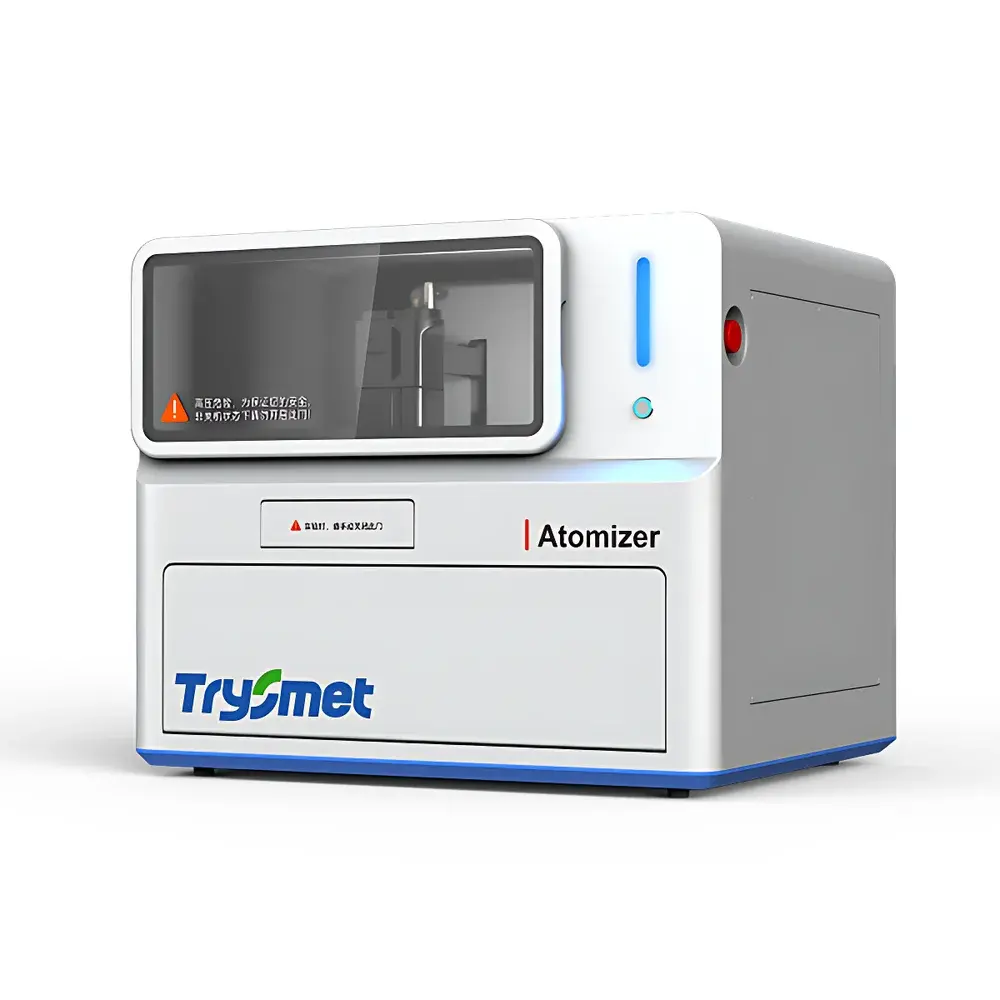
TrySmet Atomizer Matrix Sprayer
| Brand | TrySmet |
|---|---|
| Origin | Beijing, China |
| Manufacturer Type | Authorized Distributor |
| Country of Manufacture | China |
| Model | Atomizer |
| Pricing | Available Upon Request |
Overview
The TrySmet Atomizer Matrix Sprayer is a precision-engineered sample preparation workstation designed specifically for matrix-assisted laser desorption/ionization (MALDI) mass spectrometry imaging (MSI). It operates on the principle of controlled pneumatic nebulization within an enclosed, environmentally regulated chamber, enabling uniform, reproducible deposition of crystalline organic matrix compounds—such as α-cyano-4-hydroxycinnamic acid (CHCA), sinapinic acid (SA), or 2,5-dihydroxybenzoic acid (DHB)—onto tissue sections, cultured cells, or thin-layer chromatography (TLC) plates. Unlike manual sprayers or airbrush-based systems, the Atomizer integrates real-time environmental control (temperature, relative humidity, and inert gas atmosphere) to minimize matrix crystal polymorphism, suppress analyte delocalization, and ensure spatial fidelity critical for high-resolution MSI workflows.
Key Features
- Enclosed spray chamber with independent regulation of temperature (range: 10–30 °C, ±0.5 °C stability) and relative humidity (20–60% RH, ±3% RH accuracy), mitigating solvent evaporation gradients and promoting homogeneous matrix microcrystal formation.
- Programmable aerosol generation system using ultralow-flow piezoelectric atomization, supporting droplet size distribution centered at 5–15 µm (volumetric mean) for optimal surface coverage without oversaturation or pooling.
- Integrated inert gas (N₂ or Ar) purge capability to maintain oxygen-free conditions during spraying—essential for oxidation-sensitive metabolites and labile post-translational modifications.
- Optional laser transfer module compatible with UV (355 nm) or IR (1064 nm) lasers, enabling matrix-assisted laser transfer (MALTI) of intact tissue films onto conductive targets prior to MALDI analysis—preserving spatial integrity while enhancing signal-to-noise ratio for low-abundance endogenous metabolites.
- Modular mounting interface for standard microscope slides (1″ × 3″), cryo-sections (up to 20 µm thickness), and ITO-coated glass substrates; accommodates sample dimensions up to 76 mm × 26 mm.
Sample Compatibility & Compliance
The Atomizer supports biological specimens including formalin-fixed paraffin-embedded (FFPE) and frozen tissue sections, cell monolayers, bacterial colonies, and plant tissue slices. Its environmental control architecture aligns with best practices outlined in ASTM E3292–22 (“Standard Guide for MALDI Imaging Sample Preparation”) and ISO/IEC 17025:2017 requirements for method validation in analytical laboratories. The inert gas functionality facilitates compliance with GLP documentation standards for preclinical imaging studies, while hardware-level audit trails (via optional firmware upgrade) support alignment with FDA 21 CFR Part 11 data integrity expectations when integrated into regulated QC/QA environments.
Software & Data Management
Controlled via a dedicated Windows-based application with intuitive graphical workflow builder, the Atomizer software enables stepwise protocol definition—including spray duration, nozzle translation speed, layer count, dwell time between layers, and environmental ramping profiles. All parameters are timestamped and exportable in CSV/JSON format. The system logs environmental sensor readings (temperature, humidity, O₂ level) synchronously with actuator events, providing traceable metadata for method reproducibility assessments. Optional API integration allows bidirectional communication with LIMS platforms and third-party MSI acquisition software (e.g., Bruker flexImaging, Waters HDMS, or Shimadzu Imaging Suite).
Applications
- High-fidelity MALDI-MSI of lipids, peptides, and small-molecule metabolites in neurodegenerative disease models.
- Quantitative spatial mapping of drug distribution and metabolism in pharmacokinetic tissue sections.
- Multi-omics correlation studies integrating MALDI imaging with adjacent H&E staining or immunohistochemistry.
- Development and validation of novel matrix formulations for improved ionization efficiency across diverse analyte classes.
- Laser-transfer-enhanced MSI of fragile samples—such as decalcified bone sections or embryonic tissues—where conventional matrix application induces structural disruption.
FAQ
What matrix solvents are compatible with the Atomizer?
Acetonitrile/water/trifluoroacetic acid (ACN/H₂O/TFA), ethanol/water, and methanol/water mixtures are routinely used; solvent compatibility is verified up to 40% v/v water content and ≤10% v/v acid concentration.
Can the Atomizer be integrated into automated histology workflows?
Yes—its RS-232 and Ethernet interfaces support external triggering from slide stainers or autostainers; custom scripting via Python SDK enables synchronization with sectioning and staining cycles.
Is the laser transfer module validated for quantitative applications?
The optional laser transfer subsystem meets linearity criteria per USP for gradient dilution series (R² ≥ 0.998 over 3 orders of magnitude) when coupled with internal standard normalization protocols.
Does the system require external exhaust or fume hood installation?
No—the integrated HEPA-filtered recirculation system maintains Class 1000 cleanroom-equivalent particulate levels within the chamber; optional active carbon filtration is available for volatile organic compound (VOC) capture.
What maintenance intervals are recommended for long-term operational reliability?
Piezoelectric nozzles require ultrasonic cleaning every 200 operational hours; environmental sensors are factory-calibrated annually, with NIST-traceable verification kits available for in-house recalibration.



