
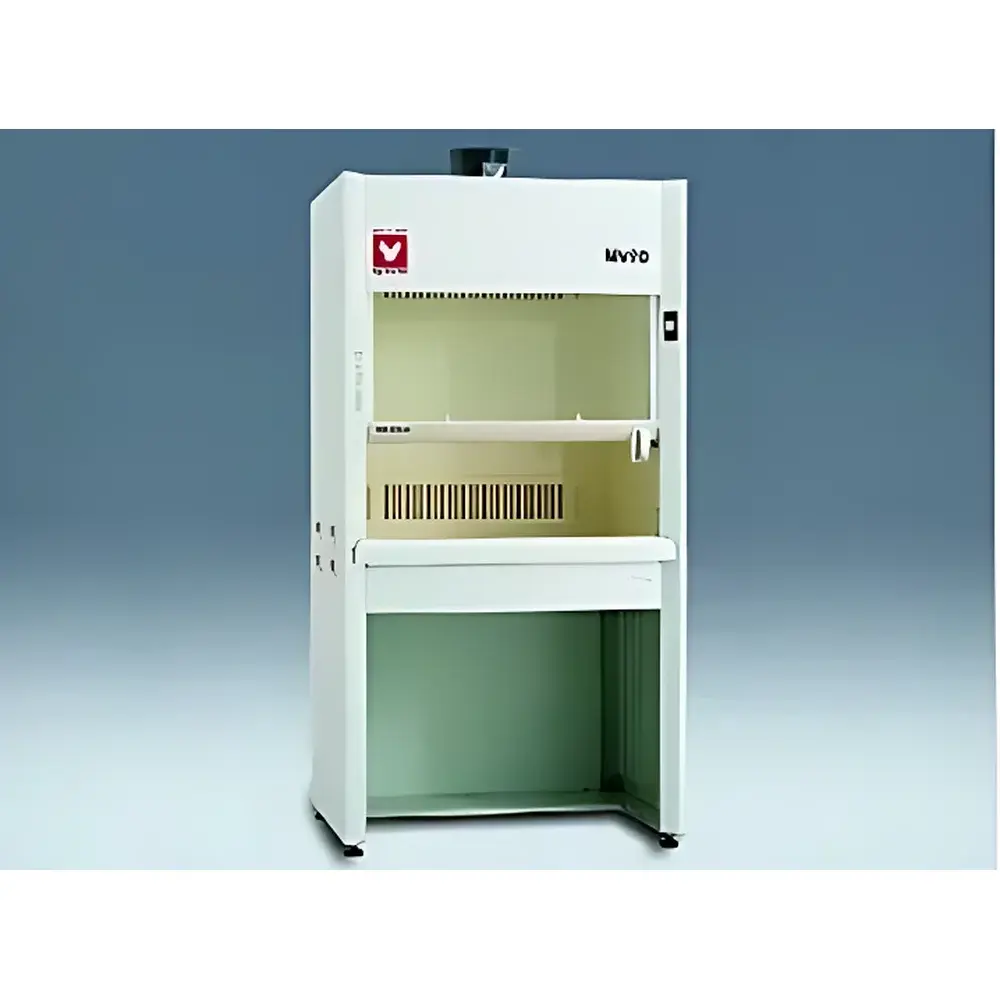
YAMATO MS90C Compact Benchtop Fume Hood for Organic Solvents and Acids
| Brand | YAMATO |
|---|---|
| Origin | Japan |
| Model | MS90C |
| Construction | Steel outer cabinet with chemical-resistant powder coating |
| Interior options | SUS304 stainless steel (for organic solvents) or rigid polyethylene (for acidic vapors) |
| Sash | 5 mm tempered glass, counterbalanced vertical sliding |
| Airflow | 7 m³/min nominal exhaust volume |
| Static pressure | 40 Pa (≈4.1 mmH₂O) |
| Power supply | Single-phase 220 V AC, 50/60 Hz, 10 A |
| Dimensions (W×D×H) | 900 × 750 × 1985 mm (2035 mm including flange) |
| Weight | ~130 kg |
| Operating environment | 5–35 °C, 20–80 % RH (non-condensing) |
| Lighting | Two 20 W fluorescent lamps |
| Drain outlet | φ40 mm with drain cap and collection pot |
| Safety features | Sash braking mechanism, blower operation monitor, grounded AC outlets (220 V, 5 A), floor-anchoring hardware included |
| Compliance | Designed to meet JIS Z 9921:2018 (Laboratory Fume Hoods – Performance Requirements and Test Methods) |
| compatible with ISO 10975 | 2005 (General requirements for laboratory fume hoods) |
Overview
The YAMATO MS90C is a compact, benchtop-integrated fume hood engineered for routine containment of low-to-moderate volatility hazardous vapors—particularly those generated during handling of organic solvents (e.g., acetone, ethanol, chloroform) and corrosive inorganic acids (e.g., hydrochloric, nitric, sulfuric acid). Its design follows the principle of constant-volume, face-velocity-controlled ventilation: airflow is drawn uniformly across the work surface at a nominal face velocity of ≥0.5 m/s (adjustable via sash height), then directed upward through a baffle system and exhausted via an integrated or externally coupled ducted blower. Unlike walk-in hoods, the MS90C achieves containment efficiency through optimized aerodynamic profiling—including a streamlined airfoil-shaped baffle and laminarized inlet flow path—minimizing turbulence and vortex formation within the work chamber. The unit operates as a ducted system requiring connection to a building’s central exhaust network or a dedicated inline centrifugal fan (optional), and does not function as a recirculating or filtered “ductless” hood.
Key Features
- Modular interior lining: Standard SUS304 stainless steel construction for compatibility with organic solvents; optional rigid polyethylene (PE-HD) liner available for full resistance to strong mineral acids and oxidizers.
- Vertically sliding 5 mm tempered glass sash with mechanical counterbalance and fail-safe braking mechanism—prevents uncontrolled descent and ensures stable positioning at any height.
- Integrated airflow management: Precision-engineered baffle geometry and plenum distribution ensure uniform face velocity across the full 900 mm width, validated per JIS Z 9921 tracer gas testing protocols.
- Plug-and-play installation: Requires only standard 220 V AC power and duct interface—no on-site electrical panel upgrades, structural reinforcement, or complex HVAC integration.
- Dual 20 W fluorescent lighting with diffuser lens provides shadow-free illumination (≥400 lux at work surface); fixtures are sealed and rated for chemical exposure environments.
- Drainage system includes φ40 mm threaded outlet, removable drain cap, flexible PVC drain hose, and 5 L capacity polypropylene collection pot—enabling safe disposal of incidental liquid spills or condensate.
Sample Compatibility & Compliance
The MS90C is validated for use with Class I and II chemical hazards under Japanese Industrial Standards (JIS Z 9921:2018), which defines performance thresholds for containment leakage (≤0.05 ppm tracer gas breakthrough), face velocity stability (±10 % over sash range), and structural integrity under static pressure loading. Interior material selection directly governs chemical compatibility: SUS304 offers excellent resistance to aliphatic/aromatic hydrocarbons, ketones, and esters but is unsuitable for halogenated acids or hot concentrated oxidizers; the PE-HD liner maintains integrity against 37 % HCl, 65 % HNO₃, and 98 % H₂SO₄ at ambient temperatures. Units are supplied with anchoring hardware compliant with JIS B 0601 for seismic restraint in laboratories located in earthquake-prone regions. While not certified to EN 14175 or ANSI/ASHRAE 110 by default, third-party validation per these standards is achievable with documented blower integration and field commissioning.
Software & Data Management
The MS90C is a standalone mechanical device without embedded microprocessors, digital displays, or network connectivity. Operational monitoring relies on analog instrumentation: a built-in blower status indicator light confirms power delivery to the exhaust fan circuit, while optional external manometers or anemometers (sold separately) enable periodic verification of static pressure and face velocity per GLP-aligned maintenance schedules. For regulated environments (e.g., pharmaceutical QC labs operating under GMP or ISO/IEC 17025), users may integrate the hood into facility-wide environmental monitoring systems via discrete 4–20 mA airflow transmitters or relay-based interlock signals—supporting audit-ready documentation of operational continuity and alarm logging.
Applications
- Routine solvent-based sample preparation in analytical chemistry (e.g., LC-MS vial derivatization, SPE cartridge conditioning).
- Acid digestion workflows in trace metal analysis (ICP-MS/OES), including open-vessel HNO₃/HF treatments.
- Small-scale synthesis and purification steps involving volatile reagents (Grignard reactions, diazotization, acylation).
- Standardization and calibration of volumetric glassware using fuming reagents (e.g., concentrated HCl for pH meter buffer prep).
- Education laboratories where space-constrained benches require reliable, low-footprint vapor control without infrastructure retrofitting.
FAQ
Does the MS90C include an integrated exhaust blower?
No—the MS90C is a ducted hood requiring connection to either a building’s centralized exhaust system or an externally mounted inline centrifugal blower (e.g., YAMATO FV-100 series). No internal fan or motor is housed within the cabinet.
Can the MS90C be used for perchloric acid digestion?
No—perchloric acid applications require specialized wash-down hoods with water mist suppression and non-organic interior surfaces. The MS90C is not rated for oxidizing acid mists above 60 °C or for periodic decontamination cycles.
Is the unit compliant with US OSHA or UK HSE ventilation standards?
While designed to JIS Z 9921, compliance with OSHA 1910.1450 or HSE HS(G)258 requires site-specific face velocity validation (0.5–0.6 m/s), regular tracer gas testing, and documented maintenance logs—responsibilities of the end-user laboratory.
What is the recommended minimum duct diameter for optimal performance?
A minimum internal duct diameter of 150 mm is advised to maintain ≤1,200 Pa system resistance at 7 m³/min flow; undersized ducting will reduce effective face velocity and compromise containment.
Are replacement parts (e.g., sash cables, baffle gaskets) available through YAMATO global distributors?
Yes—standard spare parts kits (P/N MS90C-SK1) and individual components are supported under YAMATO’s international service network, with lead times typically under 4 weeks ex-warehouse Tokyo.



