
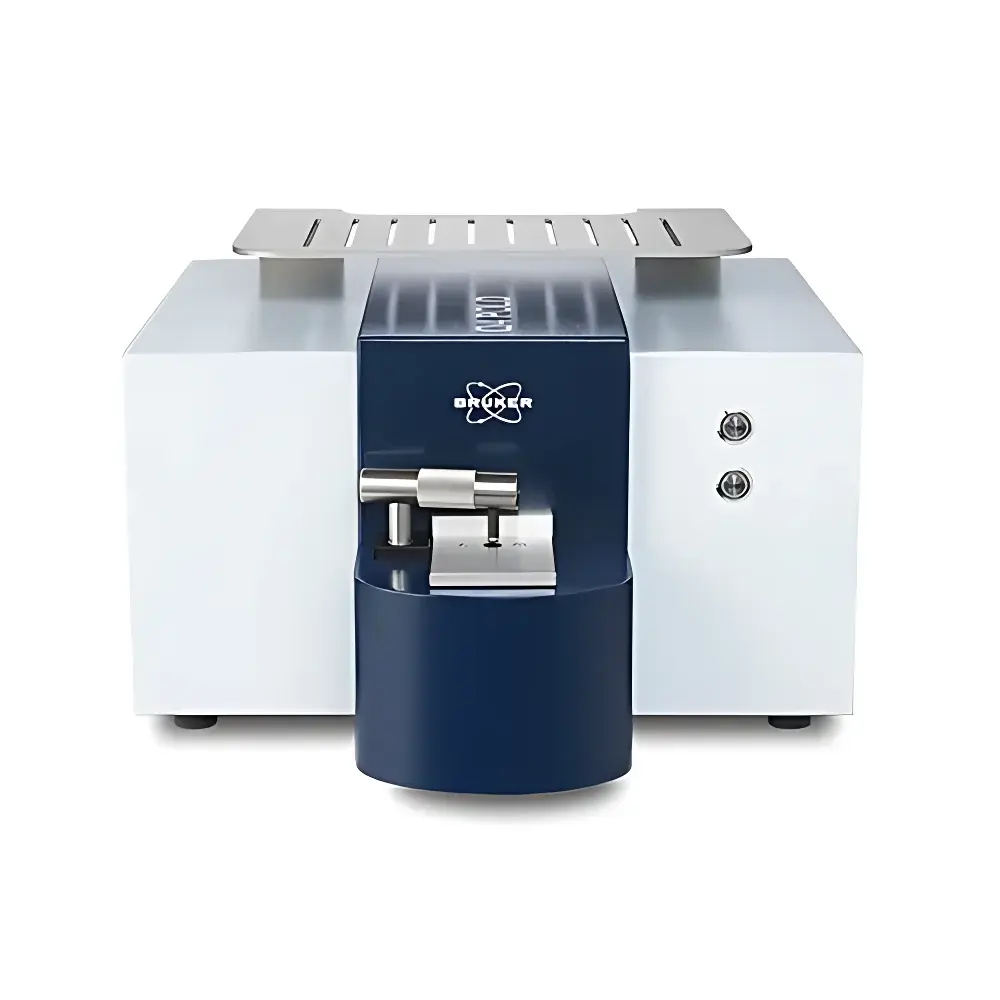
Bruker Q4 POLO Desktop Spark Optical Emission Spectrometer
| Brand | Bruker |
|---|---|
| Origin | Germany |
| Model | Q4 POLO |
| Instrument Type | Benchtop |
| Excitation Method | Spark |
| Detector Type | Photomultiplier Tube (PMT) |
| Focal Length | 800 mm |
| Grating Groove Density | 3600 lines/mm |
| Wavelength Range | 120–200 nm |
| Number of Channels | 128 |
Overview
The Bruker Q4 POLO is a high-performance benchtop spark optical emission spectrometer (OES) engineered for precise, rapid elemental analysis of metallic alloys in quality control, incoming material inspection, and production environments. It operates on the principle of spark discharge atomic emission spectroscopy: a controlled high-voltage spark vaporizes a micro-volume of conductive solid sample, generating excited atoms and ions whose characteristic UV–visible emission lines are dispersed and quantified by a fixed-grating optical system. The Q4 POLO employs a Paschen–Runge mount with MultiVision™ optical components—optimized for signal-to-noise ratio and spectral resolution—housed in a high-vacuum ultraviolet (UV) chamber to ensure stable transmission below 190 nm, critical for accurate determination of key elements including C, P, S, N, and B. Its robust mechanical architecture minimizes thermal drift and mechanical misalignment, supporting long-term calibration stability across variable laboratory conditions.
Key Features
- Paschen–Runge Optical Design with MultiVision™ Optics: Precision-machined cast-iron frame and thermally stabilized optical bench ensure mechanical rigidity; optimized mirror coatings and detector alignment maximize photon collection efficiency in the vacuum UV range.
- High-Vacuum UV Chamber: Maintains pressure <10⁻³ mbar to eliminate atmospheric O₂ and H₂O absorption, enabling reliable detection of spectral lines down to 120 nm without purging gases.
- AAC™ Dynamic Temperature Compensation: Real-time correction of focal plane shift via integrated temperature sensors and adaptive optical path adjustment, compensating for differential thermal expansion of optical substrates (e.g., fused silica vs. aluminum mounts) to preserve peak resolution and intensity reproducibility.
- Single-Spark Excitation Technology: Delivers consistent energy delivery per spark pulse, reducing matrix-dependent fractionation effects and improving short-term precision (RSD <0.5% for major alloying elements).
- SafetyTip™ Sample Holder Interface: Insulated electrode design with positional feedback prevents misalignment during sample loading; conforms to DIN EN 61000-6-4 and DGUV Regulation 3 for electrical safety in industrial laboratories.
- Benchtop Form Factor with Modular Sample Handling: Compact footprint (<0.8 m² floor space); integrated vibration-damping feet; tool-free sample stage adjustment for height, tilt, and lateral position.
Sample Compatibility & Compliance
The Q4 POLO accommodates a broad range of metallic specimens—including cast iron, stainless steel, aluminum, copper, titanium, and nickel-based superalloys—via standardized flat, cylindrical, and irregular sample adapters. Optional accessories include mini-sample clamps (≥3 mm diameter), tube holders (ID/OD adjustable from 6–50 mm), wire fixtures (0.5–6 mm Ø), and thin-sheet supports (≥0.2 mm thickness). All sample interfaces comply with ISO 11573:2021 (metallic materials — spark emission spectrometric analysis) and ASTM E415–22 (standard test method for analysis of carbon and low-alloy steel by spark OES). The instrument’s firmware supports GLP/GMP audit trails, user access levels, and electronic signature capability per FDA 21 CFR Part 11 when paired with Bruker’s SPECTRO Analytical Software Suite.
Software & Data Management
Controlled via Bruker’s SPECTRO Analytical Software (SAS), the Q4 POLO provides intuitive method setup, real-time spectral visualization, automated background correction, and multivariate calibration management. SAS includes built-in statistical process control (SPC) tools compliant with ISO 22514–8, customizable report templates (PDF/CSV/XLSX export), and secure database archiving with timestamped raw spectra and metadata (operator ID, sample ID, date/time, environmental logs). Remote diagnostics and firmware updates are supported over Ethernet or Wi-Fi (WPA2-secured), with optional integration into LIMS via ASTM E1384-compliant HL7 or OPC UA protocols.
Applications
The Q4 POLO delivers trace-level detection (sub-ppm for C, P, S in steel) and high-precision quantification (±0.005 wt% for Cr/Ni in stainless grades) across metallurgical QA/QC workflows. Typical use cases include: verification of heat composition prior to forging; scrap sorting and grade identification; certification of aerospace-grade Ti-6Al-4V; monitoring of wear-resistant coatings; and compliance testing against EN 10027, ASTM A240, or JIS G 4303 specifications. Its analytical speed (<25 s per analysis cycle, including purge and spark sequence) supports high-throughput foundry labs and contract testing facilities requiring ISO/IEC 17025 accreditation.
FAQ
What vacuum level does the Q4 POLO maintain in its optical chamber?
The system achieves and sustains a base pressure of ≤1×10⁻³ mbar using a dual-stage rotary vane pump and integrated pressure monitoring.
Is argon purging required for operation?
No—its high-vacuum UV chamber eliminates the need for continuous argon flow, reducing operational cost and gas dependency.
Can the Q4 POLO analyze non-conductive samples?
Not directly; it requires electrically conductive metallic samples. Non-metals or coated samples must be prepared via conductive coating or fusion bead techniques using external equipment.
How many calibration curves can be stored in the instrument’s onboard memory?
Up to 128 multi-element calibrations, each supporting ≥32 analytes with independent line selection, interference corrections, and drift compensation models.
Does the system support remote software updates and diagnostics?
Yes—via secure HTTPS-based firmware update portal and remote desktop-assisted troubleshooting through Bruker’s ServiceLink platform.





