
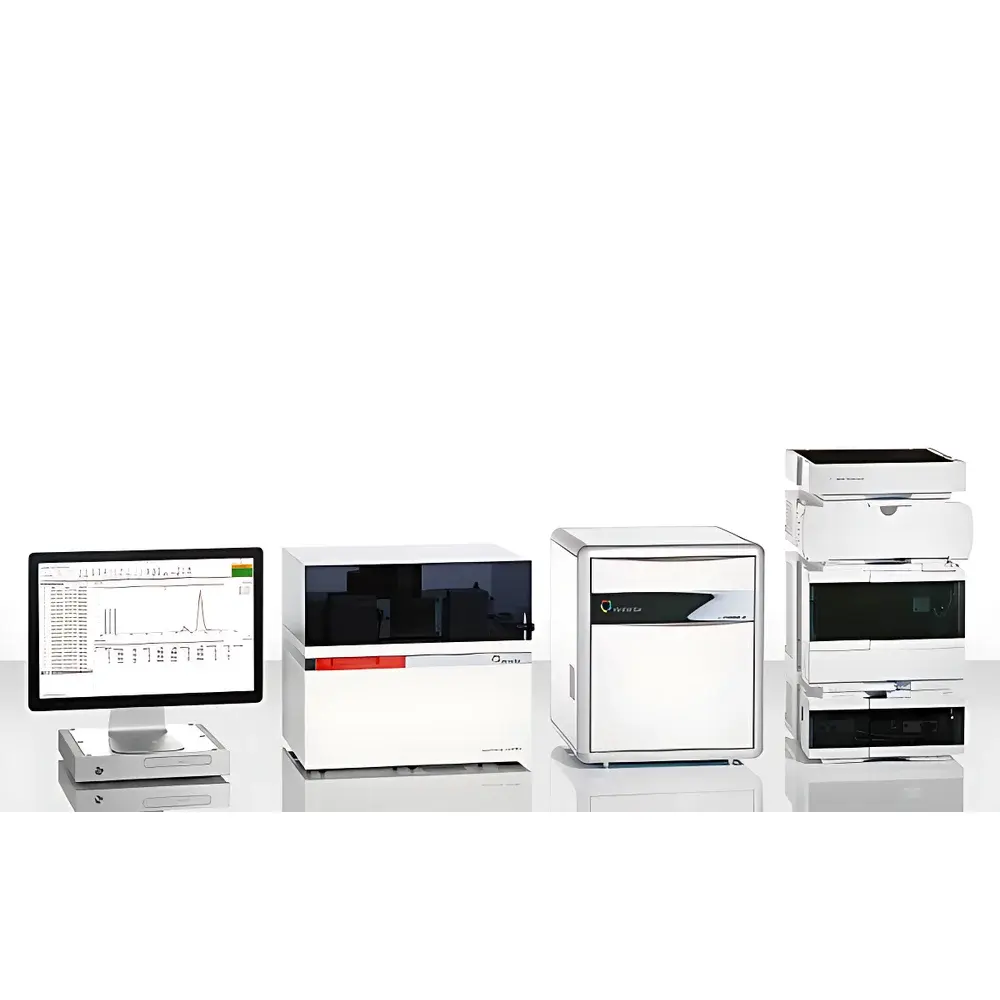
Elementar BiovisION Honey Isotope Ratio Mass Spectrometer
| Brand | Elementar |
|---|---|
| Origin | Germany |
| Model | BiovisION Honey |
| Instrument Type | Dedicated Liquid Chromatography–Isotope Ratio Mass Spectrometry (LC-IRMS) System |
| Measurement Precision | δ¹³C ≤ 0.06‰, δ¹⁵N ≤ 0.06‰ |
| Measured Isotopes | ¹³C, ¹⁵N, ¹⁸O, ²H, ³⁴S |
| Mass Range | 1–96 Da |
| Resolution (m/Δm) | 100 |
| Sensitivity (M/I at m/z 44) | <1200 |
| Warranty | 10-year combustion furnace warranty |
Overview
The Elementar BiovisION Honey is a purpose-built isotope ratio mass spectrometer (IRMS) engineered specifically for high-throughput, regulatory-grade stable isotope analysis of honey and other viscous, sugar-rich food matrices. Unlike conventional LC-IRMS systems relying on wet chemical oxidation—prone to column fouling, reagent consumption, and frequent maintenance—the BiovisION Honey employs a robust, high-temperature ceramic combustion interface (1050 °C) coupled with proprietary gas chromatographic separation and continuous-flow introduction. This architecture eliminates derivatization, minimizes matrix interference, and ensures quantitative conversion of organic carbon and nitrogen into CO₂ and N₂ without isotopic fractionation. The system operates under true continuous-flow IRMS principles, delivering traceable δ-value measurements compliant with ISO 11290, AOAC 2017.01, and EU Regulation No. 2019/1871 for honey authenticity verification.
Key Features
- Dedicated High-Temperature Combustion Interface: A patented ceramic furnace operating at 1050 °C ensures complete, reproducible oxidation of complex carbohydrate matrices—including fructose, glucose, sucrose, and oligosaccharides—without catalyst deactivation or clogging.
- Automated LC-IRMS Workflow: Integrated HPLC module with dual-pump gradient capability, inline degassing, and temperature-controlled column oven (30–60 °C) enables unattended separation of honey monosaccharides prior to isotopic detection.
- 10-Year Combustion Furnace Warranty: Reflecting its mechanical durability and thermal stability, the furnace is certified for >100,000 injections under routine use—significantly exceeding industry norms for IRMS combustion modules.
- lyticOS® Software Platform: Unified acquisition, calibration, peak integration, and reporting environment supporting ASTM D6866, ISO 14883, and USP data validation protocols; includes full audit trail, electronic signatures, and 21 CFR Part 11 compliance modules.
- Low-Noise Ion Optics & High-Stability Faraday Detection: Optimized for m/z 44 (CO₂), 46 (¹⁸O-enriched CO₂), 28 (N₂), and 30 (¹⁵N¹⁴N) detection, enabling simultaneous multi-isotope measurement with sub-permil precision.
Sample Compatibility & Compliance
BiovisION Honey is validated for direct analysis of raw, filtered, and ultrafiltered honey samples—with no dilution, hydrolysis, or derivatization required. It accommodates sample volumes from 1–20 µL injected onto a C18 reversed-phase column (2.1 × 150 mm, 1.7 µm), achieving baseline resolution of fructose/glucose peaks in <8 min. The system meets GLP and GMP documentation requirements for contract testing laboratories accredited to ISO/IEC 17025:2017. All calibration standards (USGS40, IAEA-CH-7, USGS41) are traceable to NIST SRMs, and instrument performance is verified daily using internal reference compounds with certified δ¹³C and δ¹⁵N values.
Software & Data Management
lyticOS® provides end-to-end data governance: from method setup and real-time chromatogram overlay to automated δ-value calculation using internal standard normalization (e.g., acetanilide or glycine). Raw data files (.raw) are stored with embedded metadata (operator ID, timestamp, instrument configuration, calibration history), while processed reports export to PDF, CSV, or LIMS-compatible XML formats. Version-controlled method templates ensure inter-laboratory comparability, and the software supports scheduled recalibration, drift correction algorithms, and outlier detection per ISO 13528. Audit logs record all user actions—including data deletion, parameter edits, and report generation—with immutable timestamps.
Applications
- Regulatory honey adulteration screening (C₄ sugar syrups, beet sugar addition)
- Geographic origin assignment via δ¹³C–δ²H–δ¹⁸O multi-isotope fingerprinting
- Botanical source differentiation (e.g., acacia vs. clover vs. manuka)
- Stable isotope tracing in apicultural research and pollination ecology studies
- Reference material certification and proficiency testing program support
FAQ
What sample preparation is required prior to injection?
No derivatization, hydrolysis, or solvent exchange is needed. Samples are centrifuged (10,000 × g, 5 min), filtered (0.22 µm PTFE), and directly injected.
Can the system analyze other viscous food matrices besides honey?
Yes—validated for maple syrup, agave nectar, molasses, and concentrated fruit juices; method adaptation requires minor LC gradient optimization.
How is calibration traceability maintained across long-term operation?
Daily bracketing with two-point calibration (light/heavy reference standards) and quarterly verification against NIST-traceable CRM batches ensure metrological continuity.
Is remote monitoring and troubleshooting supported?
Yes—lyticOS® includes secure TLS-encrypted remote access, live instrument status dashboards, and predictive maintenance alerts based on furnace temperature stability metrics.
Does the system comply with EU Honey Directive (2001/110/EC) analytical requirements?
Yes—fully aligned with Annex II testing criteria, including mandatory δ¹³C measurement of protein and sugar fractions and permissible deviation thresholds (±0.2‰).





