
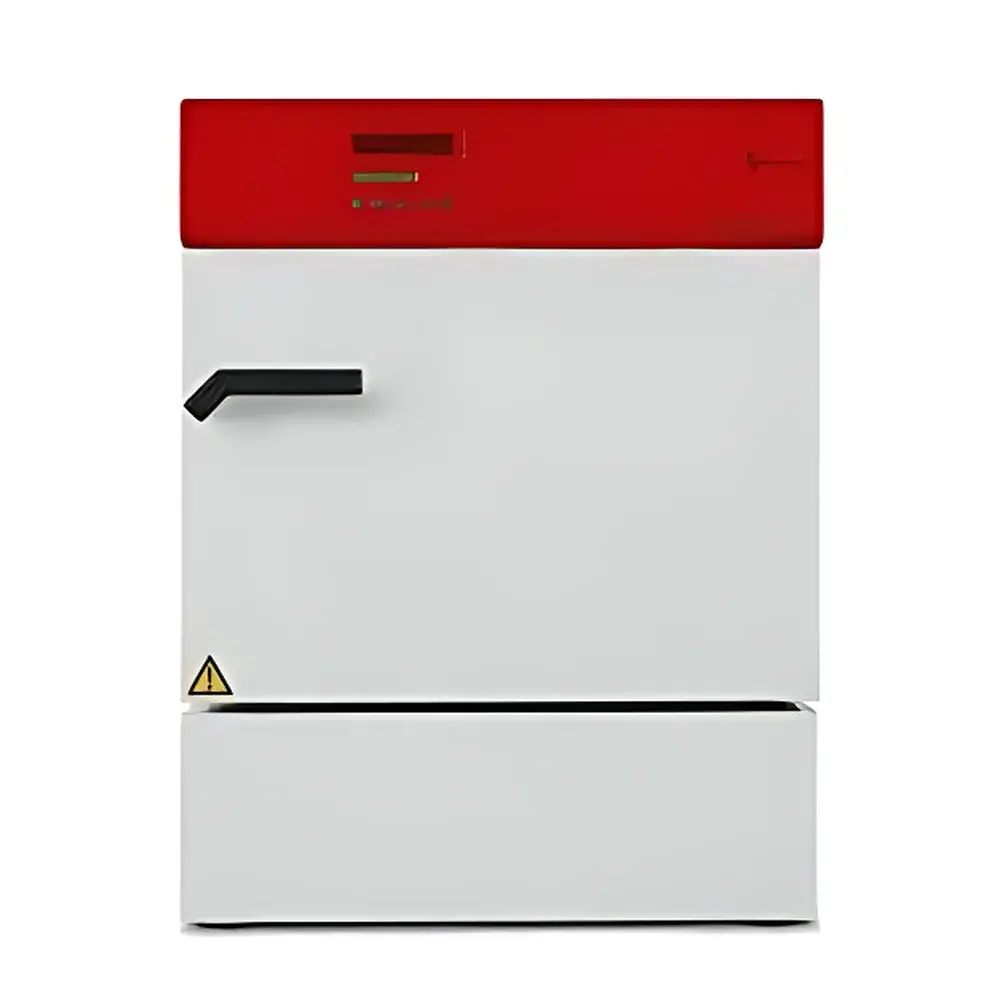
BINDER KB Series Low-Temperature Incubators
| Brand | BINDER |
|---|---|
| Origin | Germany |
| Model | KB |
| Temperature Range (KB 23) | 0 °C to 100 °C |
| Temperature Range (KB 53/115/240/400/720) | –5 °C to 100 °C |
| Cooling System | Compressor-based |
| Preheating Chamber Technology | APT.line™ |
| Inner Door Material | Safety Glass (ESG) |
| Interior Construction | Stainless Steel |
| Shelving | 2 Adjustable Stainless Steel Shelves |
| Stackable Units | Up to 115 L Models |
| Access Ports | Silicone-sealed, Available from 240 L |
| Temperature Safety Class | DIN 12880 Class 3.1 (Optical & Acoustic Alarm) |
| Controller | Programmable with Interval & Real-Time Scheduling |
| Runtime Timer | Integrated |
| Fan Speed Control | Adjustable from 240 L Onward |
| Interface | RS 422 |
| Internal Volume | 20–698 L (Model-Dependent) |
| External Dimensions (KB 23) | 435 × 620 × 520 mm |
| Internal Dimensions (KB 23) | 222 × 330 × 277 mm |
| Net Weight (KB 23) | 44 kg |
Overview
The BINDER KB Series Low-Temperature Incubators are precision-engineered environmental chambers designed for reliable, stable temperature control in microbiological cultivation, stability testing, and long-term sample storage under controlled cold conditions. Unlike general-purpose incubators, the KB series integrates compressor-based cooling with BINDER’s proprietary APT.line™ preheating chamber technology—ensuring uniform temperature distribution (< ±0.3 K at 37 °C), minimal thermal gradients, and rapid recovery after door openings. The system operates across a broad temperature range: models KB 23 maintain 0 °C to 100 °C, while all larger variants (KB 53 through KB 720) extend down to –5 °C, enabling low-temperature adaptation studies, psychrophilic organism cultivation, and cold-chain validation protocols. Constructed entirely in laboratory-grade stainless steel interiors and featuring safety glass (ESG) inner doors, these units meet stringent hygiene and decontamination requirements common in GLP-compliant microbiology labs and pharmaceutical QC environments.
Key Features
- APT.line™ preheating chamber technology for superior temperature homogeneity and stability—even during ambient fluctuations or frequent access
- Compressor-based refrigeration system delivering consistent sub-zero performance without cryogenic consumables
- DIN 12880 Class 3.1 certified temperature safety system with independent optical and acoustic alarm outputs
- Programmable controller supporting both interval-based and real-time scheduling—including ramp-hold profiles and multi-step cycles
- Adjustable fan speed (available from KB 240 onward) to optimize airflow for sensitive cultures or stacked configurations
- Silicone-sealed access ports (standard on KB 240 and above) for uninterrupted monitoring or external sensor integration
- Stainless steel interior with two height-adjustable shelves; ESG inner door minimizes condensation and supports UV decontamination
- RS 422 digital interface for remote monitoring, data logging, and integration into centralized lab management systems
Sample Compatibility & Compliance
The KB series accommodates standard microbiological vessels—including Petri dishes, test tubes, multi-well plates, and culture flasks—across internal volumes ranging from 20 L (KB 23) to 698 L (KB 720). Its stainless steel chamber and smooth, crevice-free interior surfaces comply with ISO 14644-1 Class 5 cleanroom-compatible maintenance protocols. All models conform to EN 61000-6-2 (immunity) and EN 61000-6-4 (emissions), and support audit-ready operation under FDA 21 CFR Part 11 when paired with validated third-party data acquisition software. Temperature mapping reports per ISO/IEC 17025 and ICH Q5C guidelines can be generated using the integrated runtime timer and RS 422 output—facilitating qualification (IQ/OQ/PQ) in regulated biopharma and contract testing laboratories.
Software & Data Management
While the KB series features an embedded microprocessor controller with local display and keypad navigation, its RS 422 interface enables bidirectional communication with external SCADA platforms or LIMS. Users may export timestamped temperature logs, alarm events, and program execution records for traceability. When deployed in GxP environments, the controller’s non-volatile memory retains all settings and event histories across power cycles—supporting 21 CFR Part 11 compliance when combined with role-based access control and electronic signature workflows implemented at the host system level. Optional BINDER CUBE software (sold separately) provides graphical trend analysis, deviation alerts, and PDF report generation aligned with ALCOA+ data integrity principles.
Applications
- Psychrotrophic and mesophilic microbial growth studies under defined low-temperature regimes
- Stability testing of raw materials and finished pharmaceuticals per ICH Q1A(R2)
- Environmental simulation for validation of cold-storage logistics and transport packaging
- Cultivation of fastidious organisms requiring precise thermal control and minimized vibration
- Long-term storage of reference standards, clinical isolates, and master cell banks
- Supporting USP / microbial enumeration and absence-of-pathogen testing workflows
FAQ
Does the KB series support humidity control?
No—humidity regulation is not integrated. The KB series is optimized for temperature-critical, low-moisture applications; for combined temp/humidity control, consider BINDER’s BD or MKF series.
Can KB incubators be stacked safely?
Yes—models up to 115 L (KB 115) are certified for vertical stacking with optional stabilization kits. KB 240 and larger units require dedicated floor-standing installation due to structural load and ventilation requirements.
What calibration documentation is provided?
Each unit ships with a factory calibration certificate traceable to DAkkS-accredited standards, covering temperature uniformity and accuracy at three points (–5 °C, 37 °C, and 80 °C) per DIN 12880.
Is the RS 422 interface compatible with modern Ethernet-based lab networks?
Yes—via commercially available RS 422-to-Ethernet converters, the interface supports seamless integration with LabVantage, STARLIMS, or custom Python/Node-RED data ingestion pipelines.



