
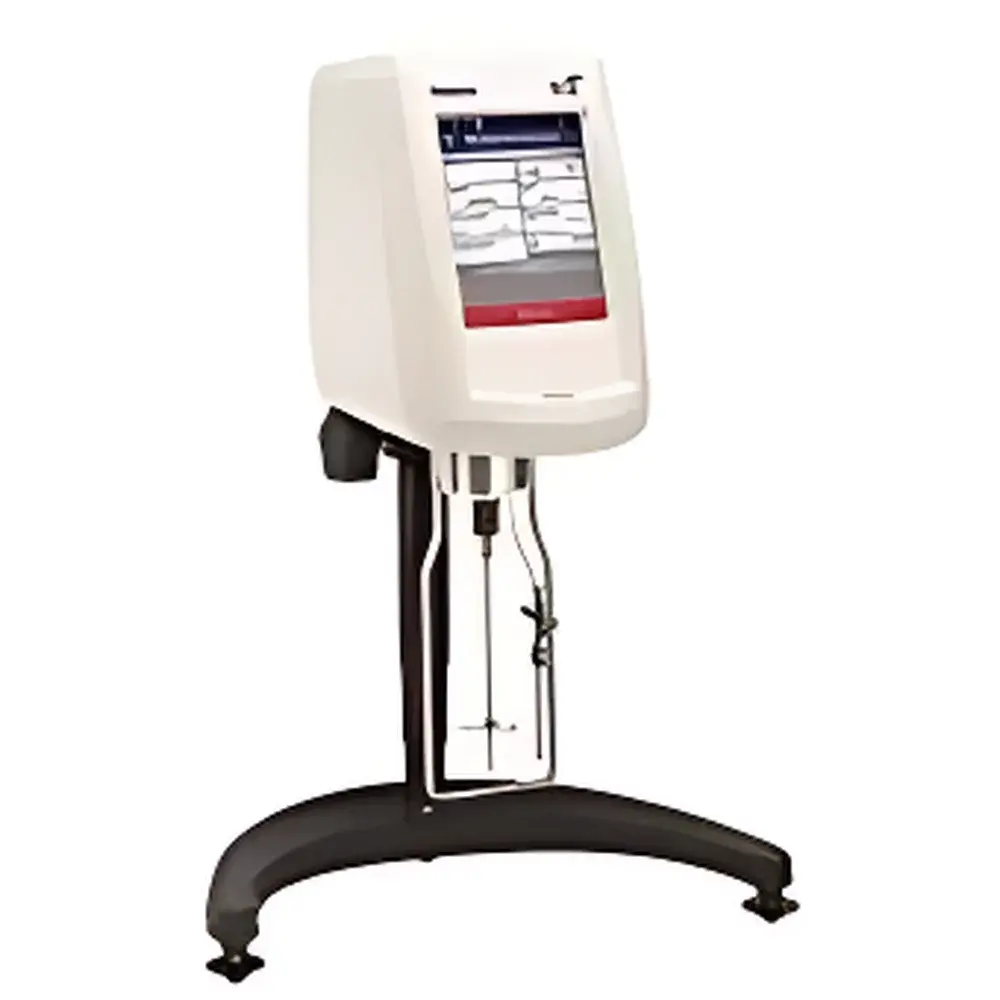
Brookfield DV2T Advanced Rotational Viscometer
| Brand | Brookfield |
|---|---|
| Origin | USA |
| Model | DV2T |
| Instrument Type | Rotational Viscometer |
| Viscosity Range | 1–320,000 mPa·s (depending on spindle/spindle-speed combination) |
| Speed Range | 0.1–200 rpm |
| Speed Increment | 0.1 rpm |
| Accuracy | ±1.0% of full-scale reading |
| Repeatability | ±0.2% |
| Temperature Sensor | Integrated RTD probe |
| Data Storage | 150 MB internal memory |
| Interface | USB for PC connectivity |
| Software | RheoCalcT (included), PG Flash (for custom program download) |
| Compliance | Designed for GLP/GMP environments with audit-ready data logging capabilities |
Overview
The Brookfield DV2T Advanced Rotational Viscometer is a precision-engineered, microprocessor-controlled instrument designed for reliable and repeatable viscosity measurements across R&D, quality control, and production environments. Operating on the principle of rotational viscometry—where torque required to rotate a spindle at a defined speed in a fluid is measured—the DV2T delivers quantitative rheological data essential for characterizing Newtonian and non-Newtonian behavior under controlled shear conditions. Its modular architecture supports interchangeable spindles (LV, RV, HA, HB) and programmable speed profiles, enabling measurement of viscosity from 1 mPa·s (e.g., solvents, thin oils) up to 320,000 mPa·s (e.g., pastes, gels, heavy polymers), depending on spindle geometry and rotational speed selection. The instrument’s integrated RTD temperature probe ensures simultaneous temperature monitoring, critical for temperature-dependent viscosity analysis per ASTM D2196 and ISO 2555 standards.
Key Features
- Microprocessor-based control with intuitive LCD interface and real-time display of viscosity, shear rate, shear stress, % torque, and temperature
- EZ-Lock quick-connect spindle system: two-step attachment/detachment minimizes mechanical stress and eliminates misalignment errors during frequent spindle changes
- High-precision ball-bearing suspension mechanism enhances long-term stability, reduces bearing wear, and improves measurement reproducibility over extended operational cycles
- Quick-Position stand with push-button vertical adjustment enables rapid sample exchange and precise immersion depth control—critical for compliance with ASTM D1084 and ISO 3219
- Internal 150 MB memory stores test parameters, raw data, timestamps, and operator IDs; data export via USB to CSV or Excel-compatible formats
- Comprehensive software suite included: RheoCalcT for real-time PC control, automated data acquisition, curve fitting, and report generation; PG Flash for uploading user-defined test protocols
Sample Compatibility & Compliance
The DV2T accommodates a broad range of sample types—including liquids, suspensions, emulsions, molten polymers, food products, pharmaceutical formulations, and coatings—provided they exhibit sufficient homogeneity and thermal stability during testing. Spindle selection (LV, RV, HA, HB) is matched to expected viscosity range and sample volume constraints. For regulatory environments, the system supports traceable data integrity through time-stamped logs, operator authentication fields, and exportable audit trails—facilitating alignment with FDA 21 CFR Part 11 requirements when deployed with validated software configurations. It conforms to international viscosity measurement standards including ISO 2555, ASTM D1200 (Ford Cup), and ASTM D2196 (spindle method), and is routinely employed in laboratories operating under GLP and GMP frameworks.
Software & Data Management
RheoCalcT software provides full remote operation, real-time graphing (viscosity vs. time, shear rate, or temperature), statistical analysis (mean, SD, CV%), and customizable reporting templates compliant with internal QA documentation requirements. All data files retain metadata—including date/time stamps, spindle ID, speed setting, temperature, and user login—enabling full traceability. PG Flash allows users to pre-load multi-step test sequences (e.g., ramped speed profiles, timed hold periods, temperature-triggered measurements), reducing manual intervention and operator-induced variability. USB data transfer supports secure integration into LIMS or ELN platforms without proprietary drivers.
Applications
The DV2T is widely deployed across industries requiring routine or method-specific viscosity validation: formulation development and stability assessment in pharmaceuticals (e.g., syrups, ointments, injectables); QC of lubricants, resins, and adhesives in chemical manufacturing; consistency testing of sauces, dairy products, and batters in food science; and rheological screening of inkjet inks, paints, and cosmetic creams. Its portability and battery-free desktop design make it suitable for both fixed-lab and mobile field use—particularly where bench space is constrained or multi-location testing is required.
FAQ
What spindle should I use for my sample?
Selection depends on expected viscosity and sample volume. LV spindles are optimal for low-viscosity fluids (< 6 million mPa·s), while HB spindles extend range to highly viscous materials. Consult the included spindle selection chart or use RheoCalcT’s auto-suggest feature.
Does the DV2T support temperature-controlled measurements?
Yes—the built-in RTD probe continuously monitors sample temperature. For active temperature regulation, pair with Brookfield TC series circulating baths or Peltier-based accessories.
Can test data be exported to LIMS or ERP systems?
Yes—CSV and Excel exports are natively supported; metadata-rich files can be parsed by most laboratory informatics platforms with minimal configuration.
Is calibration traceable to NIST standards?
Brookfield-certified calibration services provide NIST-traceable documentation; users may also perform routine verification using standard reference oils supplied with calibration kits.
How does the DV2T ensure compliance with 21 CFR Part 11?
When operated with validated RheoCalcT configurations—including electronic signatures, audit trails, and role-based access controls—the system meets core technical requirements for electronic records and signatures in regulated environments.



