
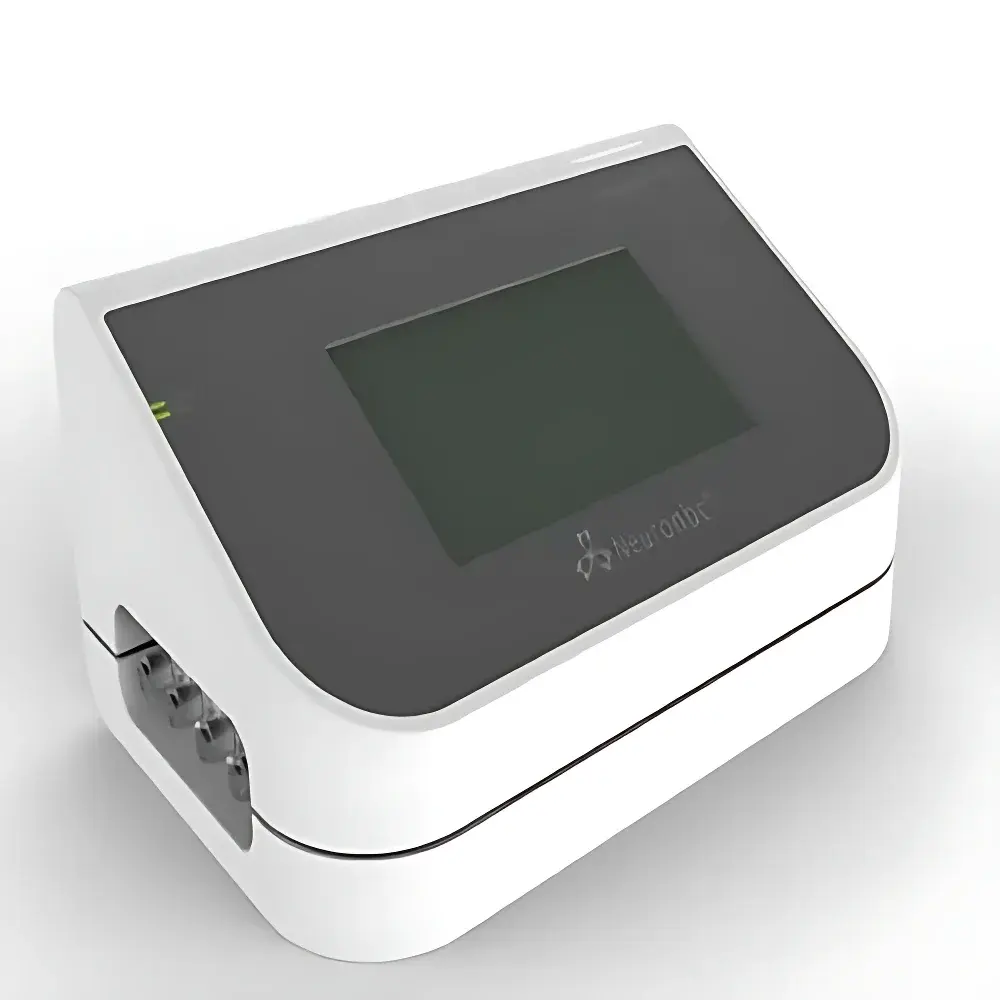
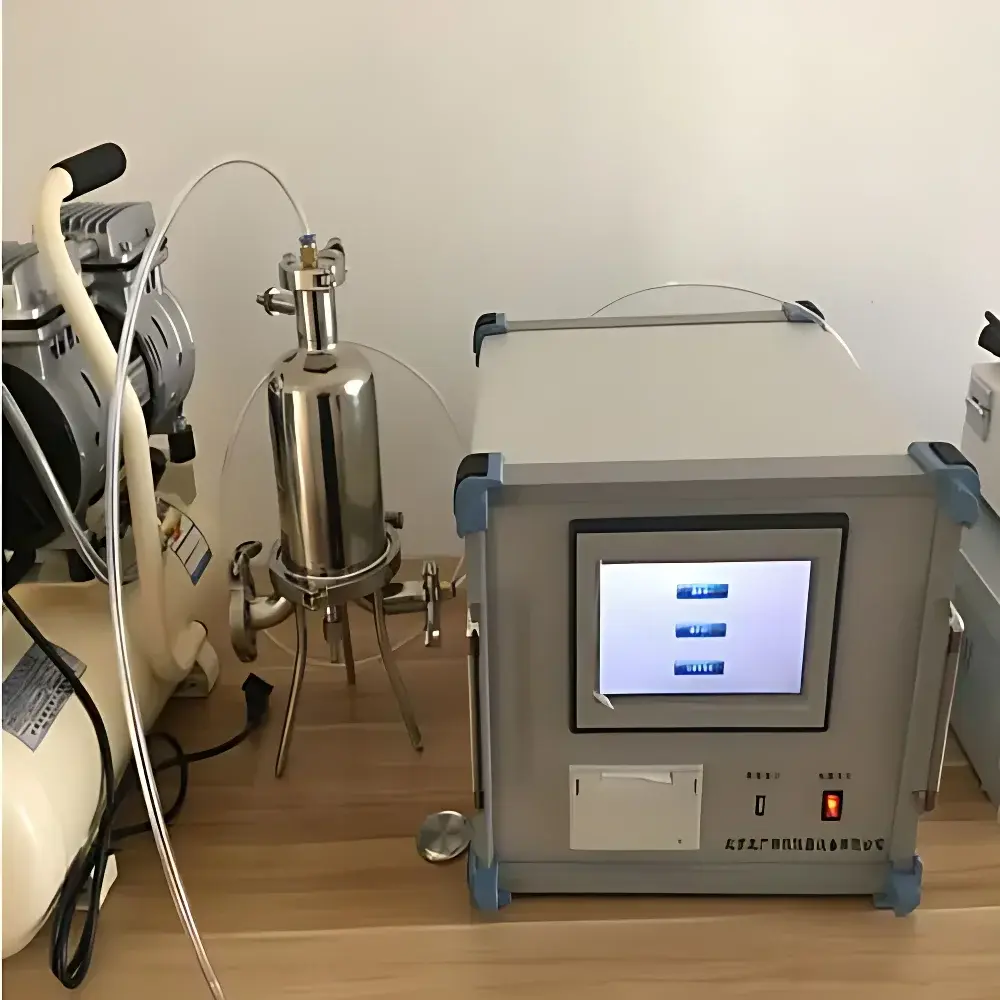
North Guang Precision Instrument BQS-80 High-Efficiency Filter Integrity Tester
| Brand | North Guang Precision Instrument |
|---|---|
| Origin | Beijing, China |
| Manufacturer Type | Manufacturer |
| Country of Origin | Domestic (China) |
| Model | BQS-80 |
| Power Supply | 100–240 VAC, 50 Hz, 120 W |
| Operating Pressure Range | 100–10,000 mbar (150 psi) |
| Pressure Units | mbar, kPa, psi, kgf/cm² |
| Environmental Operating Conditions | 5–40 °C, 10–80% RH |
| Dimensions (L×W×H) | 480 × 300 × 210 mm |
| Weight | 10 kg |
| IP Rating | Front Panel IP65, Main Unit IP54 |
| Display | 10-inch high-resolution color touchscreen |
| Test Methods | Manual Bubble Point, Basic Bubble Point, Enhanced Bubble Point, Hold Pressure, Diffusion Flow, Water Intrusion, Ultrafiltration Membrane Pack Testing |
| Accuracy | Bubble Point ±50 mbar |
| Measurement Ranges | Bubble Point 100–8000 mbar |
| Sample Compatibility | Symmetric & asymmetric membranes, syringe filters, capsule filters, flat-sheet filters, cartridge filters (up to 12-core, ≤20 inch), ultrafiltration cassettes & columns, irregularly shaped filters |
| Data Storage | ≥5 years of audit trail logs |
| Compliance | FDA 21 CFR Part 11, EU CE Marked, GMP-aligned architecture |
| Connectivity | RS232, USB, optional RS485, 4–20 mA analog output, 12 V alarm output, wireless module (optional) |
| User Management | 1000 user accounts, four-tier permission hierarchy, customizable role-based access, electronic signature support |
| Predefined Protocols | Up to 1000 stored test methods |
| Built-in Thermal Printer | Non-ink, particle-free, legible for >10 years |
| Maximum Tubing Length Support | 100 m (optimized gas path algorithm) |
| Safety Features | Anti-backflow device, self-diagnostic on startup |
Overview
The North Guang Precision Instrument BQS-80 High-Efficiency Filter Integrity Tester is an engineered solution for deterministic validation of liquid and gas filtration systems in regulated pharmaceutical, biotechnology, and sterile manufacturing environments. It operates on the fundamental principles of capillary flow analysis—specifically, the correlation between applied pressure, gas diffusion across a wetted membrane, and the critical pressure at which bulk flow (bubble point) initiates. Designed to meet stringent regulatory expectations, the BQS-80 supports all standard integrity test modalities defined in ASTM F838, ISO 13408-2, USP , and PDA Technical Report No. 26. Its dual-mode capability enables both offline benchtop verification and online integration into clean utility or process skid systems—ensuring continuity between qualification, routine monitoring, and post-sterilization validation.
Key Features
- Multi-method integrity testing platform supporting manual and automated bubble point, enhanced bubble point, hold pressure, diffusion flow, water intrusion, and ultrafiltration membrane pack tests—validated for symmetric and asymmetric polymeric membranes, ceramic filters, and depth filters.
- Real-time three-curve display and printout: diffusion flow vs. pressure, pressure decay vs. time, and flow stabilization profile—enabling visual assessment of membrane wetting uniformity and defect localization.
- Dual-pressure-sensor architecture with high-stability transducers (±0.1% FS) and proprietary temperature-compensated algorithms, delivering ±4% net volume accuracy and extended pneumatic line tolerance up to 100 meters without calibration drift.
- Embedded Linux operating system optimized for deterministic real-time control, eliminating latency in pressure ramping, valve actuation, and data acquisition—reducing average test duration by 35% versus legacy Windows-based instruments.
- Front-panel IP65-rated 10-inch capacitive touchscreen with glove-compatible responsiveness, anti-glare optical bonding, and configurable layout for operator ergonomics in Grade C/D cleanrooms.
- Comprehensive self-diagnostics executed at power-on and prior to each test sequence—including sensor zero-point verification, solenoid valve timing calibration, leak-check of internal manifolds, and thermal printer head integrity confirmation.
- Integrated thermal line printer with archival-grade media—designed to eliminate ink migration, particulate shedding, or solvent vapor emission, ensuring compliance with ISO 14644-1 Class 5 environmental constraints.
Sample Compatibility & Compliance
The BQS-80 accommodates a broad spectrum of filter configurations: single-use syringe filters (0.2/0.45 µm), sterilizing-grade capsule filters, pleated cartridge assemblies (including multi-core 20-inch housings), flat-sheet tangential flow devices, and hollow-fiber ultrafiltration cassettes. Its pressure control resolution (0.1 mbar) and flow measurement sensitivity (0.01 mL/min) enable precise characterization of low-diffusion hydrophilic PVDF, PES, and regenerated cellulose membranes—as well as high-integrity hydrophobic PTFE and nylon filters used in vent applications. Regulatory alignment includes full traceability per FDA 21 CFR Part 11 (electronic signatures, audit trail immutability, role-based access), EU Annex 11 requirements for computerized system validation, and ICH Q5A/Q5D-relevant documentation for viral clearance filter qualification. CE marking confirms conformity with the EU Medical Device Regulation (MDR) Annex I essential requirements for safety and performance.
Software & Data Management
The instrument’s firmware implements a secure, embedded database with write-once-read-many (WORM) architecture for all audit trail entries—including user login/logout timestamps, parameter modifications, test initiation/abort events, calibration actions, and printer output triggers. Each log entry contains cryptographic hash signatures to prevent tampering. Data export via USB supports three distinct file formats: CSV (raw sensor values at 10 Hz), XML (structured metadata-compliant with ASTM E2500), and PDF/A-2b (archival-ready reports with embedded digital signatures). Optional OPC UA or Modbus TCP gateways allow seamless integration into MES/SCADA platforms for centralized data aggregation and statistical process control (SPC) charting. All user accounts are authenticated via SHA-256 password hashing, with session timeouts, failed-login lockouts, and mandatory periodic credential rotation enforced per GxP IT security policies.
Applications
- Pre-use post-sterilization integrity verification of sterilizing-grade filters in bioreactor harvest lines and buffer preparation systems.
- Final filter release testing for aseptic drug product filling lines, including lyophilization stopper wash and diluent filtration circuits.
- Validation of ultrafiltration/diafiltration cassettes during monoclonal antibody purification campaigns—correlating diffusion flow results with protein passage assays.
- Periodic requalification of compressed air and nitrogen distribution systems serving isolators and RABS enclosures.
- Technical transfer support for filter selection studies, pore size distribution mapping, and wetting agent compatibility screening (e.g., ethanol vs. IPA vs. water).
- Root cause analysis of filter failures through retrospective curve morphology comparison—identifying partial drying, O-ring extrusion, or housing gasket deformation patterns.
FAQ
Does the BQS-80 support automated integration with PLC-controlled sterilization cycles?
Yes—via configurable dry-contact inputs and 4–20 mA analog outputs, the instrument can trigger test initiation upon SIP cycle completion and feed pass/fail status back to the DCS.
Can audit trail data be exported in machine-readable format for third-party eDMS ingestion?
Yes—XML exports comply with ASTM E2500-22 and include XSD schema definitions for automated parsing and metadata enrichment.
Is validation documentation (IQ/OQ/PQ protocols and reports) provided with the system?
North Guang supplies a complete URS-aligned validation toolkit, including executable test scripts, expected result matrices, and blank report templates compliant with Annex 15 and GAMP 5.
What is the maximum allowable upstream volume for diffusion flow testing?
The system maintains ±4% volumetric accuracy for upstream volumes up to 15 L when using the 100 m tubing extension mode, validated per ASTM F3159-18 Annex A3.
How does the water intrusion test function differ from standard diffusion flow methodology?
Water intrusion employs elevated pressure (up to 10,000 mbar) on hydrophobic membranes while monitoring displaced water volume—not gas flow—enabling detection of sub-micron defects in vent filters without organic solvent use.




