
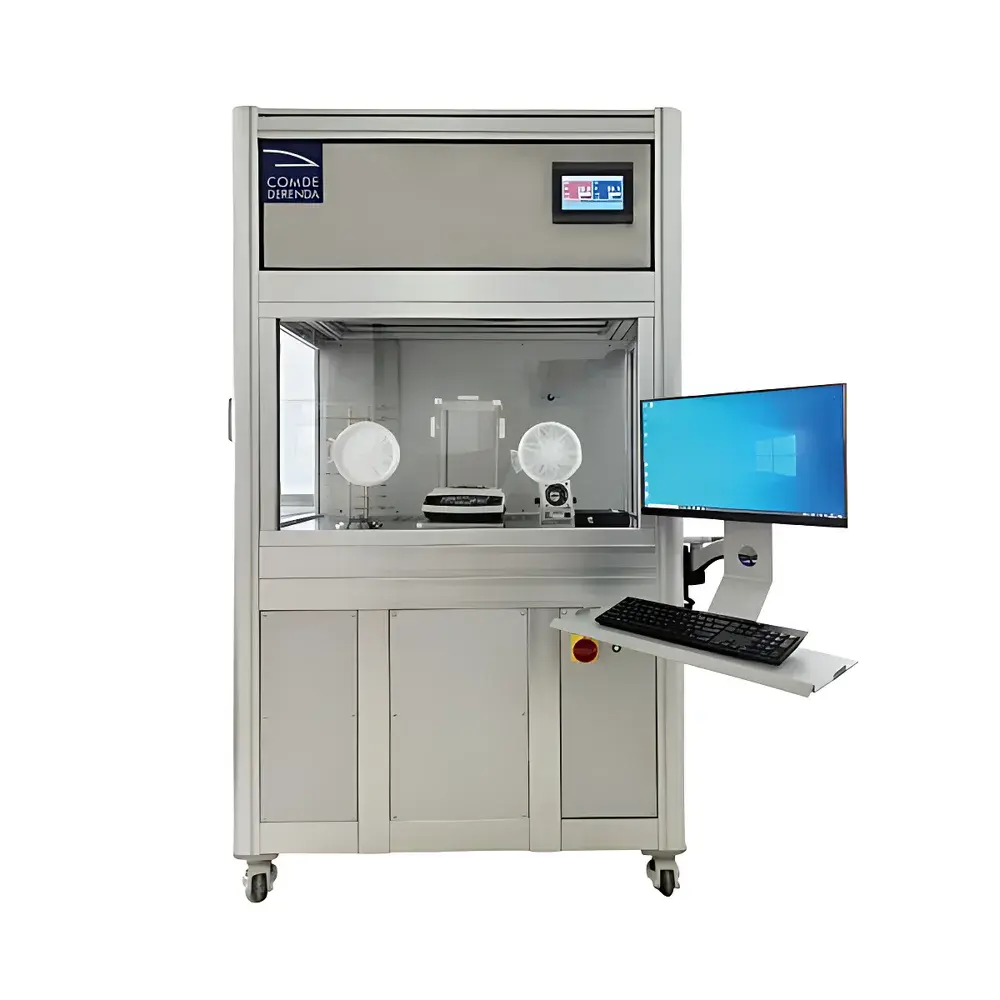
Derenda MWS-3 Manual Weighing System with Temperature & Humidity Control
| Brand | Derenda |
|---|---|
| Origin | Jiangsu, China |
| Manufacturer Type | Authorized Distributor |
| Origin Category | Domestic |
| Model | MWS-3 |
| Price | USD 1 (FOB) |
| Measured Parameters | TSP / PM₁₀ / PM₂.₅ |
Overview
The Derenda MWS-3 Manual Weighing System is a precision environmental laboratory instrument engineered for gravimetric analysis of atmospheric particulate matter collected on filter media. Designed in accordance with ISO 12103-1, EPA Method IO-4.3, and Chinese HJ 656-2013 standards, the MWS-3 provides a controlled, ISO Class 6 clean environment (per ISO 14644-1) for conditioning and manual weighing of TSP, PM₁₀, PM₂.₅, and PM₁.₀ filters—ensuring metrological traceability and measurement reproducibility. Its core function is to maintain stable thermal and hygrometric conditions (15–30 °C ±0.1 °C; 40–60 %RH ±0.1 %RH) throughout the full conditioning and weighing cycle, limiting temperature drift to ≤±0.5 °C and humidity fluctuation to ≤±5 %RH. This eliminates ambient contamination, electrostatic interference, and mechanical vibration—critical variables that compromise microgram-level mass determination accuracy in regulatory-grade air quality monitoring.
Key Features
- ISO Class 6 clean chamber with full-perimeter H14 HEPA filtration (99.995% @ 0.3 µm), integrated differential pressure monitoring and audible/visual alarm for timely filter replacement
- Double-glove manual operation ports enabling operator access without compromising internal cleanliness or environmental stability
- Ergonomically optimized work surface height (750 mm) aligned with ISO 11228-1 anthropometric guidelines for sustained operator comfort during extended weighing sessions
- Modular architecture with standardized interface for future integration with the AWS-2RE automated weighing system (optional upgrade path)
- Ionizing blower-based static elimination (non-radioactive), achieving full charge neutralization on 47 mm and 90 mm filters within ≤20 seconds
- Four-stage anti-vibration isolation: independent “island” foundation platform, reinforced 50 kg counterweight base, passive damping mounts, and active decoupling between chamber structure and balance support
Sample Compatibility & Compliance
The MWS-3 accommodates standard environmental sampling media including 47 mm and 90 mm quartz fiber or PTFE membrane filters, low-concentration sampling heads per HJ 656-2013 Annex B, and ASTM D3289-compliant 3# glass fiber filter tubes. All sample handling occurs within a sealed, particle-controlled workspace certified to ISO 14644-1 Class 6 (≤35,200 particles/m³ ≥0.3 µm). The system supports GLP-compliant documentation workflows: timestamped environmental logs (temperature/humidity), operator ID tracking, and manual entry of balance readings into auditable lab notebooks. Optional NIM-calibrated reference weights (100 mg / 200 mg) and accredited temperature/humidity calibration certificates are available to satisfy CNAS-CL01 and ISO/IEC 17025 requirements.
Software & Data Management
The MWS-3 operates as a hardware platform without embedded software or network connectivity—intentionally designed to eliminate cybersecurity risks and ensure deterministic environmental control. All data recording is performed externally using validated laboratory information management systems (LIMS) or electronic lab notebooks (ELN). Environmental parameters (T/RH) are logged via calibrated external sensors with NIST-traceable calibration reports. When paired with optional high-resolution balances (e.g., 0.01 mg readability, 0–50 g range), the system fully complies with USP , FDA 21 CFR Part 11 (when used with compliant ELN), and EU Annex 11 audit trail requirements for manual data entry procedures.
Applications
- Regulatory compliance testing at national and provincial environmental monitoring stations conducting PM₂.₅ and PM₁₀ monitoring per China’s Ambient Air Quality Standard (GB 3095-2012)
- Reference method validation laboratories performing inter-laboratory comparison studies under CNAS accreditation scope
- Academic research on aerosol mass closure, source apportionment, and hygroscopic growth kinetics requiring ultra-stable weighing conditions
- Third-party environmental testing institutions executing contract analyses for industrial emission permits and stack testing (e.g., low-concentration particulate sampling per HJ 836-2017)
- Meteorological observatories conducting long-term trend analysis of regional particulate loading using standardized filter protocols
FAQ
What filtration grade does the MWS-3 chamber use, and how is filter maintenance tracked?
The system employs H14 HEPA filters (EN 1822-1:2019) with real-time differential pressure monitoring. An integrated alarm triggers when ΔP exceeds manufacturer-specified thresholds, prompting scheduled filter replacement.
Can the MWS-3 be used with balances other than those specified in the datasheet?
Yes—the chamber and anti-vibration platform are mechanically agnostic. Users may install any analytical or microbalance meeting ISO 17025 metrological requirements, provided physical dimensions and weight distribution remain within the platform’s load envelope.
Is the MWS-3 suitable for ISO/IEC 17025-accredited laboratories?
Yes, when operated with documented procedures, NIM-certified reference weights, and calibrated environmental sensors, the MWS-3 satisfies clause 6.4.10 (environmental conditions) and clause 6.5.2 (measurement traceability) of ISO/IEC 17025:2017.
Does the system meet U.S. EPA or European EEA regulatory requirements for filter weighing?
It fulfills the environmental control criteria specified in EPA Method IO-4.3 (2016) and EN 12341:2014 for PM₁₀/PM₂.₅ gravimetric analysis, including temperature stability (±0.5 °C), RH control (40–60 %RH), and particle-free conditions (Class 6).
What is the recommended maintenance schedule for the ionizer and HEPA system?
Ionizer emitters require cleaning every 90 days; HEPA filters are replaced annually or after 1,500 operational hours—whichever occurs first—based on pressure drop trends and particle challenge testing.
Related Products







