
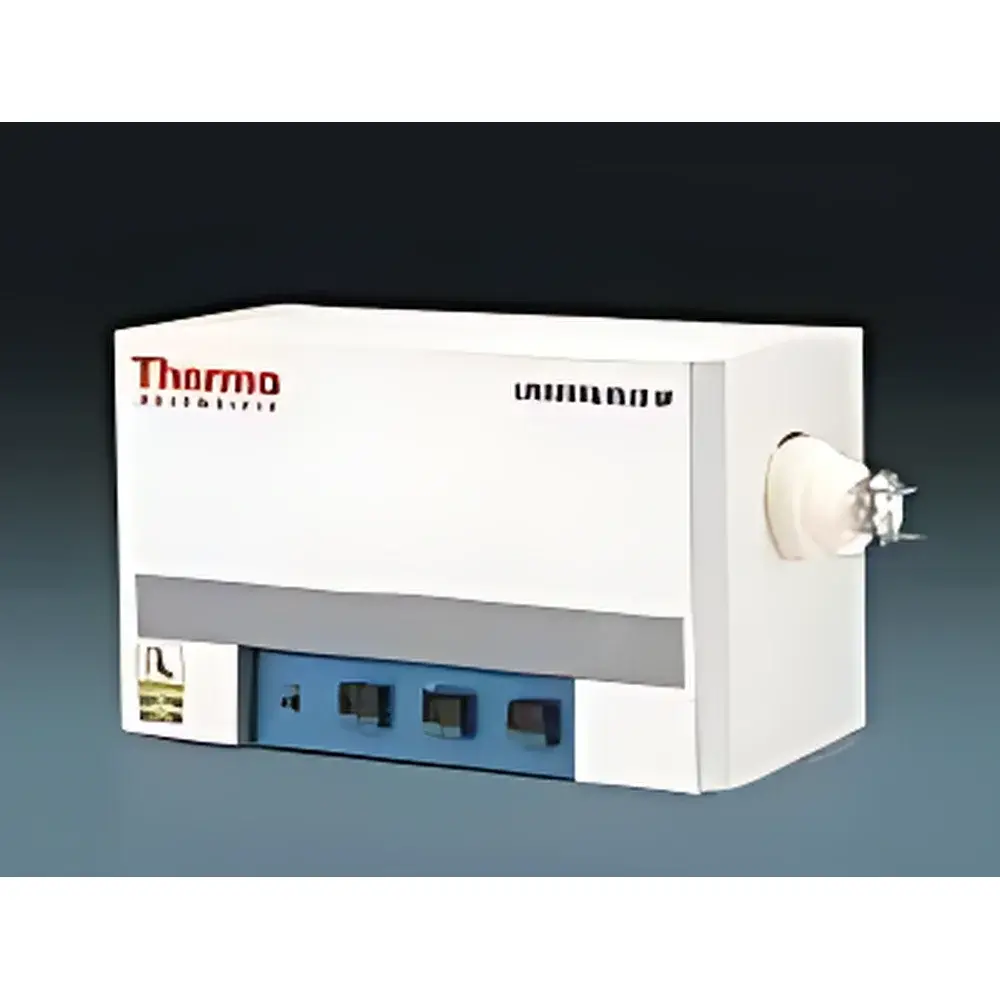
Thermo Fisher Lindberg/Blue M Muffle Furnace
| Brand | Thermo Fisher |
|---|---|
| Origin | USA |
| Manufacturer Type | Authorized Distributor |
| Origin Category | Imported |
| Model | Lindberg/Blue M |
| Pricing | Contact for Quote |
Overview
The Thermo Fisher Lindberg/Blue M Muffle Furnace is a high-performance, laboratory-grade thermal processing system engineered for precision heating, ashing, calcination, sintering, and heat treatment applications in research, quality control, and industrial R&D environments. Built upon decades of thermal design heritage, these furnaces employ advanced ceramic fiber insulation architecture and optimized radiant heating dynamics to deliver exceptional temperature uniformity (±3 °C at 1000 °C), rapid thermal response, and long-term stability under repeated thermal cycling. Unlike conventional refractory-lined furnaces, the Lindberg/Blue M platform utilizes a double-shell enclosure with variable-density Moldatherm® ceramic fiber composite insulation—vacuum-formed around the chamber—to minimize conductive and convective heat loss while maximizing radiant energy transfer efficiency. This architecture supports operation across a standard temperature range of ambient to 1200 °C (with select models rated to 1700 °C), with ramp rates up to 20 °C/min and soak stability maintained within ±1 °C over 8-hour cycles.
Key Features
- Patented Moldatherm® ceramic fiber insulation: Enables 70% lower external surface temperatures versus legacy muffle designs, improving lab safety and reducing ambient heat load.
- LGO (Light Gauge Overbend) heating elements: Precision-wound, high-emissivity resistance alloys providing fast heat-up (≤30 min to 1000 °C), rapid recovery after door opening, and extended service life (>5,000 hr at 1100 °C).
- Double-shell construction with air-gap thermal barrier: Enhances structural integrity, reduces thermal drift, and improves energy efficiency by up to 25% compared to single-wall alternatives.
- Modular control architecture: Supports both integral (panel-mounted) and remote (standalone) controllers—from basic solid-state single-setpoint units to microprocessor-based systems compliant with FDA 21 CFR Part 11 for audit-trail-capable process logging.
- Flexible installation: Horizontal or vertical orientation options; compatible with fume hoods, gloveboxes, and multi-furnace rack configurations via centralized control cabinets.
- Safety-certified design: UL 61010-1, CAN/CSA C22.2 No. 61010-1, CE marked, and compliant with NFPA 86 (Standard for Ovens and Furnaces) and NEC Article 427.
Sample Compatibility & Compliance
The Lindberg/Blue M muffle furnace accommodates crucibles, boats, and trays made from alumina, silicon carbide, quartz, and platinum—compatible with ASTM E1529 (fire-test-response standards), ISO 11358 (thermogravimetric analysis), and USP <231> (heavy metals testing). Chamber geometries (ranging from 1 L to 120 L volume) support standardized sample holders per ASTM D3174 (ash content in coal) and EPA Method 2540E (total solids ignition). All units undergo factory calibration traceable to NIST standards, with optional IQ/OQ documentation packages available for GLP/GMP-regulated laboratories.
Software & Data Management
Microprocessor-based controllers feature RS-232/RS-485 serial interfaces and optional Ethernet connectivity for integration into LabVantage, Thermo Fisher SampleManager LIMS, or custom SCADA systems. Programming capabilities include up to 16 segments per profile, dwell timers, ramp/soak sequences, and real-time data export in CSV or XML format. Audit trail functionality logs user ID, setpoint changes, alarm events, and calibration history—fully compliant with 21 CFR Part 11 requirements when paired with electronic signature modules and secure access protocols.
Applications
- Residue/ash content determination in pharmaceutical excipients (USP <281>), food matrices (AOAC 942.05), and environmental solids (EPA 3010A).
- Pre-treatment of catalysts and battery electrode materials prior to XRD or BET surface area analysis.
- Thermal gravimetric analysis (TGA) sample conditioning and binder burnout in ceramic green bodies.
- Calibration of thermocouples and RTDs per ASTM E230/E230M.
- Heat treatment of metallurgical specimens for microstructural development (e.g., annealing, stress relieving).
FAQ
What temperature uniformity can be expected across the working chamber?
At 1000 °C, typical uniformity is ±3 °C measured at nine points (center + eight corners) per ASTM E2203.
Is NIST-traceable calibration documentation included?
Factory calibration certificates are provided; full IQ/OQ/PQ validation kits and third-party calibration services are available upon request.
Can the furnace be integrated into an automated sample-handling workflow?
Yes—digital I/O ports and Modbus TCP support enable synchronization with robotic arms, conveyor systems, and central process controllers.
What maintenance intervals are recommended for LGO heating elements?
Under continuous operation at ≤1100 °C, inspection is advised every 2,000 hours; replacement frequency depends on thermal cycling severity and atmosphere composition.
Are explosion-proof variants available for solvent-rich atmospheres?
Select Blue M models (e.g., FBB series) are certified Class I, Division 1, Groups C & D per UL 1203 and meet ATEX Directive 2014/34/EU for hazardous locations.



