
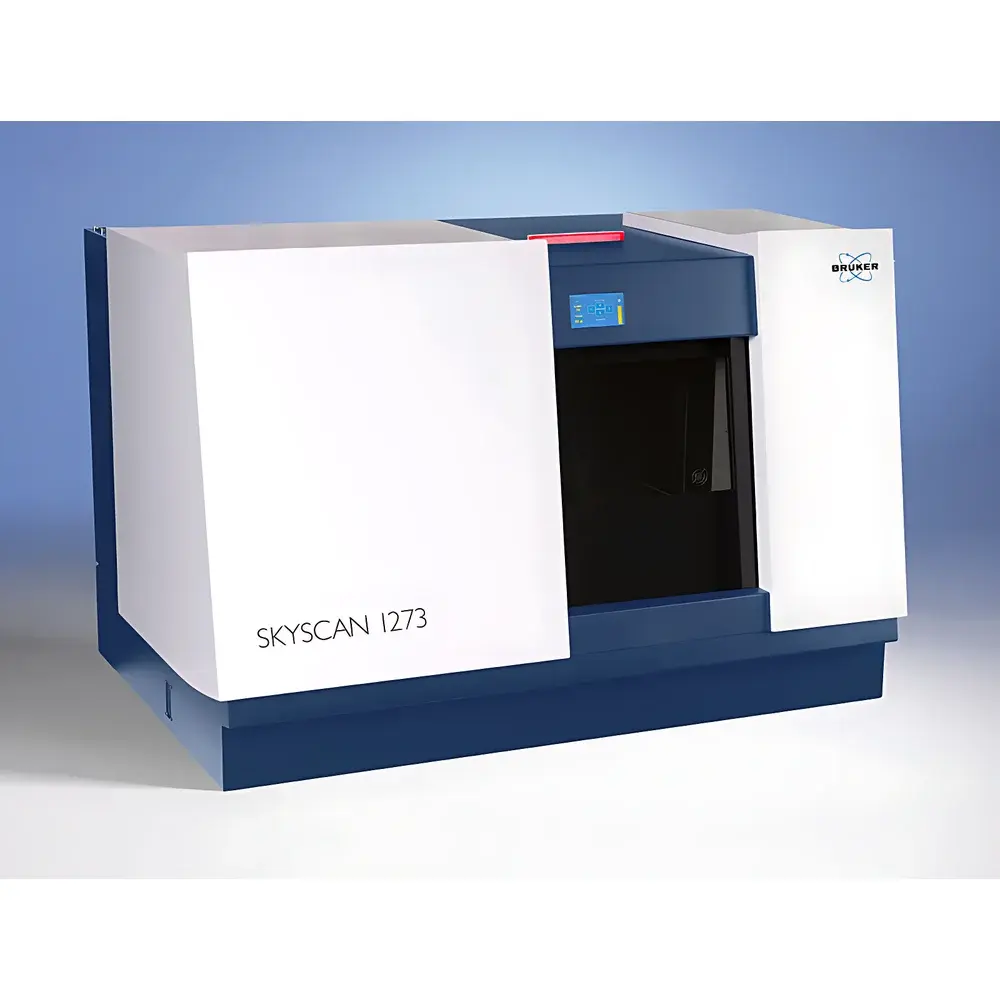
Bruker SKYSCAN 1273 Desktop High-Resolution Micro-CT System
| Brand | Bruker |
|---|---|
| Origin | Germany |
| Model | SKYSCAN 1273 |
| X-ray Source Energy | 40–130 kV, up to 39 W |
| Detector | 6 MP CMOS flat-panel, 3072 × 1944 pixels |
| Spatial Resolution | < 5 µm (3D) |
| Voxel Size | < 3 µm |
| Maximum Sample Dimensions | Ø300 mm × H500 mm, up to 20 kg |
| Field of View | Ø250 mm × H250 mm |
| Image Matrix | up to 4800 × 4800 pixels |
| Detector Output Speed | High-frame-rate acquisition enabled |
Overview
The Bruker SKYSCAN 1273 is a high-performance, benchtop micro-computed tomography (micro-CT) system engineered for non-destructive, three-dimensional internal structure visualization at sub-micron spatial resolution. Operating on the principle of cone-beam X-ray computed tomography, the system acquires hundreds of projection images as the sample rotates through 360°, followed by iterative or filtered back-projection reconstruction to generate isotropic volumetric datasets (voxel-based 3D models). Unlike conventional industrial CT systems requiring dedicated shielded rooms, the SKYSCAN 1273 integrates radiation-hardened shielding and interlocked safety protocols into its compact footprint—enabling routine use in standard laboratory environments without structural modifications. Its high-voltage X-ray source (40–130 kV), coupled with a large-area, low-noise CMOS flat-panel detector (3072 × 1944 pixels), delivers exceptional contrast-to-noise ratio (CNR) and signal fidelity across diverse material densities—from low-Z polymers to high-Z metals and mineral composites.
Key Features
- Compact desktop architecture with integrated lead-shielded enclosure compliant with IEC 61000-6-3 and local radiation safety regulations (e.g., German RöV)
- High-power microfocus X-ray source (up to 39 W) enabling rapid scanning of dense or thick samples (e.g., cast aluminum parts, geological cores, or orthopedic implants)
- Large-format CMOS detector with 6 million active pixels and programmable binning modes for optimized trade-offs between speed, resolution, and dose efficiency
- Sub-5 µm true 3D spatial resolution verified per ISO 15732:2021 (X-ray CT performance testing standards)
- Automated sample handling with motorized tilt/rotation stages and optional precision translation stage for extended field-of-view stitching
- Real-time preview and adaptive exposure control to minimize beam hardening artifacts and optimize photon flux per projection
Sample Compatibility & Compliance
The SKYSCAN 1273 accommodates samples up to Ø300 mm × H500 mm and 20 kg—making it suitable for full-size production components, geological core segments, medical device assemblies, and pre-clinical specimens. Its dynamic range supports quantitative density calibration using NIST-traceable reference phantoms (e.g., hydroxyapatite, aluminum, and PMMA step wedges). The system meets essential regulatory requirements for quality assurance workflows: raw projection data and reconstructed volumes retain full audit trail metadata (acquisition time, kV/mA, filter settings, geometry parameters), satisfying GLP/GMP documentation needs. While not FDA-cleared as a diagnostic device, its output complies with ASTM E1441 (Standard Guide for Computed Tomography), ISO/IEC 17025 traceability frameworks, and supports validation protocols aligned with USP and ISO 12718 for dimensional metrology applications.
Software & Data Management
Controlled via Bruker’s proprietary NRecon (reconstruction), CTAn (analysis), and CTVox (visualization) software suite, the SKYSCAN 1273 provides end-to-end processing within a single licensed environment. NRecon implements GPU-accelerated Feldkamp-Davis-Kress (FDK) and iterative SART algorithms with ring artifact suppression and beam hardening correction. CTAn enables automated segmentation, pore network modeling (per ISO 23851), particle size distribution (PSD) analysis, wall thickness mapping, and fiber orientation tensor calculation—all exportable as CSV, STL, or DICOM-CT compliant files. All software modules enforce role-based access control and support 21 CFR Part 11–compliant electronic signatures when deployed on validated Windows Server platforms with domain authentication.
Applications
- Manufacturing QA: Porosity quantification in investment-cast turbine blades; detection of inclusions, shrinkage cavities, and unmelted powder particles in additively manufactured Ti-6Al-4V components
- Geosciences: Pore throat connectivity analysis in carbonate reservoir cores; grain size distribution and cementation index mapping in sandstone samples
- Medical Device Development: Dimensional verification of laser-sintered porous acetabular cups; coating thickness uniformity assessment on drug-eluting stents
- Pharmaceutical Packaging: Seal integrity evaluation of blister packs and vial stoppers; quantification of delamination in multi-layer laminates
- Materials Science: In situ thermal expansion tracking during heating cycles (with optional environmental chamber); fiber alignment analysis in carbon-fiber-reinforced polymer (CFRP) laminates
FAQ
What is the minimum achievable voxel size under optimal conditions?
The system achieves isotropic voxel sizes down to < 3 µm when imaging small, low-absorption samples (e.g., polymer foams or biological tissue) at high magnification using geometric magnification mode.
Does the SKYSCAN 1273 support time-resolved (4D) imaging?
Yes—when paired with programmable environmental stages (e.g., heating/cooling or mechanical loading rigs), the system supports sequential scan acquisition with temporal registration, enabling deformation or phase-change process analysis.
Can reconstructed volumes be exported for finite element analysis (FEA)?
Absolutely—binary or grayscale segmented volumes can be exported as ASCII or binary STL, PLY, or raw voxel arrays compatible with ANSYS, COMSOL, and Simpleware ScanIP.
Is remote operation supported for unattended scanning?
Yes—the instrument supports secure SSH and VNC-based remote desktop access, and scheduled scans can be initiated via command-line interface (CLI) scripts integrated into lab automation pipelines.



