
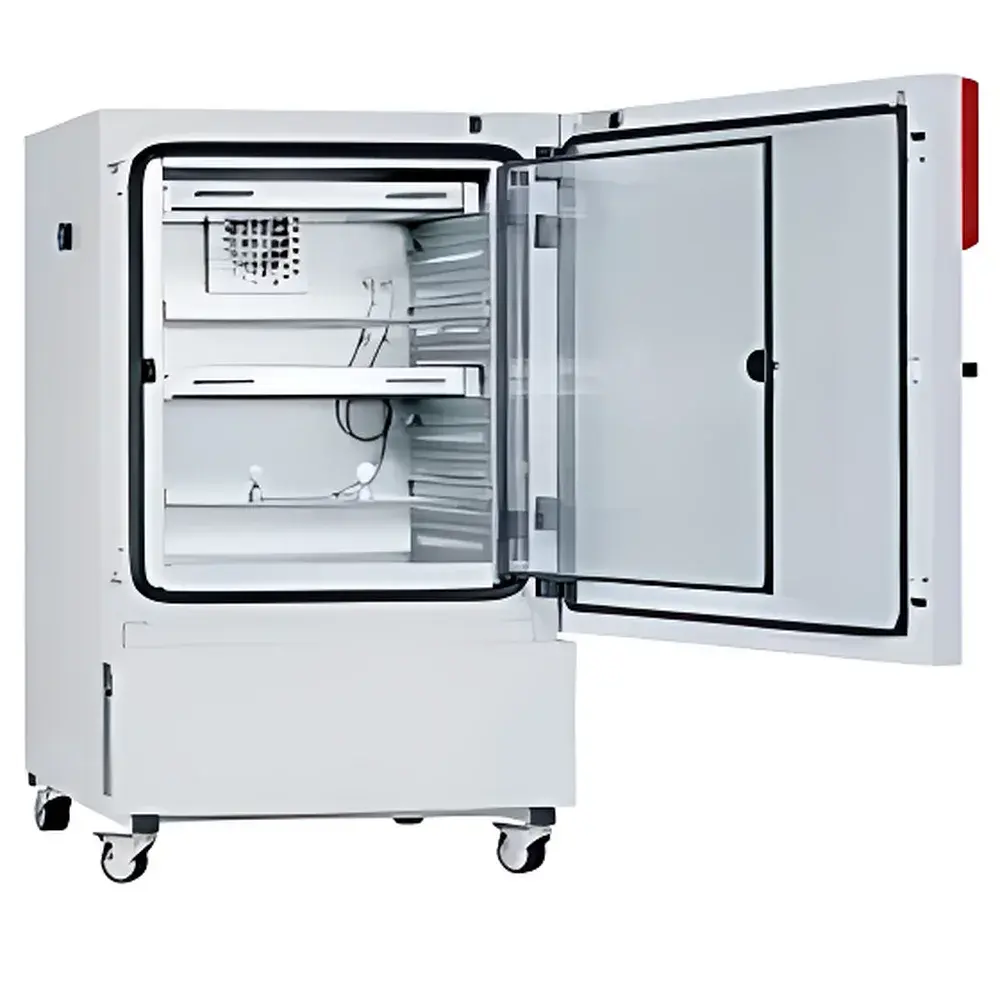
BINDER KBWF Series Temperature-Controlled Plant Growth Chambers
| Brand | BINDER |
|---|---|
| Origin | Germany |
| Model | KBWF |
| Internal Volume | 247 L (KBWF 240) / 700 L (KBWF 720) |
| External Dimensions (W×H×D) | 925×1465×800 mm (KBWF 240) / 1250×1925×890 mm (KBWF 720) |
| Internal Dimensions (W×H×D) | 650×785×485 mm (KBWF 240) / 973×1250×576 mm (KBWF 720) |
| Net Weight | 214 kg (KBWF 240) / 374 kg (KBWF 720) |
| Temperature Range | 0–70 °C (dark), 10–60 °C (with illumination) |
| Humidity Range | 10–80 % RH |
| Illumination | 2 or 3 adjustable fluorescent lamp compartments (5 tubes each) |
Overview
The BINDER KBWF Series Temperature-Controlled Plant Growth Chambers are precision-engineered environmental simulation systems designed for reproducible, long-term cultivation and physiological stress testing of higher plants, algae, and model organisms under tightly regulated climatic conditions. Unlike generic incubators or greenhouse modules, the KBWF series integrates DIN-compliant thermal management, dynamic humidity control, and spectrally stable illumination into a single monolithic chamber architecture—enabling controlled-environment experiments aligned with OECD Test Guidelines, ISO 17025-accredited laboratory practices, and GLP-compliant plant phenotyping workflows. The core operating principle combines forced-air convection with APT.line™ preheating chamber technology to eliminate thermal gradients across the entire internal volume, ensuring uniform temperature distribution (±0.3 K at setpoint) even during ramp cycles or load changes. Humidity is actively maintained via steam humidification and real-time feedback from capacitive sensors—critical for simulating drought, high-humidity pathogen pressure, or transpiration-driven stomatal response studies.
Key Features
- APT.line™ preheating chamber technology ensures homogeneous temperature distribution (≤ ±0.3 K deviation across working volume) and minimizes overshoot during setpoint transitions.
- Dual-range temperature control: 0–70 °C in darkness; 10–60 °C under active illumination—optimized for photoperiod-sensitive growth stages including germination, rosette development, and flowering induction.
- Humidity regulation from 10 % to 80 % RH using steam-based humidification and capacitive sensing—enabling precise emulation of arid, mesic, or tropical microclimates.
- Modular illumination system: KBWF 240 includes two independently positionable fluorescent lamp compartments (5 T5 tubes each); KBWF 720 provides three compartments—each configurable for PAR (Photosynthetically Active Radiation) output calibration and spectral tuning via optional filters.
- Programmable interval controller with color LCD interface supports multi-step climate profiles (e.g., diurnal cycles, vernalization protocols, or abiotic stress ramps) with timestamped logging.
- Class 3.1 independent temperature safety device (per DIN 12880) with optical and acoustic alarm—certified for unattended operation in regulated research environments.
- Ethernet interface enables remote monitoring, data export, and integration into centralized lab infrastructure (e.g., LIMS or building management systems) with support for standard TCP/IP protocols.
Sample Compatibility & Compliance
The KBWF chambers accommodate standard plant growth vessels—including Petri dishes, Magenta boxes, square pots (up to 15 cm × 15 cm), hydroponic trays, and multi-well plates—on stainless steel adjustable shelves. Internal ESG safety glass doors minimize condensation while maintaining structural integrity under repeated thermal cycling. All models comply with IEC 61000-6-3 (EMC emission), IEC 61000-6-2 (immunity), and EN 61010-1 (safety for laboratory equipment). Optional validation packages support IQ/OQ documentation per GxP requirements, including traceable calibration certificates for temperature and humidity sensors (NIST-traceable reference standards). The system architecture meets audit readiness criteria for FDA 21 CFR Part 11 when paired with BINDER’s validated software suite.
Software & Data Management
Data acquisition and parameter scheduling are managed through the integrated controller with local color LCD display and Ethernet connectivity. Logged parameters—including chamber temperature, relative humidity, illumination status, and alarm events—are stored internally with ≥30 days of buffered history. Export is supported via CSV over FTP or direct Ethernet download. For advanced integration, BINDER’s optional *ecoLINK* software provides centralized fleet monitoring, automated report generation (PDF/Excel), user access control (role-based permissions), and electronic signature capability compliant with 21 CFR Part 11 Annex 11 requirements. All data records include immutable timestamps, operator ID, and change history—ensuring full traceability for peer-reviewed publications or regulatory submissions.
Applications
- Controlled-environment phenotyping of crop mutants under defined drought, heat, or cold stress regimes.
- Pathogen–host interaction studies requiring synchronized infection timing and post-inoculation climate staging (e.g., Pseudomonas syringae on Arabidopsis).
- Seed dormancy breaking and stratification protocol development (e.g., vernalization at 4 °C ± 0.5 K for 6 weeks).
- Photobiology experiments involving blue/red/far-red light ratios, circadian entrainment, or UV-B exposure gradients.
- Pre-acclimation trials prior to field release or greenhouse transition—supporting IPM (Integrated Pest Management) strategy validation.
- Regulatory ecotoxicity testing (OECD 208, 227) where plant biomass endpoints must be quantified under standardized abiotic conditions.
FAQ
What is the maximum allowable load volume without compromising temperature uniformity?
For KBWF 240, up to 60 % of internal volume (148 L) may be occupied by samples and fixtures while maintaining DIN 12880-defined uniformity; for KBWF 720, the limit is 700 L × 0.6 = 420 L.
Can the illumination spectrum be customized beyond standard fluorescent tubes?
Yes—third-party LED arrays with programmable spectral output (380–780 nm) can be mounted inside the lamp compartments using the provided rail system and power terminals.
Is door heating active during humidity control cycles?
Yes—door heating operates continuously during humidification phases to prevent condensation-induced light scattering and microbial colonization on the inner glass surface.
Does the system support validation documentation for ISO/IEC 17025 accreditation?
Yes—BINDER provides Factory Acceptance Test (FAT) reports, sensor calibration certificates (including uncertainty budgets), and IQ/OQ templates aligned with ISO/IEC 17025:2017 clause 6.4.3.
How is alarm event data archived and retrievable?
All alarms (temperature deviation, humidity fault, lamp failure, door open) are time-stamped, logged to non-volatile memory, and exportable as CSV with UTC timestamps and severity codes (warning/critical).






