
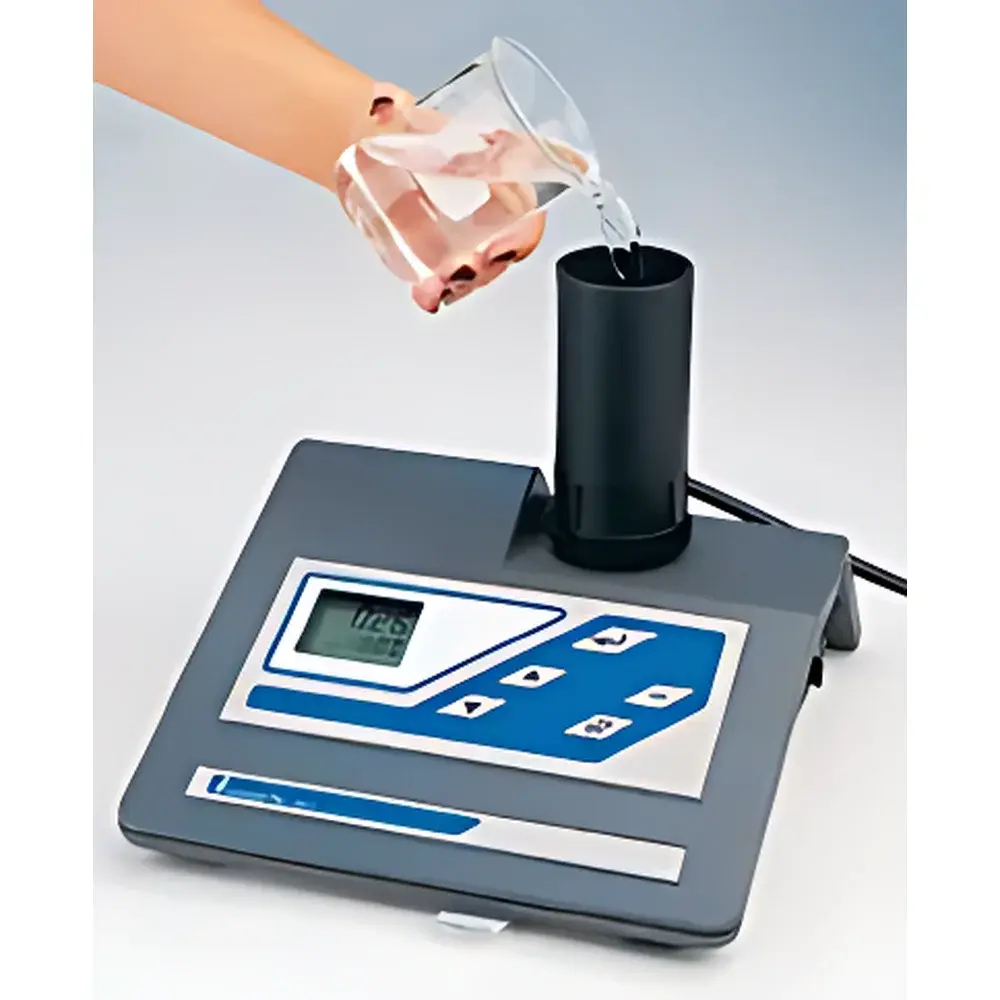
Lovibond ET93811 Advanced Microprocessor Turbidimeter
| Brand | Lovibond (Tintometer) |
|---|---|
| Origin | United Kingdom |
| Model | ET93811 |
| Measurement Standards | ISO 7027 (IR), EPA Method 180 (optional white light) |
| Range | 0.0001–10000 NTU / FNU / FAU / EBC |
| Resolution | 0.0001 NTU (at lowest range) |
| Accuracy | ±2% ±0.01 NTU (0–1000 NTU), ±5% (1000–4000 NTU), ±10% (4000–10000 NTU) |
| Detection Geometry | 90° detector + auxiliary photodiode array for color compensation |
| Light Source | IR LED (ISO 7027 compliant) or tungsten lamp (EPA 180 mode, optional) |
| Response Time | 6 seconds |
| Sample Volume | 30 mL (min. 27 mL) |
| Calibration | Auto-recognized standards at 0.2, 10, 100, and 1750 NTU |
| Data Interface | RS232 |
| Environmental Operating Conditions | 0–50°C, 30–90% RH |
| Certifications | CE, UL, CSA, ISO 7027 compliant |
| Power Supply | 100–240 VAC / 12 VDC |
| Dimensions | 355 × 304 × 305 mm |
| Weight | 3180 g |
Overview
The Lovibond ET93811 Advanced Microprocessor Turbidimeter is a high-precision optical instrument engineered for laboratory-grade turbidity measurement in compliance with internationally recognized standards—including ISO 7027 (infrared 90° scatter detection) and EPA Method 180 (white-light nephelometry, configurable via optical module selection). Designed for rigorous analytical environments, the ET93811 employs a dual-detector architecture: a primary 90° scatter photodetector coupled with an auxiliary photodiode array to dynamically compensate for sample chromaticity and background interference. This design ensures robust signal integrity across diverse matrices—from ultrapure water (sub-0.001 NTU) to highly concentrated industrial effluents (up to 10,000 NTU)—without manual range intervention. Its microprocessor-controlled auto-ranging system continuously evaluates incident and scattered light intensity to select the optimal optical gain and integration time, delivering stable, repeatable results within six seconds per measurement. The instrument’s infrared LED light source (standard) eliminates spectral interference from colored samples, satisfying ISO 7027’s requirement for monochromatic 860 nm illumination—making it suitable for regulatory reporting in pharmaceutical, drinking water, and environmental monitoring applications governed by WHO, EU Directive 98/83/EC, and US EPA guidelines.
Key Features
- Auto-ranging measurement from 0.0001 to 10,000 NTU with seamless unit conversion among NTU, FNU, FAU, and EBC—enabling cross-method comparability and method-specific reporting.
- Dual-mode optical configuration: factory-default ISO 7027 IR mode (860 nm LED); optional white-light tungsten lamp module available for EPA Method 180 compliance.
- Integrated color-compensation algorithm using auxiliary photodiode array—automatically corrects for absorbance-induced scatter attenuation, critical for yellow/brown-colored samples (e.g., humic-rich surface waters or malt beverages).
- Intelligent cuvette recognition system detects sample cell presence and orientation, triggering automatic zeroing and range optimization prior to measurement initiation.
- “Golden-Time” calibration kit (0.2, 10, 100, and 1750 NTU Formazin-equivalent standards) with traceable NIST-traceable documentation; auto-calibration recognition minimizes operator error and supports GLP audit trails.
- Condensation-resistant sample chamber with purge port compatible with dry-air or nitrogen lines—prevents moisture-induced stray light artifacts during high-humidity operation or cold-sample analysis.
- Onboard self-diagnostic firmware performs real-time verification of LED output stability, detector linearity, and electronic offset drift—logging status flags accessible via RS232.
Sample Compatibility & Compliance
The ET93811 accommodates standard 30 mL glass or quartz cuvettes (supplied: two ET98551 cells) and supports three operational modes: static batch measurement, flow-through analysis (with optional peristaltic pump interface), and volume-limited “fill-to-mark” sampling (minimum 27 mL). Its optical path length and detector geometry are validated per ISO 7027 Annex B for repeatability ≤±0.5% RSD under controlled conditions. The instrument meets CE marking requirements for electromagnetic compatibility (EN 61326-1) and safety (EN 61010-1), carries UL and CSA certification for North American deployment, and adheres to ISO/IEC 17025-relevant design principles for metrological traceability. For regulated laboratories, its RS232 interface enables integration with LIMS or ELN systems supporting 21 CFR Part 11-compliant data capture when paired with validated software—ensuring audit-ready records of measurement date/time, operator ID, calibration history, and raw scatter voltage outputs.
Software & Data Management
Data export is supported via ASCII-formatted RS232 serial protocol (9600 baud, no parity, 1 stop bit), transmitting timestamped values including turbidity reading, selected unit, measurement mode, and calibration status flag. While the ET93811 operates as a standalone instrument, its communication protocol is compatible with third-party data acquisition platforms (e.g., LabVIEW, MATLAB Serial I/O Toolboxes) and certified laboratory informatics solutions. Internal memory retains up to 200 measurement records with timestamps; external archiving requires direct serial connection to PC or thermal printer. Firmware updates—distributed via Lovibond’s secure technical portal—maintain alignment with evolving ISO 7027:2016 amendments and regional regulatory interpretations. No proprietary software installation is required for basic data logging, ensuring compatibility with air-gapped or IT-restricted lab networks.
Applications
- Drinking water quality control per WHO Guidelines and EU Council Directive 98/83/EC—validating filtration efficiency and disinfection process performance.
- Pharmaceutical water-for-injection (WFI) and purified water (PW) monitoring per USP and EP 2.2.2, where sub-0.05 NTU detection limits are mandated.
- Beverage industry QC—beer clarity (EBC scale), wine stabilization assessment, and soft drink particulate stability testing.
- Environmental field lab analysis of wastewater effluent, stormwater runoff, and lake/reservoir profiling—supporting NPDES permit compliance reporting.
- Research applications requiring high-resolution kinetic turbidity profiling (e.g., coagulation-flocculation studies, nanoparticle aggregation kinetics).
FAQ
Does the ET93811 comply with ISO 7027:2016?
Yes—the instrument’s default infrared LED source (860 ±30 nm), 90° scatter geometry, and detector spectral response are fully aligned with ISO 7027:2016 requirements for formazin-based calibration and measurement uncertainty management.
Can it measure samples with strong coloration, such as tea or fruit juice?
Yes—its auxiliary photodiode array performs real-time absorbance correction, significantly reducing color-related bias compared to single-detector turbidimeters.
Is the calibration kit NIST-traceable?
The supplied 0.2/10/100/1750 NTU Formazin standards include individual CoA documents referencing NIST SRM 2134 traceability and in-house gravimetric validation per ISO 8772.
What is the minimum detectable turbidity level?
At the 0.0001 NTU resolution setting (0–0.9999 NTU range), the limit of detection (LoD) is 0.0003 NTU (3σ of blank variability), verified using ultrapure water filtered through 0.1 µm membrane.
Can the instrument be integrated into a GLP/GMP environment?
Yes—when used with validated RS232 data capture software featuring electronic signatures, audit trails, and calibration lockout functions, it satisfies core ALCOA+ data integrity principles for regulated workflows.




