
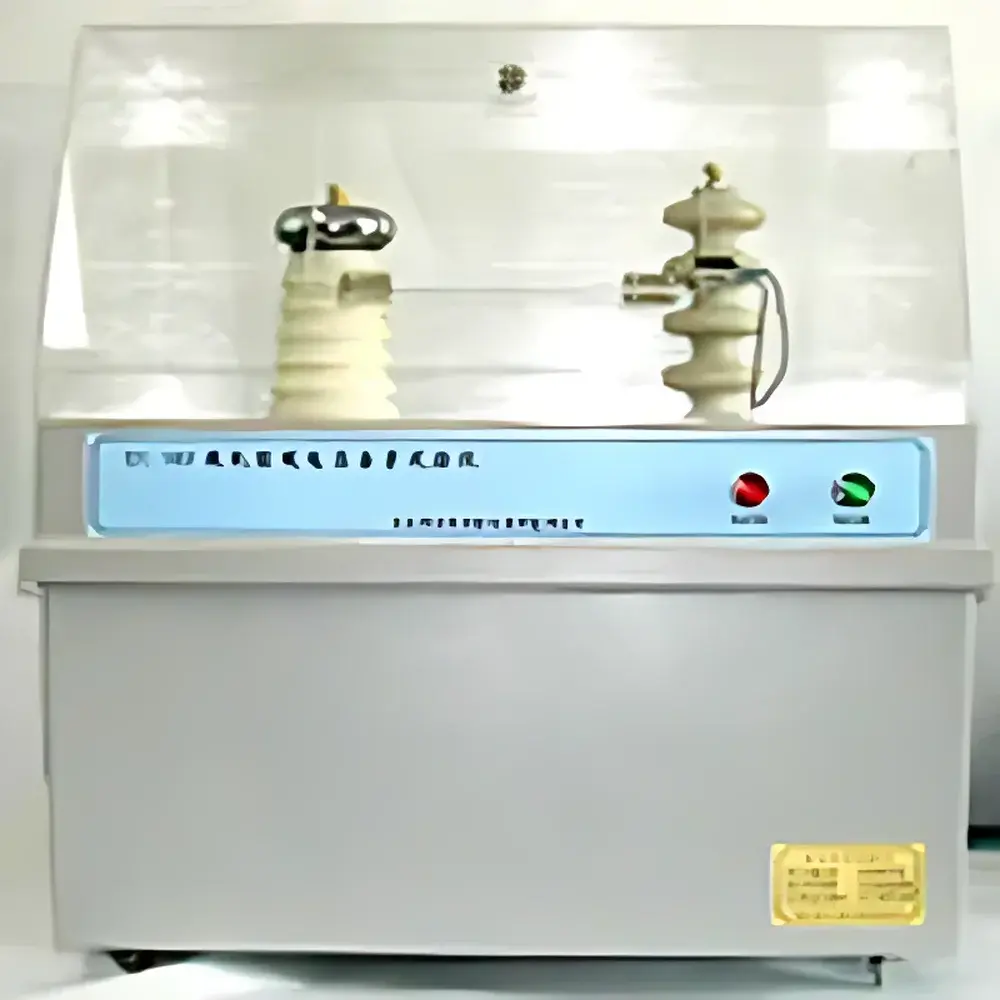
North Guang Precision BDJC-50KC AC/DC Dielectric Breakdown Tester
| Brand | North Guang Precision Instrument |
|---|---|
| Origin | Beijing, China |
| Manufacturer Type | Manufacturer |
| Model | BDJC-50KC |
| Output Voltage | AC 0–50 kV / DC 0–70 kV |
| Power Capacity | 3 kVA |
| Voltage Accuracy | ≤1% |
| Rise Rate Options | 100–3000 V/s (adjustable in 6 steps) |
| Electrode Configurations | Ø25 mm & Ø75 mm disc electrodes |
| Safety Protection | 9-level interlock system (overvoltage, overcurrent, short-circuit, safety door, software error, zero-voltage reset, post-test discharge, independent grounding, resin-based discharge rod) |
| Test Modes | AC/DC breakdown, withstand, stepwise ramp |
| Compliance Standards | GB/T 1408.1–2006, GB/T 1695–2005, GB/T 3333, HG/T 3330, GB 12656, ASTM D149 |
| Software Platform | Windows-based control interface with real-time curve plotting, Excel export, user access management, multi-standard selection, and GLP-compliant audit trail logging |
Overview
The North Guang Precision BDJC-50KC AC/DC Dielectric Breakdown Tester is an engineered solution for quantitative assessment of dielectric strength and voltage withstand capability in solid insulating materials. It operates on the principle of controlled voltage application—either sinusoidal AC at 50 Hz or polarity-stable DC—until electrical breakdown occurs across a defined electrode gap within the test specimen. This event marks the point where the material’s insulating integrity fails under electric stress, yielding the dielectric breakdown voltage (kV) and, when normalized to thickness, the dielectric strength (kV/mm). Designed for laboratories conducting quality control, R&D, and regulatory compliance testing, the BDJC-50KC meets stringent requirements outlined in international standards including ASTM D149, IEC 60243-1, and multiple GB-series specifications governing plastics, elastomers, laminates, films, ceramics, glass, varnishes, and insulating components.
Key Features
- True dual-mode operation: fully independent AC (0–50 kV RMS) and DC (0–70 kV) high-voltage generation with seamless mode switching via software interface.
- Precision digital voltage regulation using contactless solid-state control—eliminating mechanical variac wear, hysteresis, and nonlinearity inherent in legacy belt-driven systems.
- Six programmable voltage ramp rates (100, 200, 500, 1000, 2500, 3000 V/s), compliant with Clause 8.2.2 of ASTM D149 and GB/T 1408.1–2006 for rapid-rise testing, as well as low-rate protocols required for slow-breakdown analysis.
- Integrated 9-level hardware and firmware safety architecture: includes overvoltage cutoff, current-limiting trip (<0.05 s response), interlocked safety enclosure, zero-voltage reset enforcement, dedicated resin-core discharge rod, isolated earth ground, and software-level misoperation lockout.
- Simultaneous leakage current monitoring with real-time digitization and storage—enabling detection of pre-breakdown conduction trends and partial discharge onset thresholds.
- Multi-specimen capability: up to five specimens may be tested sequentially without manual reconfiguration, significantly improving throughput versus single-position competitors.
- Full-range, unsegmented 0–50 kV AC output enabled by high-fidelity voltage sensing circuitry—removing reliance on coarse tap-switched transformers and associated calibration discontinuities.
Sample Compatibility & Compliance
The BDJC-50KC accommodates standardized geometries per major material classes: flat-sheet specimens (using Ø25 mm or Ø75 mm brass disc electrodes per IEC 60243-1 Annex A), tubular samples (with matched cylindrical electrodes), and coated substrates (per HG/T 3330). Its design supports both volumetric and surface breakdown evaluation under controlled ambient conditions (23 ±2 °C, 50±5% RH recommended). All operational parameters—including dwell time (0–6 hours, software-defined), ramp profile, and pass/fail criteria—are configurable to align with material-specific test methods in GB/T 1695 (vulcanized rubber), GB/T 3333 (cable paper), GB 12656 (capacitor paper), and ASTM D149 (general solid dielectrics). The system satisfies essential requirements for GLP and GMP environments, including electronic signature support, user-level permission tiers, and tamper-evident audit trails meeting FDA 21 CFR Part 11 data integrity expectations.
Software & Data Management
Controlled via a native Windows application, the BDJC-50KC software provides deterministic instrument orchestration with deterministic timing resolution (<10 ms loop cycle). Real-time oscillographic display plots voltage, current, and derivative dV/dt during each test. All raw waveforms and metadata—including operator ID, timestamp, environmental notes, electrode type, and standard reference—are embedded into proprietary binary files (.bdj) and exportable CSV/Excel datasets. Report templates are customizable: users define header fields, pass/fail logic, statistical summaries (mean, SD, min/max), and graphical overlays. The system maintains full traceability—each test record logs firmware version, calibration certificate ID, and hardware serial numbers. Audit logs capture login events, parameter changes, and test aborts, supporting ISO/IEC 17025 accreditation workflows.
Applications
- Quality assurance of polymer films (PET, PI, PP) used in capacitors and flexible electronics.
- Evaluation of ceramic substrate dielectric integrity for high-voltage PCBs and power modules.
- Validation of insulating coatings on magnet wire and motor windings per NEMA MW 1000.
- R&D screening of nanocomposite dielectrics for improved breakdown resistance.
- Third-party certification testing for UL 746C, IEC 60674-2, and RoHS-compliant material declarations.
- Failure analysis of aged insulation in transformers, bushings, and cable terminations.
FAQ
What standards does the BDJC-50KC directly support out-of-the-box?
It includes preloaded test templates for GB/T 1408.1–2006, GB/T 1695–2005, ASTM D149, and HG/T 3330—with editable parameters to accommodate lab-specific deviations.
Can the system perform step-stress testing with automatic voltage hold and increment?
Yes—both AC and DC step-ramp modes allow user-defined voltage levels, dwell durations (1 s to 6 h), and incremental steps, with auto-advance upon pass or abort on failure.
Is remote operation or integration with LIMS possible?
The software exposes COM/ActiveX interfaces and TCP/IP command sets, enabling integration with LabWare, STARLIMS, or custom MES platforms via OPC UA or RESTful middleware.
How is calibration traceability maintained?
Each unit ships with a NIST-traceable calibration certificate covering voltage output, current measurement, and timing accuracy—valid for 12 months under normal use.
What maintenance is required for long-term reliability?
Annual verification of HV transformer insulation resistance, electrode surface finish inspection, and firmware updates—no consumables or scheduled part replacements are specified.



