
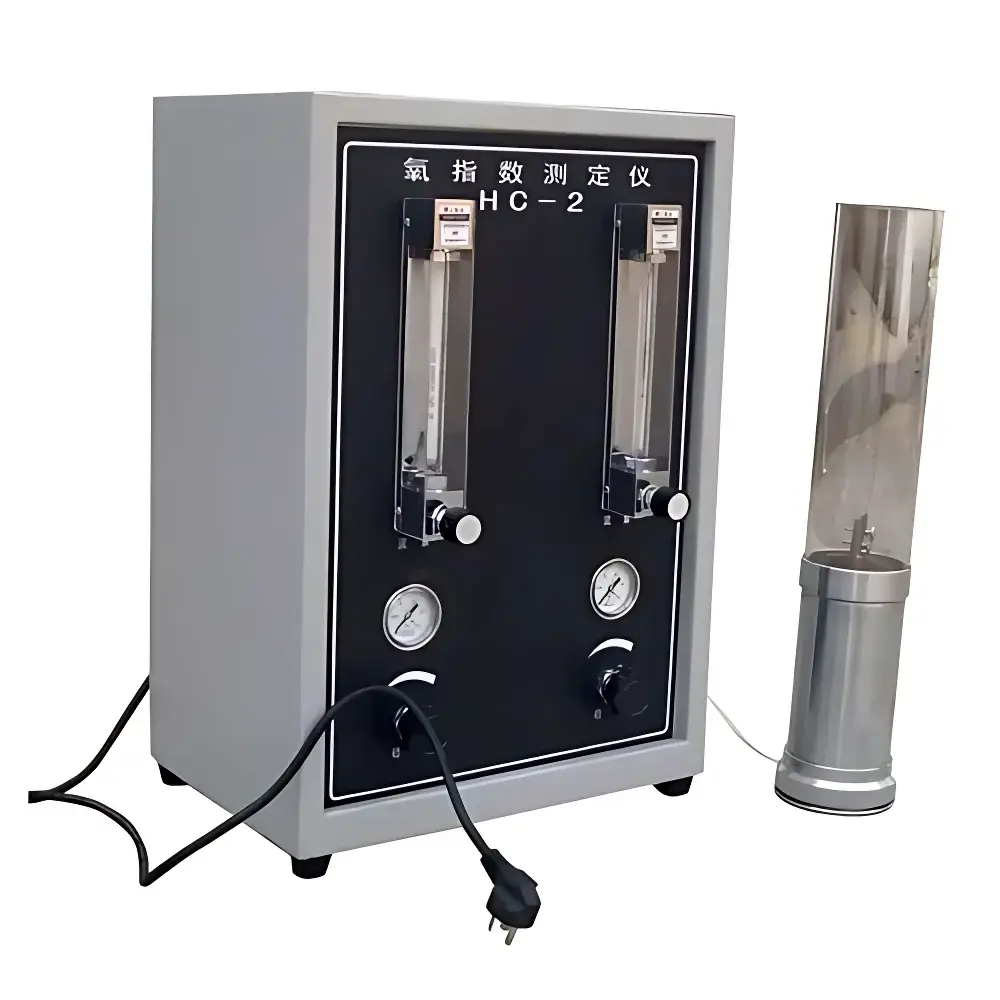
Beiguang Jingyi YZS-75A Digital Oxygen Index Tester
| Brand | Beiguang Jingyi / All Precision Instrument |
|---|---|
| Origin | Beijing, China |
| Manufacturer Type | OEM Manufacturer |
| Country of Origin | China |
| Model | YZS-75A |
| Price | USD 1,890 (FOB Beijing) |
| O₂ Measurement Range | 0–100 vol% |
| Accuracy | ±2.5 vol% O₂ |
| Response Time | <10 s |
| Drift | <5% per year |
| Operating Temperature | −10 °C to +45 °C |
| Relative Humidity | <85% RH |
| Supply Gases | GB3863 Industrial Oxygen & GB3864 Industrial Nitrogen |
| Regulated Output Pressure | 0.25–0.4 MPa |
| Working Pressure | 0.1 MPa |
Overview
The Beiguang Jingyi YZS-75A Digital Oxygen Index Tester is a precision benchtop instrument engineered for the quantitative determination of the Limiting Oxygen Index (LOI) of solid polymeric materials in accordance with ISO 4589-2 and ASTM D2863. It operates on the principle of controlled combustion in a vertically oriented sample holder within a defined oxygen–nitrogen gas mixture stream. The LOI value—expressed as the minimum volume percentage of oxygen in the mixture required to sustain candle-like burning of a standardized specimen for either 50 mm length or 180 seconds—is a fundamental parameter for assessing relative flammability and flame-retardant efficacy. Unlike qualitative pass/fail fire tests, the YZS-75A delivers traceable, repeatable numerical data essential for material screening, regulatory documentation, and formulation optimization in R&D and QC environments.
Key Features
- Digital microprocessor-controlled gas blending system with dual mass flow controllers (MFCs) for precise, independent regulation of O₂ and N₂ flow rates
- High-resolution digital display (0.1% O₂ resolution) with real-time monitoring of oxygen concentration, flow rate, and test duration
- Calibrated thermocouple-integrated ignition source (standardized 50 mm Bunsen burner) with adjustable flame height and reproducible ignition timing
- Stainless-steel combustion chamber with integrated exhaust ducting and flame arrestor for operator safety and consistent thermal environment
- Compliance-ready design: supports manual calibration verification per ISO 4589-2 Annex A; compatible with external calibration gas standards (e.g., certified 21% O₂/N₂ mix)
- Rugged industrial-grade construction with EMI-shielded electronics and corrosion-resistant gas pathways for long-term stability under laboratory use
Sample Compatibility & Compliance
The YZS-75A accommodates standard test specimens per ISO 4589-2: rectangular bars (80–150 mm × 10 ± 0.5 mm × 4 ± 0.25 mm), foams (≥10 mm thick), textiles (mounted on rigid backing), laminates, films, and flexible sheets. Specimen conditioning follows ISO 291 (23 °C/50% RH, 48 h). The instrument meets core requirements of GB/T 2406.2–2009 (Chinese national adoption of ISO 4589-2), ASTM D2863–22, and UL 94 pre-screening protocols. While not inherently 21 CFR Part 11 compliant (as it lacks electronic audit trail functionality), its analog/digital hybrid architecture permits integration into GLP-compliant workflows via external loggers and SOP-controlled manual data recording. All mechanical components conform to RoHS Directive 2011/65/EU for restricted substances.
Software & Data Management
The YZS-75A operates in standalone mode without proprietary software dependency. All operational parameters—including setpoint O₂%, actual measured O₂%, total test time, and visual burn observations—are recorded manually in laboratory notebooks or LIMS-compatible spreadsheets. For enhanced traceability, users may pair the unit with optional third-party data acquisition systems (e.g., National Instruments DAQ modules) that interface via 4–20 mA or RS-232 analog outputs (available upon request). Calibration logs, maintenance records, and test reports generated per ISO/IEC 17025 requirements must be retained externally by the end user. Firmware updates are not applicable; hardware-level calibration is performed annually using certified reference gases.
Applications
This tester serves critical functions across multiple sectors: polymer R&D labs evaluating halogen-free flame retardants (e.g., phosphinates, metal hydroxides); cable manufacturers validating jacket compound compliance with IEC 60332-1; automotive interior suppliers verifying seat foam and trim LOI thresholds per FMVSS 302; and academic fire science programs conducting comparative flammability studies. It is routinely employed in pre-certification screening prior to full-scale vertical/horizontal burn testing (UL 94, EN 60695-11-10), enabling rapid iteration of additive packages and reducing costly downstream failure rates. Its robustness and adherence to consensus standards make it suitable for accredited testing laboratories operating under CNAS or A2LA accreditation scopes.
FAQ
What gas purity specifications are required for valid test results?
Industrial-grade oxygen (GB3863, ≥99.5% purity) and nitrogen (GB3864, ≥99.99% purity) are mandatory. Impurities such as moisture, hydrocarbons, or CO₂ must be removed via inline desiccant and particulate filters to prevent sensor drift and inconsistent flame behavior.
Can the YZS-75A be used for testing thin films or coated substrates?
Yes—provided specimens meet minimum thickness requirements (≥0.5 mm for self-supporting films; thinner materials must be mounted on non-combustible backings per ISO 4589-2 Clause 6.3). Edge ignition and melt-drip behavior must be documented qualitatively alongside LOI values.
Is periodic recalibration required, and who performs it?
Annual calibration using certified gas standards (e.g., 18.0 ± 0.1% and 25.0 ± 0.1% O₂/N₂ blends) is recommended. Beiguang Jingyi provides factory calibration certificates; field recalibration is conducted by authorized service engineers or qualified in-house metrology personnel.
Does the instrument include safety interlocks for gas leakage or overpressure?
The YZS-75A incorporates mechanical pressure relief valves (set at 0.45 MPa) and a fail-safe solenoid shut-off triggered by chamber temperature exceedance (>150 °C). However, external gas cabinet ventilation and leak detection remain the user’s responsibility per local occupational health regulations.
What documentation accompanies shipment for regulatory audits?
Each unit ships with a Factory Calibration Report, Conformity Declaration (GB/T 2406.2–2009), Electrical Safety Test Certificate (IEC 61010-1), and complete English-language Operation & Maintenance Manual—including preventive maintenance schedules and torque specifications for gas fittings.
Related Products



