
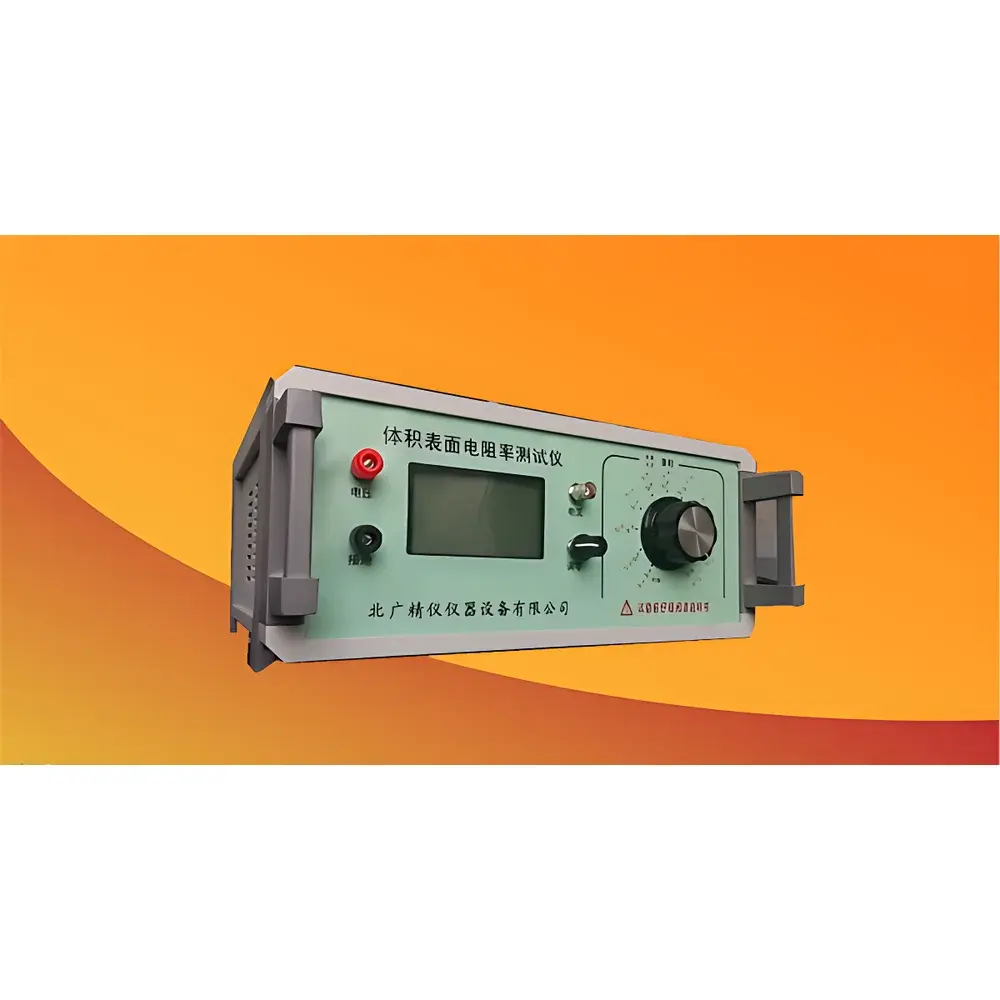
Beijing North Guang Precision Instruments BV-212 High-Insulation Resistance & Volume Resistivity Tester
| Key | Brand: Beijing North Guang Precision Instruments |
|---|---|
| Model | BV-212 |
| Origin | Beijing, China |
| Manufacturer Type | OEM Manufacturer |
| Voltage Range | 10–1000 V (6 discrete settings) |
| Resistance Range | 1×10⁴ Ω to 1×10¹⁸ Ω |
| Current Measurement Range | 2×10⁻⁴ A to 1×10⁻¹⁶ A |
| Basic Accuracy | ±1% of reading |
| Display | Dual 3½-digit LED meters |
| Power Supply | AC 220 V, 50 Hz, ~5 W |
| Dimensions | 285 × 245 × 120 mm |
| Weight | ~2.5 kg |
| Compliance | GB/T 1410–2006, ASTM D257, GB/T 20991–2007, GB 4385–1995, GJB 3007A–2009 |
Overview
The Beijing North Guang Precision Instruments BV-212 High-Insulation Resistance & Volume Resistivity Tester is a precision digital electrometer engineered for accurate, stable, and traceable measurement of extremely high electrical resistance and resistivity in solid, powdered, and liquid dielectric materials. Based on the constant-voltage (DC) method per IEC 62631-3-1 and ASTM D257, the instrument applies a calibrated, selectable DC test voltage (10 V to 1000 V) across a defined electrode geometry and measures the resulting leakage current with sub-femtoamp sensitivity. Its 14-decade resistance range (1×10⁴ Ω to 1×10¹⁸ Ω) and current resolution down to 1×10⁻¹⁶ A enable reliable characterization of ultra-high-resistivity insulators—such as polyimide films, ceramic substrates, optical-grade quartz, epoxy encapsulants, and antistatic polymer composites—under controlled environmental conditions (0–40 °C, <80% RH). The dual 3½-digit LED display simultaneously shows resistance (in Ω or derived resistivity in Ω·m) and applied voltage or measured current, supporting real-time verification of measurement integrity.
Key Features
- Ultra-wide resistance measurement range: 1×10⁴ Ω to 1×10¹⁸ Ω with ±1% basic accuracy, verified per ISO/IEC 17025-accredited calibration procedures.
- Programmable DC test voltages: six discrete outputs (10 V, 50 V, 100 V, 250 V, 500 V, 1000 V), each internally regulated and monitored for stability within ±0.5%.
- Femtoampere-class current measurement: full-scale range from 2×10⁻⁴ A to 1×10⁻¹⁶ A, achieved via low-noise, guarded electrometer circuitry with active shielding and triaxial input architecture.
- Dual-parameter LED readout: independent 3½-digit displays for resistance/resistivity and either applied voltage or measured current—enabling immediate cross-verification without mode switching.
- Modular electrode compatibility: supports standardized guarded-ring electrodes (per ASTM D257 Annex A2), parallel-plate cells for powders, liquid immersion cells, and custom fixtures for thin films or irregular geometries.
- Low-power, laboratory-grade design: 5 W typical consumption, compact footprint (285 × 245 × 120 mm), and EMI-hardened chassis for operation in shared instrumentation environments.
Sample Compatibility & Compliance
The BV-212 is validated for use with electrically insulating and static-dissipative materials across industrial and research domains. It accommodates solids (e.g., PCB laminates, elastomeric gaskets), powders (e.g., carbon-black-loaded polymers, ceramic precursors), and liquids (e.g., transformer oils, silicone dielectrics) when paired with appropriate electrode configurations. All measurements adhere to internationally recognized standards including GB/T 1410–2006 (equivalent to IEC 62631-3-1), ASTM D257–22, and GJB 3007A–2009 for electrostatic control in defense electronics. The instrument’s voltage sourcing and current sensing architecture meets the metrological requirements for GLP-compliant resistivity reporting, and its stable output enables repeatable testing under ISO 17025 audit conditions. Environmental operating limits (0–40 °C, <80% RH non-condensing) align with standard laboratory accreditation criteria.
Software & Data Management
While the BV-212 operates as a standalone benchtop instrument, its analog output (0–2 V proportional to log₁₀(resistance)) and TTL-compatible trigger interface allow integration into automated test systems using third-party DAQ hardware (e.g., National Instruments PXI or Keysight 34970A). Raw resistance and current values can be logged via external digitizers with timestamping for full 21 CFR Part 11–compliant data archiving when deployed in regulated QC labs. The built-in dual-display architecture eliminates dependency on proprietary software, reducing validation overhead in GMP environments. Calibration certificates—including as-found/as-left data, uncertainty budgets (k=2), and traceability to NIM (National Institute of Metrology, China)—are supplied with each unit and conform to ILAC-MRA mutual recognition arrangements.
Applications
- Quality assurance of ESD-safe flooring, workbenches, and footwear per GB/T 20991–2007 and GB 4385–1995.
- Volume resistivity mapping of polymer electrolytes and solid-state battery separators for R&D reproducibility studies.
- Surface resistivity screening of cleanroom garments, antistatic textiles, and semiconductor handling trays per GB/T 22042–2008.
- Dielectric integrity verification of aerospace-grade potting compounds and radome coatings.
- Leakage current analysis of photodetectors and low-dark-current optoelectronic devices (e.g., SiPMs, APDs).
- Material qualification for high-voltage insulation systems in power electronics and EV traction inverters.
FAQ
What electrode configurations are supported for powder resistivity measurement?
The BV-212 is compatible with ASTM D7262-compliant cylindrical powder cells featuring upper/lower compression electrodes and guard rings. Custom cell designs can be validated upon request.
Is the instrument suitable for compliance testing per IEC 61340-2-3?
Yes—when used with certified guarded electrodes and documented environmental controls, it satisfies the resistance measurement requirements for ESD protective materials per IEC 61340-2-3 Annex B.
Can the BV-212 perform timed-resistivity sweeps (e.g., 15 s / 60 s / 600 s)?
Manual timing is supported via the front-panel voltage activation switch; automated sweep logging requires external DAQ synchronization using the TTL trigger output.
Does the instrument include factory calibration documentation?
Each unit ships with a NIM-traceable calibration certificate listing measurement points, uncertainties, and environmental conditions at time of calibration.
What maintenance is required to sustain measurement accuracy?
Annual recalibration is recommended; routine cleaning of electrode contacts with anhydrous ethanol and periodic verification using certified high-value resistors (e.g., 10¹² Ω, 10¹⁴ Ω) are sufficient for lab-level confidence.



