
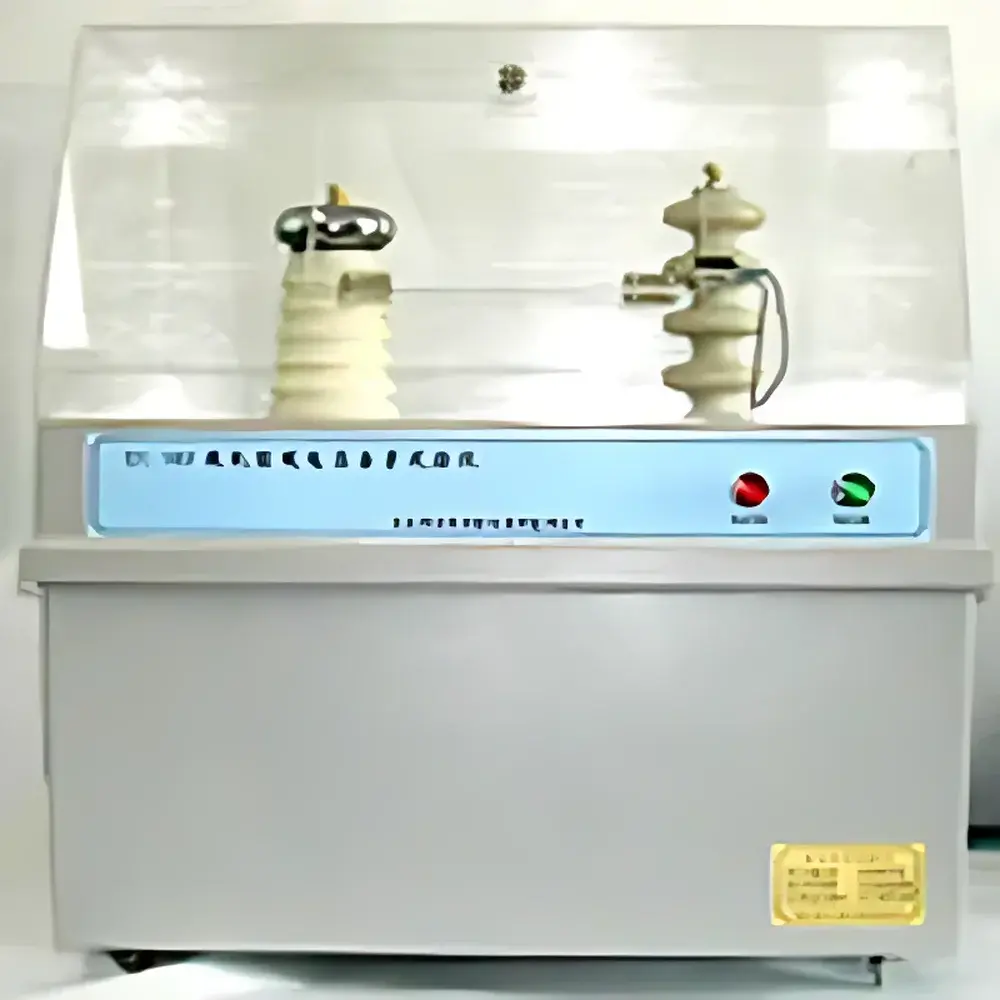
North Guangjing Precision BDJC-50KV DC/AC Dielectric Breakdown Tester
| Brand | North Guangjing Precision Instrument |
|---|---|
| Origin | Beijing, China |
| Manufacturer Type | OEM Manufacturer |
| Model | BDJC-50KV |
| Output Voltage | AC 0–50 kV / DC 0–70 kV |
| Power Capacity | 3 kVA |
| Voltage Accuracy | ≤1% |
| Rise Rate Options | 100–3000 V/s (adjustable) |
| Electrode Configurations | Ø25 mm & Ø75 mm disc electrodes |
| Safety Protection | 9-level interlock system (overvoltage, overcurrent, short-circuit, safety-door, software fault, zero-voltage reset, post-test discharge, independent grounding, resin-based discharge rod) |
| Test Modes | AC/DC dielectric strength, withstand voltage, stepwise ramp test |
| Compliance Standards | GB/T 1408.1–2006, GB/T 1695–2005, GB/T 3333, HG/T 3330, GB 12656, ASTM D149 |
| Software Platform | Windows-based control interface with real-time curve plotting, Excel export, user management, multi-sample batch testing (up to 5 specimens per run), and configurable test duration (0–6 h) |
Overview
The North Guangjing Precision BDJC-50KV DC/AC Dielectric Breakdown Tester is an engineered solution for determining the dielectric strength and voltage withstand capability of solid insulating materials under standardized industrial power frequency (50/60 Hz) or direct current conditions. It operates on the principle of controlled voltage ramping until electrical breakdown occurs—defined as the point at which a material transitions from insulator to conductor under applied electric stress. This transition is detected via rapid current surge monitoring, triggering immediate voltage termination and data capture. Designed for laboratories conducting quality control, R&D, and regulatory compliance testing in polymer science, electrical insulation manufacturing, and component validation, the instrument meets stringent requirements for reproducibility, traceability, and operational safety across global standards including ASTM D149 and GB/T 1408.1.
Key Features
- True dual-mode operation: Independent AC (0–50 kV) and DC (0–70 kV) high-voltage output with full-range continuous adjustment—eliminating segmented voltage grading common in legacy systems.
- Precision-controlled rise rate: Six selectable linear ramp rates (100, 200, 500, 1000, 2500, 3000 V/s), implemented via servo-motor-driven mechanical regulation—ensuring compliance with both slow-ramp (e.g., GB/T 1408 Annex A) and fast-ramp (ASTM D149 Method B) protocols.
- Digital real-time acquisition: High-fidelity sampling of leakage current and applied voltage enables millisecond-level detection of breakdown onset, with automatic shutdown (<0.05 s response time) and zero-voltage reset to prevent residual charge hazards.
- Multi-specimen efficiency: Supports up to five pre-conditioned samples per test sequence—significantly improving throughput versus single-sample architectures.
- Nine-tier hardware and software interlock system: Includes overvoltage cutoff, overcurrent interruption, short-circuit isolation, safety-door microswitch actuation, software-level command validation, mandatory zero-voltage reinitialization before restart, post-test passive discharge (resin-core discharge rod), dedicated earth-ground terminal, and electromagnetic interference (EMI)-shielded discharge path.
- Touchscreen-integrated Windows control platform: Enables intuitive configuration of test parameters, dynamic waveform visualization, customizable report templates, role-based user access control, and audit-ready data logging compliant with GLP principles.
Sample Compatibility & Compliance
The BDJC-50KV accommodates a broad spectrum of dielectric solids used across electronics, energy, aerospace, and automotive sectors—including thermoplastics (e.g., polyethylene, PTFE), elastomers (silicone rubber, EPDM), laminates (G10/FR4), thin films (<1 mm), ceramic substrates, glass insulators, varnish-coated windings, and paper-based capacitor dielectrics. Its electrode suite comprises standardized disc electrodes (Ø25 mm and Ø75 mm per IEC 60243-1), tubular fixtures for cylindrical specimens, and optional custom geometries for non-standard components. The system fully supports test methodologies defined in GB/T 1408.1–2006 (equivalent to IEC 60243-1), ASTM D149, GB/T 1695–2005 (for vulcanized rubber), GB/T 3333 (cable paper), HG/T 3330 (insulating varnish), and GB 12656 (capacitor paper). All voltage measurements are traceable to national metrological standards, with ≤1% full-scale accuracy verified annually per ISO/IEC 17025 guidelines.
Software & Data Management
The embedded Windows-based application provides full lifecycle test management—from parameter definition and specimen assignment to statistical analysis and regulatory reporting. Real-time voltage–time and current–time curves are rendered during execution, enabling visual confirmation of pre-breakdown conduction behavior. Post-test, raw datasets (including timestamped voltage, current, ramp rate, and breakdown event markers) are stored in binary format with SHA-256 checksum integrity verification. Export functions support CSV and native Excel (.xlsx) formats for third-party statistical processing. Reports include operator ID, calibration certificate reference, environmental conditions (optional external sensor integration), pass/fail status per selected standard clause, and digital signature fields. Audit trails record all user actions—including parameter edits, test starts/stops, and data exports—with immutable timestamps aligned to NTP-synchronized system clocks. The architecture satisfies foundational requirements for FDA 21 CFR Part 11 compliance when deployed with validated domain authentication and electronic signature workflows.
Applications
- Quality assurance of polymer extrusions and molded insulators prior to high-voltage equipment assembly.
- Material qualification for EV battery pack separators and busbar encapsulation compounds.
- Comparative evaluation of aging effects on silicone rubber housing under thermal–electrical stress cycling.
- Validation of conformal coating integrity on printed circuit boards (PCBs) subjected to humidity and contamination exposure.
- Development testing of nanocomposite dielectrics for next-generation power capacitors.
- Regulatory submission support for UL, CE, and CCC certification dossiers requiring documented dielectric performance evidence.
FAQ
What voltage ranges does the BDJC-50KV support for AC and DC testing?
The instrument delivers AC output from 0 to 50 kV RMS and DC output from 0 to 70 kV, both continuously adjustable without range switching or manual recalibration.
Does the system meet international regulatory requirements for data integrity?
Yes—the software implements role-based access control, tamper-evident audit logs, electronic signatures, and exportable raw data files compatible with 21 CFR Part 11 and EU Annex 11 validation frameworks when configured with enterprise IT infrastructure.
Can the tester accommodate non-standard electrode configurations?
While standard disc and tubular electrodes are included, North Guangjing Precision offers OEM engineering services to design and validate custom electrode sets for specialized geometries or industry-specific test fixtures.
How is electrical safety ensured during and after breakdown events?
A redundant nine-layer protection architecture ensures sub-50 ms power cutoff upon fault detection, followed by active grounding and passive resin-core discharge—preventing hazardous residual voltage accumulation or EMI-induced measurement artifacts.
Is remote operation or network integration supported?
The system includes Ethernet and RS-232 interfaces for SCADA integration, automated test sequencing via LabVIEW or Python APIs, and centralized fleet monitoring through optional cloud-connected gateway modules.



