
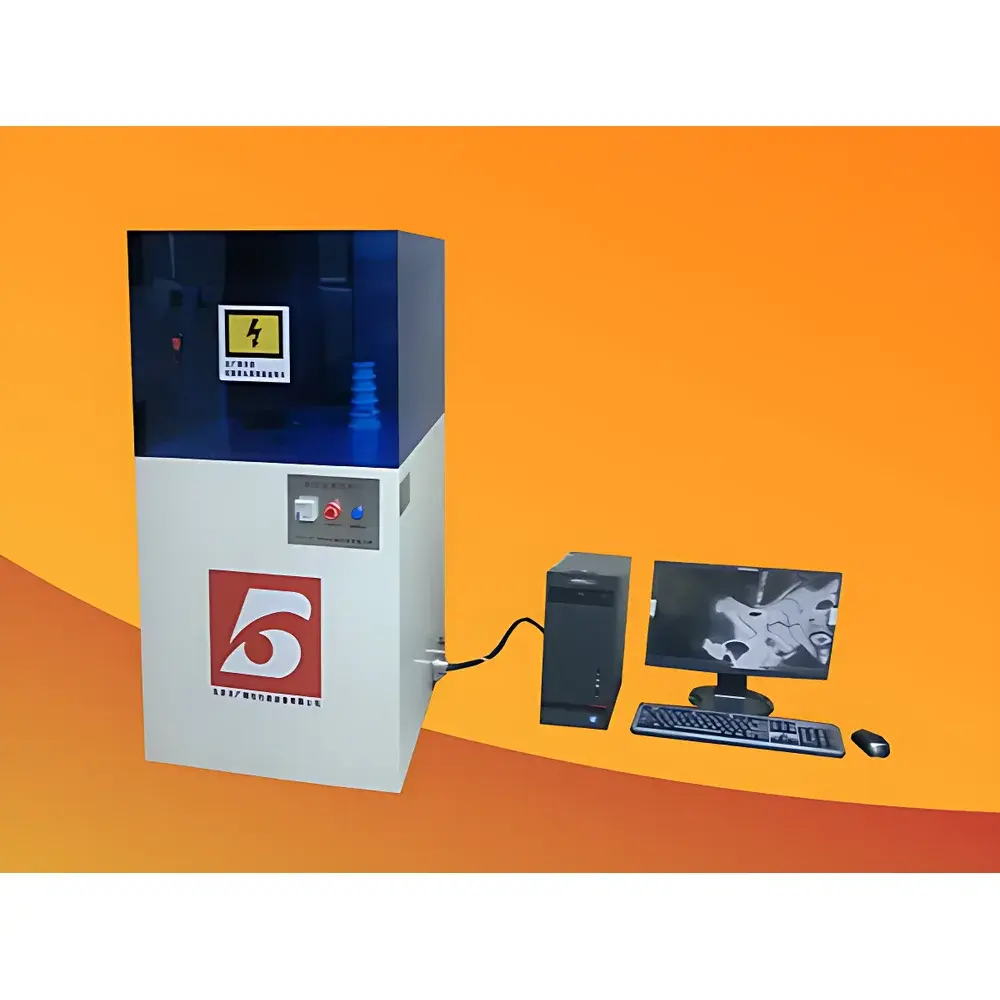
Beiguang 50 kV Dielectric Withstand & Breakdown Tester
| Brand | Beiguang Precision Instrument |
|---|---|
| Origin | Beijing, China |
| Manufacturer Type | OEM Manufacturer |
| Voltage Output | AC/DC 0–50 kV (continuously adjustable up to 100 kV) |
| Power Capacity | 10 kVA |
| Voltage Accuracy | ≤ ±1% |
| Rise Rate | 0.1–5.0 kV/s (user-programmable) |
| Test Modes | AC/DC stepwise ramp, constant-rate ramp, and hold (withstand) testing |
| Protection | Overcurrent cutoff ≤ 0.05 s, dual-level fault alarm (HMI + embedded controller) |
| Electrode Media | Air or insulating oil |
| Compliance | Meets ASTM D149, IEC 60243-1, GB/T 1408.1, and ISO 60243-1 requirements |
| Calibration | Traceable to national metrology institutes (CNAS-accredited certificates available) |
Overview
The Beiguang 50 kV Dielectric Withstand & Breakdown Tester is an engineered high-voltage test system designed for precise evaluation of electrical insulation integrity in solid dielectric materials under standardized AC and DC stress conditions. Based on the principle of controlled voltage escalation until dielectric failure occurs—either via bulk breakdown or surface flashover—the instrument quantifies key performance parameters including dielectric strength (kV/mm), breakdown voltage (kV), and withstand capability (kV @ specified duration). Its dual-mode architecture supports both sinusoidal AC (50 Hz) and pulsating DC output, enabling compliance with international test standards governing insulating materials used in power transmission, electronics encapsulation, aerospace composites, and high-reliability medical devices. The system integrates a robust 10 kVA transformer stage, digitally regulated voltage control, real-time current monitoring down to milliampere resolution, and automatic circuit interruption upon breakdown detection—ensuring repeatability, operator safety, and regulatory traceability.
Key Features
- Programmable voltage rise rate (0.1–5.0 kV/s), fully compliant with ASTM D149 Section 7.3 and IEC 60243-1 Clause 8.2 for controlled stress application
- Dual-output architecture: AC output directly from high-voltage transformer; DC output achieved via integrated silicon rectifier stack with mechanical shorting rod for mode switching—no external conversion hardware required
- Real-time acquisition of breakdown current (mA-level resolution) synchronized with voltage waveform sampling at ≥10 kHz, supporting post-event analysis of pre-breakdown discharge activity
- Redundant overcurrent protection: Embedded microcontroller triggers main contactor disengagement within ≤50 ms upon threshold exceedance, supplemented by independent hardware-based trip circuit
- Integrated dual-alarm system: Visual/audio alerts on HMI interface plus dedicated LED indicators on front panel for immediate status feedback during interlock breaches or grounding faults
- Full compliance with Class I electrical safety per IEC 61010-1:2010, including interlocked enclosure, HV equalizing sphere grounding protocol, and mandatory discharge verification sequence prior to chamber access
Sample Compatibility & Compliance
The tester accommodates flat, rigid, or flexible solid dielectrics conforming to standard electrode configurations defined in ASTM D149 and IEC 60243-1—including disk, plaque, and sheet geometries. Compatible material classes include thermoset resins (epoxy, phenolic), thermoplastics (polyimide, PTFE), ceramic substrates, glass laminates, impregnated fiber composites (e.g., FR-4), and elastomeric insulators (silicone rubber, EPDM). Testing may be performed in ambient air or dielectric oil (e.g., ASTM D877-compliant mineral oil), with optional environmental chambers (not included) for temperature/humidity-controlled trials. All operational protocols align with GLP documentation requirements: audit trails log user ID, timestamp, test parameters, raw voltage/current traces, and pass/fail determinations. Calibration certificates are issued by CNAS-accredited laboratories and reference NIM (National Institute of Metrology, China) standards—fully acceptable for ISO/IEC 17025-accredited QA labs.
Software & Data Management
The proprietary Windows-based control software provides full IEC 61508 SIL1-compliant operation, supporting test method definition, parameter scripting, real-time waveform visualization, and automated report generation in PDF/CSV formats. Each test record includes metadata such as sample ID, electrode type (e.g., brass disk, 25 mm diameter), ambient conditions (temperature, humidity, pressure), and calibration validity status. Data export conforms to ASTM E1447 requirements for digital archiving, with optional integration into LIMS platforms via OPC UA or Modbus TCP. Software enforces 21 CFR Part 11-compliant electronic signatures, role-based access control, and immutable audit logs—including all parameter modifications, manual overrides, and calibration events. Raw binary data files retain full temporal resolution for forensic reanalysis of transient conduction behavior preceding breakdown.
Applications
This system serves quality assurance, R&D, and regulatory validation workflows across multiple sectors: qualification of insulating varnishes and potting compounds in motor windings (IEC 60034-18-41); comparative assessment of polymer film dielectric strength for capacitor manufacturing (IEC 60674-2); accelerated aging studies of composite bushings under combined thermal-electrical stress (IEEE C57.19.00); screening of nanocomposite fillers for enhanced tracking resistance (ASTM D2303); and certification of medical device housings per IEC 60601-1 Clause 8.8.1. It is routinely deployed in third-party testing laboratories (e.g., Guangdong Quality Supervision Institute, SGS Shanghai), university materials science departments (Tsinghua University, University of Science and Technology of China), and Tier-1 suppliers to grid infrastructure OEMs (e.g., China General Nuclear, State Grid Corporation).
FAQ
What standards does this instrument support?
It meets ASTM D149, IEC 60243-1, GB/T 1408.1, ISO 60243-1, and IEEE 930 for dielectric breakdown and withstand testing.
Can it perform both AC and DC tests without hardware modification?
Yes—mode selection is achieved via mechanical insertion/removal of the shorting rod in the HV tower and corresponding software configuration; no external rectifiers or inverters are required.
Is the 100 kV maximum voltage rating continuous or peak?
The 100 kV specification refers to the upper limit of the continuously adjustable output range; rated continuous operation is validated at 50 kV RMS (AC) or 50 kV DC average, per EN 61000-4-5 surge immunity class.
How is measurement traceability ensured?
Each unit ships with a factory calibration certificate traceable to NIM (China National Institute of Metrology); optional on-site recalibration by CNAS-accredited providers is available.
Does the system support automated electrode cleaning or conditioning cycles?
No—electrode maintenance (cleaning, polishing, defect inspection) remains a manual procedure per ASTM D149 Section 6.2; automated routines are not implemented due to material-specific surface preparation requirements.





