
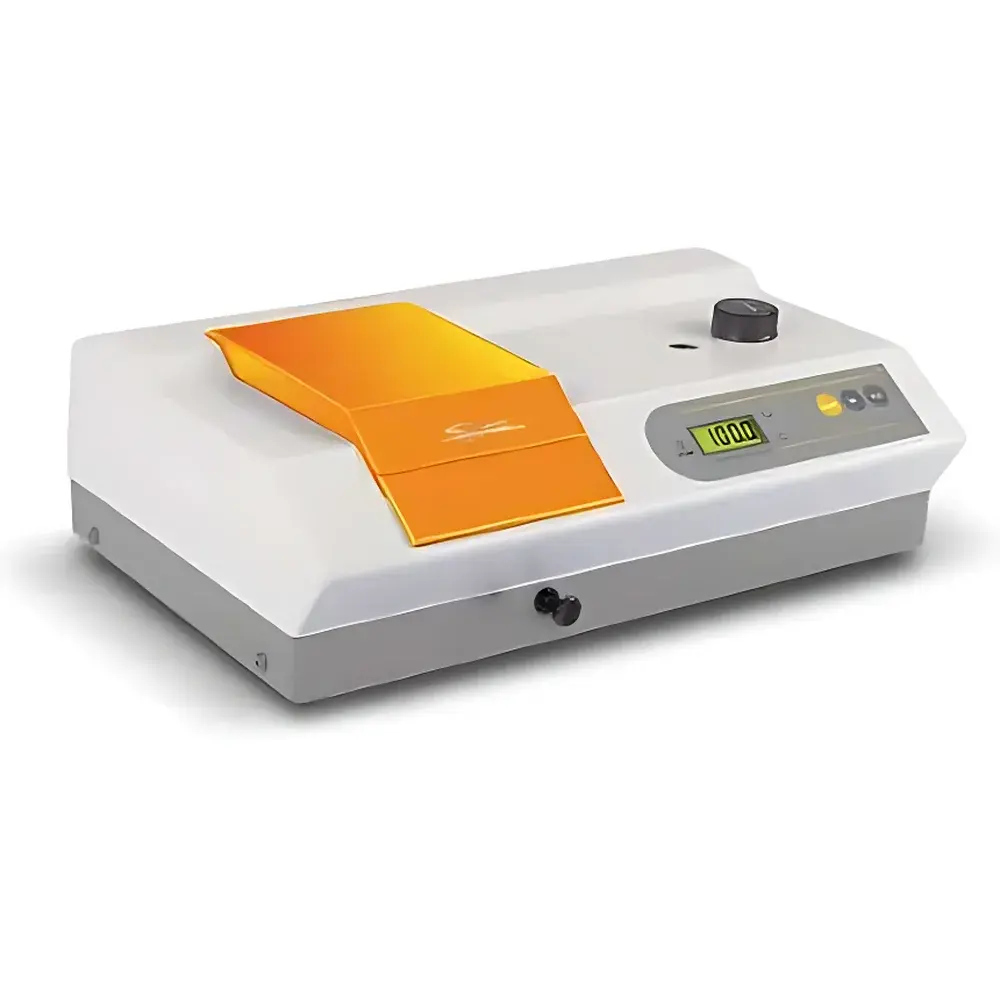
Shanghai Spectrum SP-722 Visible Spectrophotometer
| Brand | Shanghai Spectrum |
|---|---|
| Origin | Shanghai, China |
| Model | SP-722 |
| Optical System | Single-beam |
| Detector | Photocell |
| Wavelength Range | 325–1000 nm |
| Wavelength Accuracy | ±2 nm |
| Spectral Bandwidth | 5 nm |
| Stray Light | ≤0.5% T |
| Wavelength Adjustment | Manual |
| Compliance | CE-marked for laboratory use in accordance with IEC 61010-1 |
| Data Interface | RS-232 (optional USB adapter available) |
Overview
The Shanghai Spectrum SP-722 Visible Spectrophotometer is a robust, single-beam optical instrument engineered for quantitative absorption measurements in the visible spectrum (325–1000 nm). It operates on the fundamental principle of Beer–Lambert law-based photometry, where sample absorbance is determined by measuring the intensity of monochromatic light before and after transmission through a cuvette. Designed with a fixed 100 mm optical path length, the SP-722 enhances sensitivity for low-concentration analytes—particularly advantageous in environmental water analysis, food quality control, and industrial effluent monitoring. Its manually tuned wavelength selection, combined with a 5 nm spectral bandwidth and ±2 nm wavelength accuracy, ensures reproducible results across routine analytical workflows. The instrument complies with core safety and electromagnetic compatibility standards (IEC 61010-1) and supports traceable calibration practices aligned with ISO/IEC 17025 requirements for non-accredited laboratories.
Key Features
- Single-beam optical architecture optimized for stability and cost-effective operation in teaching and routine QC environments
- Extended 100 mm light path enables improved detection limits for dilute samples—ideal for COD, nitrate, phosphate, and colorimetric assays in wastewater
- Photocell detector delivers consistent linearity over 0–100% transmittance (T) and 0–2.0 absorbance (A) ranges
- Manual wavelength adjustment via calibrated dial with vernier scale; resolution sufficient for standard colorimetric methods (e.g., APHA color, iron phenanthroline)
- Low stray light performance (≤0.5% T at 360 nm) minimizes spectral interference in high-absorbance measurements
- RS-232 serial interface allows integration with external PCs for data logging, statistical reporting, and compliance-ready recordkeeping
Sample Compatibility & Compliance
The SP-722 accepts standard 10 mm or optional 100 mm rectangular quartz or glass cuvettes (10 × 10 × 45 mm or 10 × 100 × 45 mm), supporting both aqueous and mildly organic solvent-based samples. It is routinely deployed in applications governed by ASTM D1209 (APHA color), ASTM D3862 (nitrate-nitrogen), and ISO 6060 (chemical oxygen demand). While not FDA 21 CFR Part 11–compliant out-of-the-box, its RS-232 output permits integration into validated LIMS or ELN systems where audit trails and electronic signatures are implemented at the software layer. The instrument meets general GLP documentation expectations for raw data capture when paired with timestamped PC-based acquisition.
Software & Data Management
The SP-722 does not include embedded firmware-based data processing; instead, it relies on host PC software (supplied separately or developed in-house) to acquire absorbance/transmittance values via ASCII protocol over RS-232. Compatible software packages support batch data export to CSV, Excel-compatible formats, and basic statistical functions—including mean, SD, CV%, linear regression for calibration curves, and tabular report generation. Users may configure automated pass/fail thresholds against specification limits—a common requirement in sugar refinery Brix verification or electroplating bath metal concentration checks. All acquired datasets retain instrument metadata (wavelength, date/time stamp, operator ID if entered) to support internal QA review.
Applications
- Environmental monitoring: Quantification of heavy metals (e.g., Cr(VI) via diphenylcarbazide), nutrients (phosphate, nitrate), and organic pollutants (COD, TOC surrogates) in surface water, effluent, and drinking water
- Food & beverage QA: Color assessment (browning index, anthocyanin content), sugar concentration (via refractive index correlation), and additive verification (e.g., nitrite in cured meats)
- Industrial process control: Monitoring dye concentrations in textile effluents, chloride levels in boiler feedwater, and chromate content in anodizing baths
- Academic instruction: Teaching spectroscopic fundamentals, calibration curve construction, and method validation principles in undergraduate chemistry and environmental science labs
FAQ
Does the SP-722 support automatic wavelength scanning?
No—the SP-722 features manual wavelength selection only. It is not equipped with a motorized grating or scanning mechanism.
Can the instrument be used with plastic cuvettes?
Yes, for wavelengths above ~350 nm; however, optical-grade glass or fused silica cuvettes are recommended for long-term stability and minimal autofluorescence.
Is NIST-traceable calibration available for this model?
Shanghai Spectrum provides factory calibration certificates with reference to national standards (GB/T 21186–2007); users may obtain third-party NIST-traceable verification through accredited metrology labs.
What is the typical warm-up time required before measurement?
A minimum 15-minute stabilization period is recommended following power-on to ensure thermal equilibrium of the tungsten-halogen lamp and photocell detector.
How is wavelength accuracy verified during routine maintenance?
Users may validate wavelength accuracy using certified holmium oxide or didymium glass filters, which exhibit sharp absorption peaks at known wavelengths (e.g., 361.0, 418.5, 480.0, 536.2 nm).





