
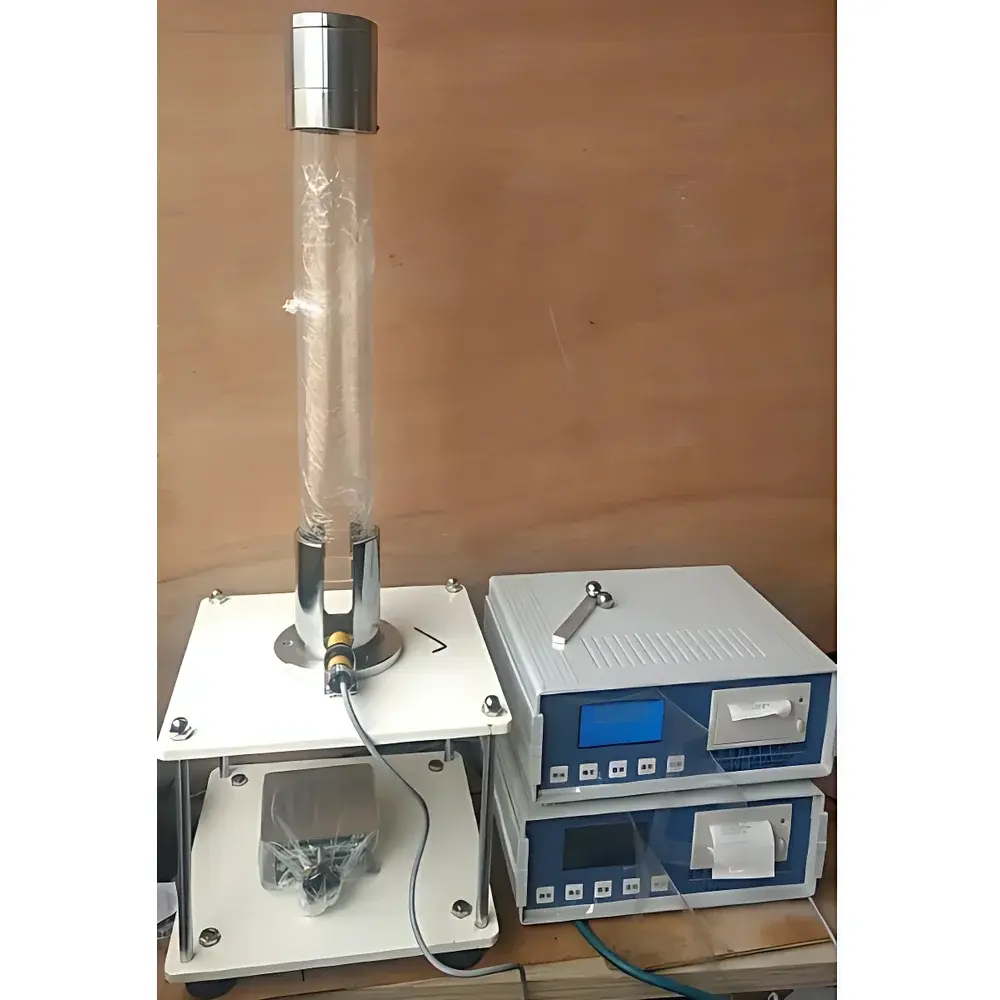
North Guangjingyi HMLQ-500 Foam Ball Rebound Tester with LCD Display
| Brand | North Guangjingyi / All Precision Instrument |
|---|---|
| Origin | Beijing, China |
| Manufacturer Type | Direct Manufacturer |
| Country of Origin | Domestic (China) |
| Model | HMLQ-500 |
| Price | USD 980 (converted from ¥7,000 at 1 USD = ¥7.14) |
| Standard Compliance | GB/T 6670–2008, ISO 8307, ASTM D3574 |
| Test Method Options | Method A (ASTM/ISO): Drop height 500 ± 0.5 mm, ball mass 16.8 ± 1.5 g, ball diameter Ø16.0 mm |
| Method B (GB/T) | Drop height 460 ± 0.5 mm, ball mass 16.3 ± 1.5 g, ball diameter Ø16 − 0.05 mm |
| Rebound Accuracy | < ±1.5% |
| Specimen Dimensions | 100 mm × 100 mm × 50 mm (rectangular, parallel surfaces, skin-free) |
| Display | 65,535-color TFT LCD touchscreen (≥7-inch diagonal), Chinese UI with voice prompts |
| Data Output | Built-in thermal micro-printer |
| Control Logic | Embedded microprocessor |
| Sensor System | High-resolution optical encoder array for precise impact and rebound height detection |
| Mechanical Features | Dual release mechanisms (manual + motorized auto-release), ball capture chamber, precision height adjustment stage, integrated bubble-level calibration system |
| Dimensions (L×W×H) | 370 × 245 × 660 mm |
| Weight | 20 kg |
| Power Supply | 220 V AC, 50 Hz |
Overview
The North Guangjingyi HMLQ-500 Foam Ball Rebound Tester is an engineered instrument designed for the quantitative assessment of elastic recovery behavior in flexible polymeric foam materials—primarily soft polyurethane (PU) foams, viscoelastic memory foams, and open-cell sponge elastomers. It operates on the principle of standardized free-fall impact dynamics: a calibrated steel sphere is released from a precisely controlled height onto a horizontally positioned specimen, and the maximum rebound height is optically measured. The rebound ratio—calculated as (maximum rebound height ÷ drop height) × 100%—serves as a dimensionless metric of instantaneous resilience under transient compressive loading. This method is fundamentally governed by energy dissipation mechanisms including viscous damping, internal friction, and structural hysteresis within the cellular matrix. The HMLQ-500 implements both Method A (aligned with ASTM D3574 and ISO 8307) and Method B (fully compliant with GB/T 6670–2008), enabling cross-regional comparability in QC labs, R&D centers, and third-party certification facilities.
Key Features
- Embedded microprocessor control architecture ensuring repeatable execution of standardized test sequences per GB/T 6670–2008, ISO 8307, and ASTM D3574 protocols.
- 7-inch full-color TFT LCD touchscreen interface with intuitive Chinese-language navigation, real-time status feedback, and voice-guided operation for reduced operator dependency.
- Dual-mode release mechanism: one manually actuated lever and one motor-driven electromagnetic release—enabling both verification checks and high-throughput batch testing.
- High-precision optical height sensing system utilizing synchronized photogate arrays to capture impact initiation and apex rebound position with sub-millimeter resolution.
- Integrated thermal micro-printer for immediate hard-copy documentation of test ID, specimen code, drop height, rebound height, rebound percentage, timestamp, and operator ID.
- USB-host interface supporting direct data export to USB flash drives in CSV format—compatible with LIMS, Excel, and statistical process control (SPC) software.
- Field-upgradable firmware via USB or remote maintenance port—ensuring long-term compliance with evolving regulatory or methodological revisions.
- Onboard data storage for ≥1,000 test records with time/date stamping, traceable to individual specimens and operators—supporting GLP-aligned audit trails.
- Modular mechanical design with adjustable base leveling feet, captive ball containment chamber, and precision vertical height calibration scale.
Sample Compatibility & Compliance
The HMLQ-500 is validated for use with homogeneous, skin-free, rectangular foam specimens measuring exactly 100 mm × 100 mm × 50 mm. Specimens must exhibit parallel top/bottom surfaces and be preconditioned per ISO 293, ISO 2936, or GB/T 2918 (23 °C ± 2 °C, 50% RH ± 5%, ≥16 h). The instrument supports both Method A (500 mm drop, 16.8 g ball) and Method B (460 mm drop, 16.3 g ball), facilitating harmonized reporting across domestic and international quality systems. All mechanical and electronic subsystems conform to IEC 61000-4 electromagnetic compatibility requirements. The test methodology satisfies clause 6.2 of ISO 8307:2019 (“Determination of resilience by ball rebound”) and Section 7 of ASTM D3574–22 (“Standard Test Methods for Flexible Cellular Materials—Slab, Bonded, and Molded Urethane Foams”). Data integrity features—including user authentication, immutable timestamps, and export-locked raw datasets—align with basic FDA 21 CFR Part 11 readiness for regulated environments.
Software & Data Management
The embedded operating system provides role-based access control (operator, supervisor, administrator) and maintains a local relational database indexed by test ID, date, material lot number, and operator code. Each record stores raw photogate timing data, calculated rebound ratio, pass/fail flag against configurable acceptance thresholds (e.g., ≥55% for automotive seating foams), and digital signature metadata. Exported CSV files contain column headers compliant with ASTM E1382–21 (Standard Guide for Computerizing Analytical Data). No cloud connectivity or external network dependencies are implemented—ensuring data sovereignty and firewall-compliant deployment in secure lab networks. Firmware updates preserve historical calibration coefficients and do not reset audit logs.
Applications
This instrument is routinely deployed in polymer formulation labs to correlate chemical crosslink density with macroscopic resilience; in automotive Tier-1 supplier QA labs for incoming inspection of seat cushioning foams; in mattress manufacturing for batch consistency monitoring of HR (high-resilience) and memory foam variants; and in academic polymer physics research investigating strain-rate dependence of viscoelastic recovery. It also supports comparative analysis between virgin and recycled PU foam blends, flame-retardant additive effects on rebound kinetics, and aging studies (post-thermal cycling or UV exposure). While not intended for closed-cell rigid foams or elastomeric gels, its repeatability (RSD < 1.2% across n=10 replicates on homogeneous reference foam) meets ISO 5725-2 precision criteria for intermediate precision.
FAQ
What standards does the HMLQ-500 fully support?
It complies with GB/T 6670–2008 (Method B), ISO 8307:2019 (Clause 6.2), and ASTM D3574–22 (Section 7) for ball rebound testing of flexible cellular polymeric materials.
Can test parameters be modified during a running sequence?
Yes—the touchscreen interface allows real-time adjustment of drop height, number of impacts per specimen, delay between impacts, and pass/fail thresholds without interrupting hardware initialization.
Is calibration traceable to national metrology institutes?
The optical height measurement subsystem is factory-calibrated using NIST-traceable laser interferometry; users receive a certificate of calibration with uncertainty budget (k=2) upon shipment.
How is specimen alignment verified before testing?
An integrated spirit-level vial and adjustable leveling feet ensure horizontal orientation; the test platen includes engraved centering guides and a removable alignment jig for consistent 100 mm × 100 mm placement.
Does the system support automated reporting for ISO/IEC 17025 accreditation?
Yes—exported CSV files include all raw sensor timestamps, calculated values, environmental conditions (if externally logged), and operator credentials, satisfying Clause 7.8.2.2 of ISO/IEC 17025:2017 for result reporting integrity.



