
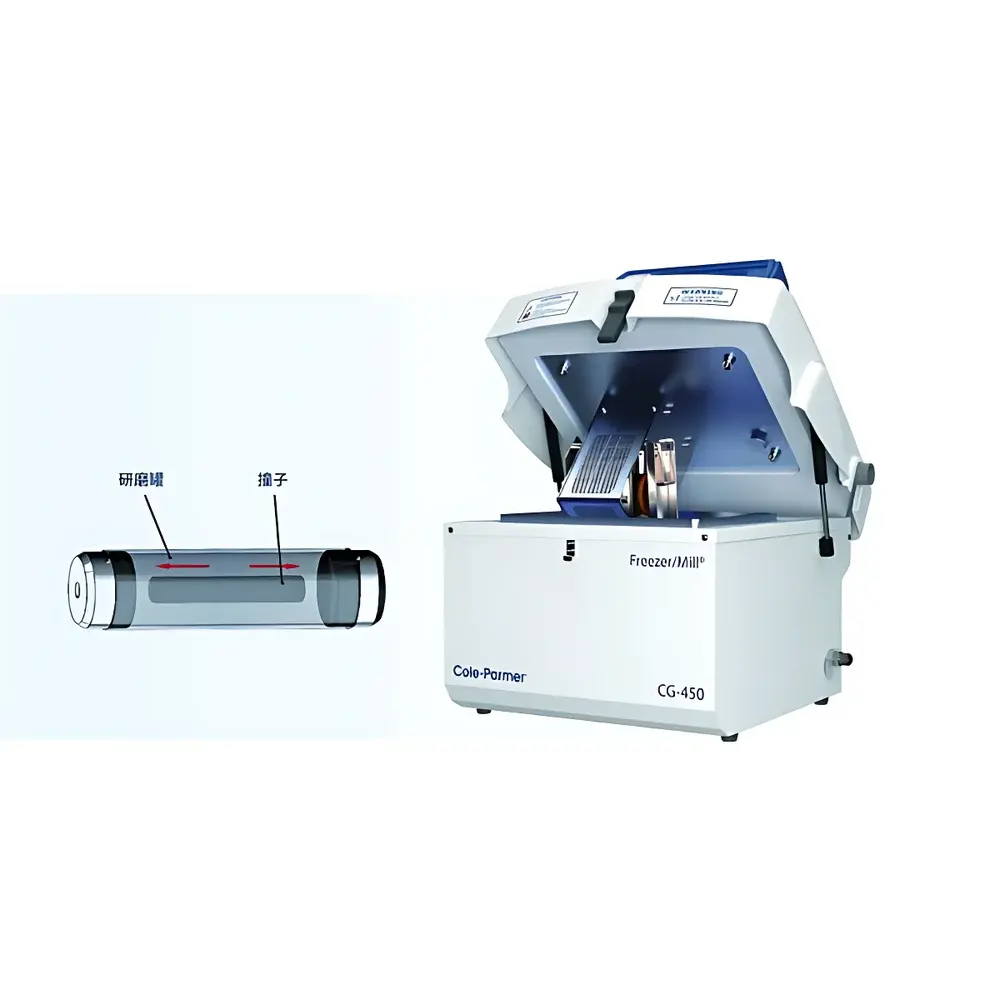
Cole-Parmer Freezer/Mill® CG-200 Cryogenic Grinder
| Brand | Cole-Parmer |
|---|---|
| Origin | USA |
| Manufacturer Type | Authorized Distributor |
| Product Origin | Imported |
| Model | CG-200 |
| Instrument Type | Cryogenic Grinder |
| Sample Compatibility | Frozen & Temperature-Sensitive Materials |
| Drive Mechanism | Electromagnetic Impact Pin System |
| Control Interface | Full-Touchscreen Programmable Controller |
| Safety Features | Liquid Nitrogen Level Sensor with Auto-Shutoff & Refill Interlock |
| Precooling Chamber | Integrated |
| Compliance | Designed for GLP/GMP-Compliant Labs, Compatible with ASTM E2918 and ISO 13320 Sample Preparation Protocols |
Overview
The Cole-Parmer Freezer/Mill® CG-200 is a high-performance cryogenic grinder engineered for reproducible, ultra-low-temperature sample pulverization. Based on the proprietary electromagnetic impact pin technology originally developed by SPEX CertiPrep (now part of Cole-Parmer), the CG-200 operates by accelerating a hardened steel impact pin inside a sealed, liquid nitrogen-cooled grinding vial. Unlike mechanical jaw or rotor-based grinders, this system eliminates rotating shafts, belts, or gears—minimizing heat generation and vibration. The entire grinding chamber—including the vial—is continuously immersed in liquid nitrogen during operation, maintaining sample temperatures below −196 °C. This ensures thermal stabilization of thermolabile analytes, prevents polymer chain mobility, suppresses enzymatic activity, and inhibits nucleic acid degradation. The CG-200 is not a general-purpose mill; it is a purpose-built tool for laboratories requiring molecular integrity preservation during comminution—particularly where volatile organics, proteins, RNA, DNA, or crystalline polymers are at risk of structural alteration under ambient or chilled conditions.
Key Features
- Electromagnetic drive system delivers precise, repeatable impact energy without mechanical wear or thermal drift
- Integrated liquid nitrogen reservoir with level sensor, automatic refill trigger, and fail-safe shutdown to prevent sample warming
- Full-touchscreen controller supporting programmable protocols: precool duration (0–30 min), impact frequency (1–10 Hz), grind cycle time (1–10 min), inter-cycle cooling intervals (0–15 min), and total cycles (1–99)
- Memory storage for ≥100 user-defined methods with timestamped execution logs—supports audit-ready traceability per FDA 21 CFR Part 11 requirements when paired with validated LIMS integration
- No direct contact between liquid nitrogen and sample—vial remains sealed and inert-gas purged (optional), eliminating contamination and oxidation risks
- Low-noise operation (<65 dB(A)) due to absence of rotating assemblies; suitable for shared lab environments
- Precooling chamber accommodates up to four standard 13 mL or two 35 mL grinding vials prior to main grinding cycle, improving throughput for batch processing
Sample Compatibility & Compliance
The CG-200 accepts a wide range of challenging matrices: fibrous tissues (hair, tendon), calcified materials (bone, teeth), elastomers (rubber, silicone), thermoplastics (PE, PTFE, nylon), botanicals (wood, seeds), and forensic evidence (textiles, charred residues). Its consistent sub-150 µm particle size distribution—verified across independent inter-laboratory studies—meets method validation criteria for EPA SW-846 Method 3500B (cryogenic grinding for organic extraction) and ASTM D7250 (polymer dispersion analysis). All vials are manufactured from stainless steel or cryo-grade ceramics and certified free of RNase/DNase and heavy metal leachables. The instrument’s architecture conforms to IEC 61010-1 safety standards for laboratory equipment and supports GLP-compliant documentation workflows via optional CSV export of run parameters and status logs.
Software & Data Management
The embedded controller firmware provides real-time monitoring of LN₂ level, cycle progress, impact count, and elapsed time. Each completed run generates a metadata-rich log file including operator ID, vial lot number, ambient temperature, and deviation alerts (e.g., “LN₂ low at t=2:17 min”). These logs are exportable as UTF-8–encoded CSV files compatible with ELN platforms such as LabArchives or Benchling. For regulated environments, optional 21 CFR Part 11 add-ons include electronic signatures, role-based access control, and immutable audit trails. No cloud dependency or external software installation is required—the system operates as a standalone, air-gapped unit unless integrated into existing lab networks via Ethernet port (HTTP/HTTPS API available upon request).
Applications
- Genomics: Homogenization of frozen tissue for RNA-seq library prep without ribonuclease activation
- Metallomics: Grinding of low-boiling-point alloys (e.g., mercury amalgams, zinc die-cast) prior to ICP-MS analysis
- Forensics: Processing of degraded bone fragments and hair shafts for STR profiling and mitochondrial DNA sequencing
- Pharmaceutical QA: Reduction of tablet excipients and active pharmaceutical ingredients (APIs) for content uniformity testing per USP
- Materials Science: Size reduction of brittle composites (carbon fiber, ceramic matrix) for SEM-EDS particle morphology assessment
- Environmental Testing: Cryo-milling of soil and sediment cores for PCB, PAH, and pesticide residue analysis per EPA Method 8082A
FAQ
How does the CG-200 differ from ambient or refrigerated grinders?
It uses sustained −196 °C immersion to immobilize molecular motion—preventing plastic deformation, melting, or volatilization that occurs even at −80 °C.
Can I use non-Cole-Parmer grinding vials?
No. Only certified SPEX/Cole-Parmer vials meet dimensional tolerances, magnetic permeability, and vacuum integrity requirements for safe electromagnetic actuation.
What maintenance is required?
Annual calibration of LN₂ level sensor and impact pin alignment; no lubrication or bearing replacement needed due to solid-state drive design.
Is the CG-200 suitable for GMP manufacturing environments?
Yes—when deployed with documented IQ/OQ protocols and integrated into a validated data management workflow, it satisfies Annex 11 and PIC/S TR 18 requirements for automated equipment.
How long does a typical 13 mL vial take to reach target particle size?
For most biological tissues: 2–4 minutes at 7 Hz impact frequency with 2-minute precool; for polymers like PTFE: 5–8 minutes with extended inter-cycle cooling.



