
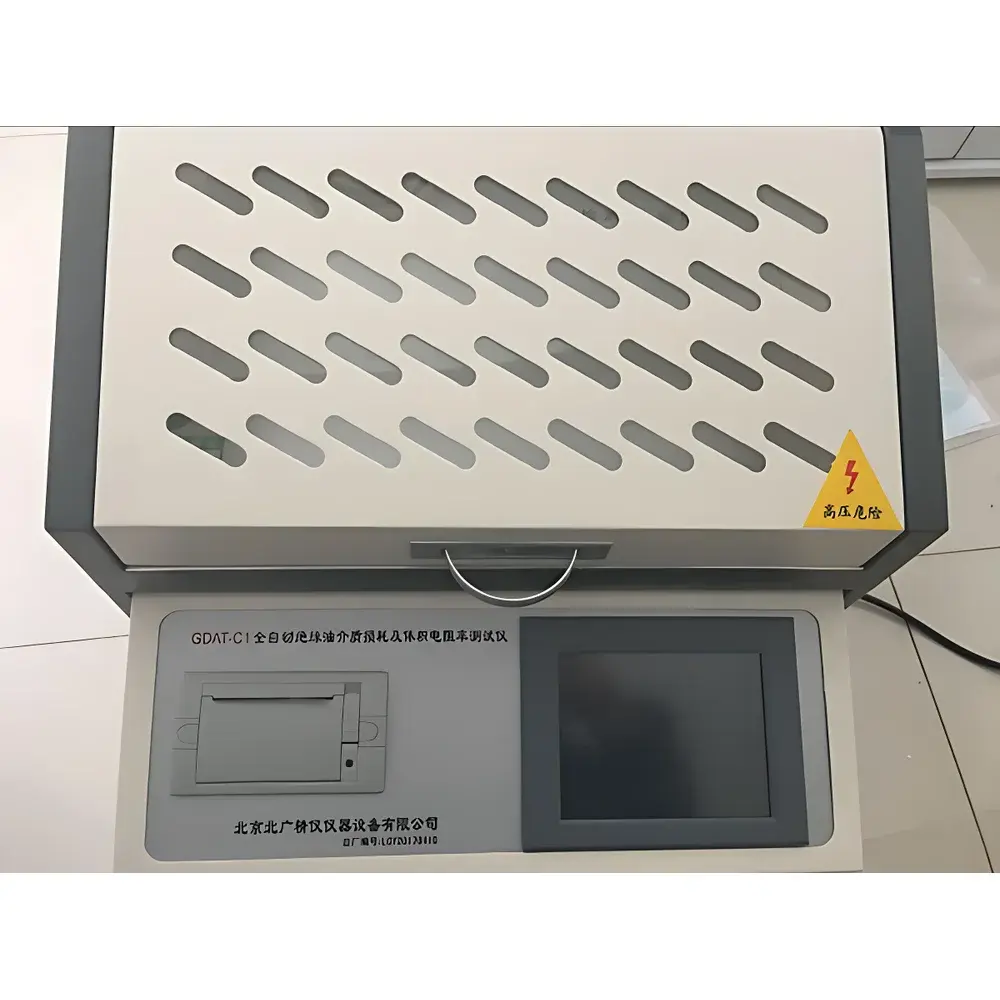
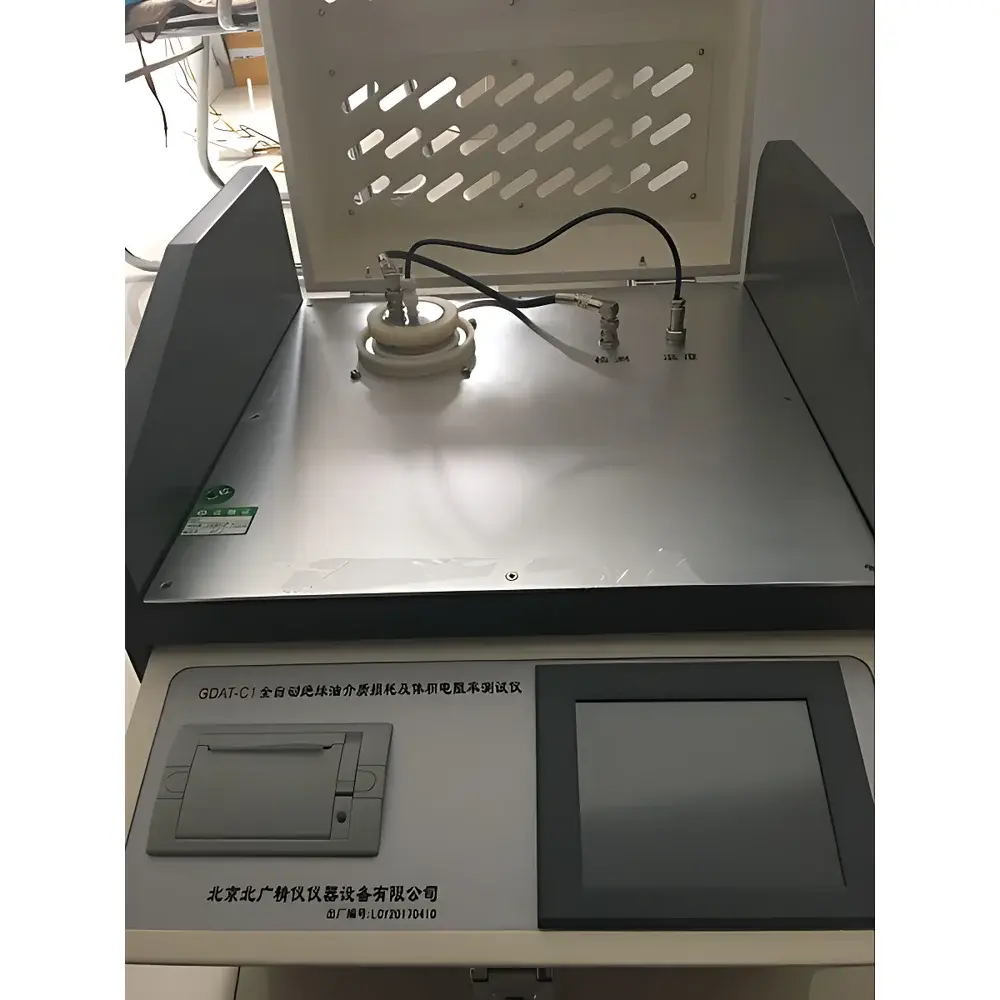
North Guangjing Precision GDAT-11 Series Insulating Oil Dielectric Loss & Resistivity Analyzer
| Brand | North Guangjing Precision Instrument |
|---|---|
| Origin | Beijing, China |
| Manufacturer Type | Manufacturer |
| Origin Category | Domestic |
| Model | GDAT-11 Series |
| Price | USD 1,700 (approx.) |
Overview
The North Guangjing Precision GDAT-11 Series Insulating Oil Dielectric Loss & Resistivity Analyzer is a fully integrated, microprocessor-controlled instrument engineered for high-accuracy measurement of dielectric dissipation factor (tan δ), relative permittivity (εr), and DC volume resistivity (ρ) of liquid insulating media—primarily transformer oils, cable oils, and other hydrocarbon-based dielectric fluids. It operates on the principle of precision AC/DC bridge measurement combined with temperature-regulated electrode cell analysis, conforming strictly to the metrological framework defined in GB/T 5654–2007, which aligns with IEC 60247 and ASTM D924 test methodologies for dielectric characterization. The system employs a three-electrode guarded cell geometry (electrode gap: 2 mm), eliminating stray capacitance and surface leakage effects that compromise measurement integrity. Its core architecture integrates a digitally synthesized variable-frequency AC excitation source (50 Hz ±0.1%), a stabilized SF6-filled reference capacitor, a high-voltage DC source (0–500 V), and a digital high-resistance meter capable of resolving resistivity up to 20 TΩ·m. All signal acquisition and control logic are implemented on an embedded RAM9 platform, ensuring deterministic real-time response and long-term calibration stability.
Key Features
- Three-terminal guarded electrode cup compliant with GB/T 5654–2007 and IEC 60247 mechanical specifications (2 mm inter-electrode spacing)
- High-frequency induction heating system with PID temperature regulation (0–120 °C; ±0.5 °C accuracy), enabling non-contact, uniform thermal conditioning of oil samples
- Dual-mode excitation: digitally synthesized 50 Hz AC source (200–2200 V, continuously adjustable) and regulated DC voltage (0–500 V)
- SF6-filled three-electrode reference capacitor with negligible temperature/humidity drift, ensuring long-term metrological traceability
- Full-digital automatic bridge balancing with adaptive null detection and real-time waveform correction using wavelet-based noise suppression
- 5.7-inch TFT color touchscreen interface (320 × 240 resolution) with intuitive Chinese-language menu navigation and contextual prompts
- Onboard real-time clock with automatic timestamping of all test records (date, time, weekday)
- Integrated safety interlocks: overvoltage/overcurrent cutoff, high-temperature limit switch (120 °C cut-off), open-sensor alarm, and HV short-circuit protection
- Automatic self-calibration routines including air-gap cup verification for baseline capacitance and tan δ offset compensation
Sample Compatibility & Compliance
The GDAT-11 is validated for use with mineral-based, synthetic ester, and silicone-based insulating oils meeting IEEE C57.106 and IEC 60296 specifications. It supports sample volumes of 35–45 mL per test cycle and accommodates viscosity ranges typical of unused and in-service transformer oils (up to 100 cSt at 40 °C). All measurements comply with GB/T 5654–2007, which references ISO/IEC 17025 requirements for laboratory competence. While not FDA 21 CFR Part 11–certified out-of-the-box, audit-ready data logging—including operator ID, parameter settings, raw bridge outputs, and environmental metadata—is stored in non-volatile memory with write-protection and tamper-evident timestamps. Data export via USB or wireless remote link (up to 100 m line-of-sight) enables integration into LIMS or QA documentation systems under GLP/GMP frameworks.
Software & Data Management
The analyzer features embedded firmware with dual-layer data handling: local storage (800 test records with full parameter sets) and external transfer capability. Each record includes measured Cx, εr, tan δ, ρ, temperature, applied voltage, and measurement duration. Export formats include CSV and printable PDF reports with embedded instrument ID, calibration due date, and operator signature field. Remote operation is supported via TCP/IP-enabled wireless module, allowing full GUI mirroring and command execution from a Windows PC without proprietary drivers. Firmware updates are performed via USB flash drive using signed binary packages to maintain integrity. Audit trails log all configuration changes, calibration events, and user login/logout sequences—essential for ISO 9001 or ISO/IEC 17025 internal audits.
Applications
- Pre-commissioning acceptance testing of new transformer oil per IEEE Std C57.106
- Condition monitoring of in-service insulating oil in power transformers, reactors, and bushings
- Quality assurance in oil reclamation and regeneration facilities
- Research and development of novel dielectric formulations (e.g., bio-based esters)
- Third-party certification laboratories performing accredited dielectric testing
- Manufacturing QA for oil-filled switchgear and cable systems
FAQ
What standards does the GDAT-11 comply with?
It is designed and verified per GB/T 5654–2007, which is technically equivalent to IEC 60247 and harmonized with ASTM D924 for dielectric loss and resistivity measurements.
Can the instrument operate from generator power?
Yes—the AC-DC-AC power conversion architecture isolates the measurement circuit from input voltage and frequency fluctuations, enabling stable operation even with ±10% voltage deviation and ±1% frequency drift.
How is electrode contamination detected?
The built-in air-gap calibration function measures empty cup capacitance and tan δ; deviations beyond preset thresholds trigger a cleaning alert and invalidate subsequent oil measurements until recalibrated.
Is remote data retrieval secure?
Wireless communication uses AES-128 encrypted UDP packets; no credentials are transmitted in plaintext, and session keys are regenerated per connection.
What maintenance is required for long-term accuracy?
Annual verification against NIST-traceable reference oils and physical inspection of electrode surfaces and heater insulation are recommended; SF6 capacitor requires no periodic servicing.
Related Products



