
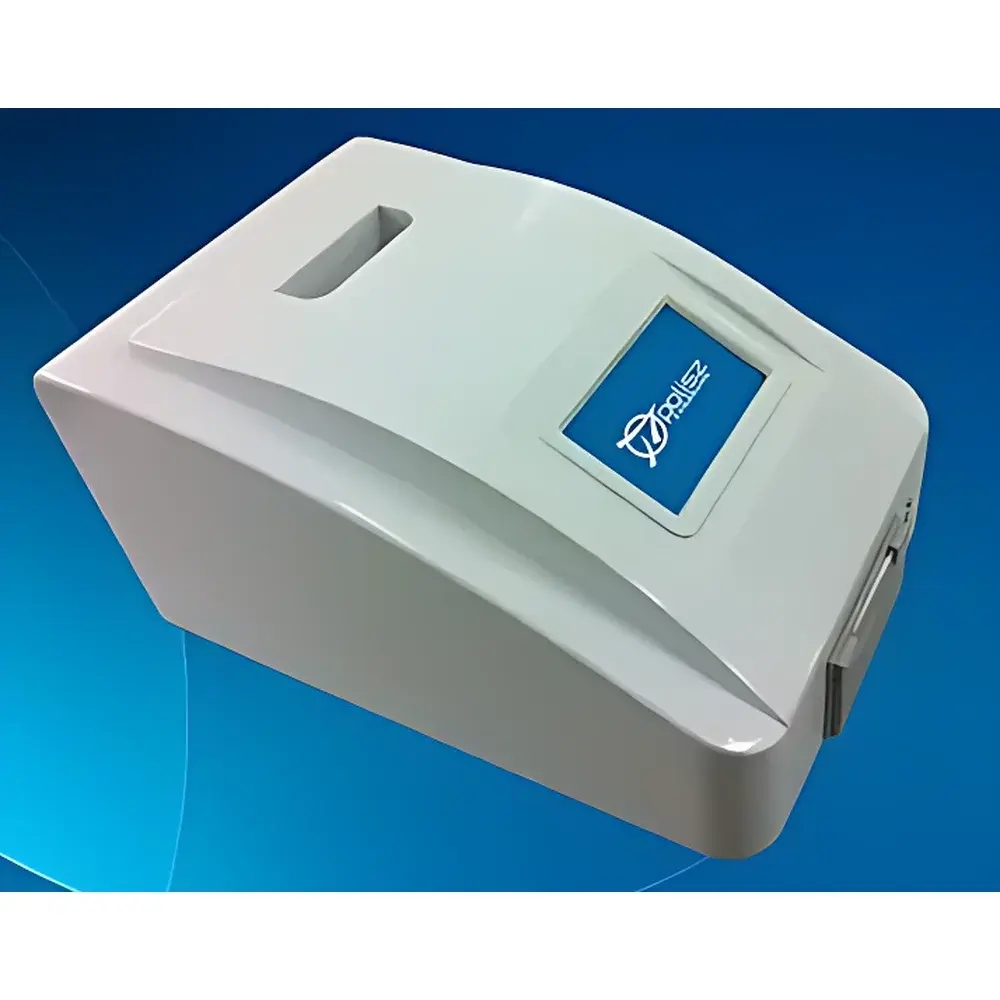
North Guang BQS-19 Filter Integrity Tester
| Brand | North Guang Precision Instrument |
|---|---|
| Origin | Beijing, China |
| Manufacturer Type | Manufacturer |
| Origin Category | Domestic |
| Model | BQS-19 |
| Price | USD 495 (approx. based on ¥3500) |
| Power Supply | 170–240 V AC, 50/60 Hz, 100 W |
| Max Operating Pressure | 7999 mbar |
| Minimum Inlet Pressure | 3000 mbar |
| Dimensions (W×D×H) | 240 × 320 × 260 mm |
| Test Pressure Range | 500–6900 mbar (customizable sensor available) |
| Pressure Sensitivity | ±1.0 mbar |
| Bubble Point Accuracy | ±60 mbar |
| Ambient Temperature | 0–50 °C |
| Relative Humidity | 10–80% RH |
| Bubble Point Test Time | 2 ± 2 min |
| Diffusion Flow Test Time | 7 ± 2 min |
| Water Intrusion Flow Test Time | 7 ± 2 min |
| System Leak Check Time | 3 ± 1 min |
| Display | 5.7–7-inch color TFT touchscreen (256-color), Chinese/English UI |
| Data Storage | 32 GB internal flash memory (≥1 million test records) |
| Print Output | Thermal printer supporting bilingual (CN/EN) reports including test parameters, results, and real-time pressure/flow curves |
| OS | Windows CE 6.0 |
| Controller | ARM9-based embedded system |
Overview
The North Guang BQS-19 Filter Integrity Tester is an engineered solution for non-destructive, quantitative verification of membrane filter integrity in pharmaceutical, biotechnology, and sterile manufacturing environments. It operates on three internationally recognized physical principles: the bubble point test (based on capillary flow theory), diffusion flow measurement (per ASTM F838-22 and ISO 13408-2), and water intrusion testing (for hydrophobic filters per USP ). The instrument applies controlled gas pressure across a wetted filter and monitors pressure decay or gas flow rates to determine whether pore structure remains within validated specifications. Designed for compliance-critical workflows, the BQS-19 delivers traceable, auditable results aligned with FDA 21 CFR Part 11 requirements for electronic records and signatures when configured with audit trail-enabled software.
Key Features
- Automated multi-method integrity testing: bubble point, diffusion flow, and water intrusion—each executed under programmable pressure ramping and stabilization protocols.
- High-precision pressure sensing with ±1.0 mbar sensitivity and ±60 mbar bubble point repeatability, ensuring consistent pass/fail determinations across batches.
- ARM9-based embedded controller running Windows CE 6.0 enables deterministic real-time response, low-latency data acquisition, and robust system stability during extended validation runs.
- Integrated thermal printer supports bilingual (English/Chinese) reporting with full traceability: test ID, timestamp, operator ID, filter type, test method, pressure curve, raw data, and final conclusion.
- Compact footprint (240 × 320 × 260 mm) and lightweight design facilitate deployment in cleanroom anterooms, QC labs, and mobile validation carts without compromising mechanical rigidity or thermal stability.
- 32 GB onboard flash storage retains ≥1 million test records with timestamped metadata, supporting retrospective analysis and regulatory inspections per ALCOA+ principles (Attributable, Legible, Contemporaneous, Original, Accurate, Complete, Consistent, Enduring, Available).
Sample Compatibility & Compliance
The BQS-19 accommodates a broad range of filtration configurations: disc membranes (Φ25 mm to Φ300 mm), standard pleated cartridges (2.5″ to 40″ length, 1–9 elements), capsule filters, mini-cartridges, and vent filters. Its pressure control architecture supports both hydrophilic (e.g., PVDF, PES, nylon) and hydrophobic (e.g., PTFE, PP) membranes. All test methods conform to core industry standards—including ASTM F838 (bacterial retention), ISO 13408-2 (sterile processing), and USP (package and container integrity). The system supports GMP documentation practices through configurable user roles, electronic signatures, and optional audit trail logging compliant with 21 CFR Part 11 Annex 11 and EU GMP Annex 11 requirements.
Software & Data Management
The embedded Windows CE 6.0 platform hosts a dedicated integrity test application with intuitive touch navigation, multilingual UI switching, and context-sensitive help. Test sequences are defined via parameter templates (e.g., “0.22 µm PVDF Cartridge – Diffusion Flow”), reducing operator error. Raw pressure and flow data are logged at ≥10 Hz resolution and archived with SHA-256 hash integrity checks. Export options include CSV for LIMS integration and PDF for QA review. Optional PC-based software enables centralized fleet management, trend analysis across multiple instruments, and automated report generation for annual requalification.
Applications
This instrument serves critical quality control functions across regulated life science operations: pre-use post-sterilization integrity verification of sterilizing-grade filters in bioreactor harvest lines; post-use integrity confirmation following viral filtration or buffer exchange; qualification of vent filters in single-use bioreactors and filling lines; validation support for aseptic process simulations (media fills); and routine monitoring of compressed air and nitrogen distribution systems. It is routinely deployed in facilities undergoing FDA, EMA, or PMDA inspections where documented filter performance directly impacts product sterility assurance.
FAQ
Does the BQS-19 support calibration traceability to national standards?
Yes—pressure transducers are factory-calibrated against NIST-traceable references, and calibration certificates are provided with each unit. Users may perform field verification using certified deadweight testers.
Can test methods be locked to prevent unauthorized modification?
Yes—administrator-level access control allows disabling of parameter editing during routine QC use, enforcing SOP adherence.
Is the thermal printer compatible with networked label systems?
The built-in printer is standalone; however, exported CSV/PDF files can be routed to enterprise print servers or integrated into MES/QMS platforms via standard APIs.
What maintenance intervals are recommended for long-term reliability?
Annual verification of pressure sensor linearity and leak-tightness of pneumatic manifolds is advised. No consumables beyond standard O-rings and filter housings are required.
How does the system handle ambient temperature fluctuations during testing?
Internal thermal compensation algorithms adjust pressure readings in real time across the full 0–50 °C operating range, minimizing drift-induced false failures.





