
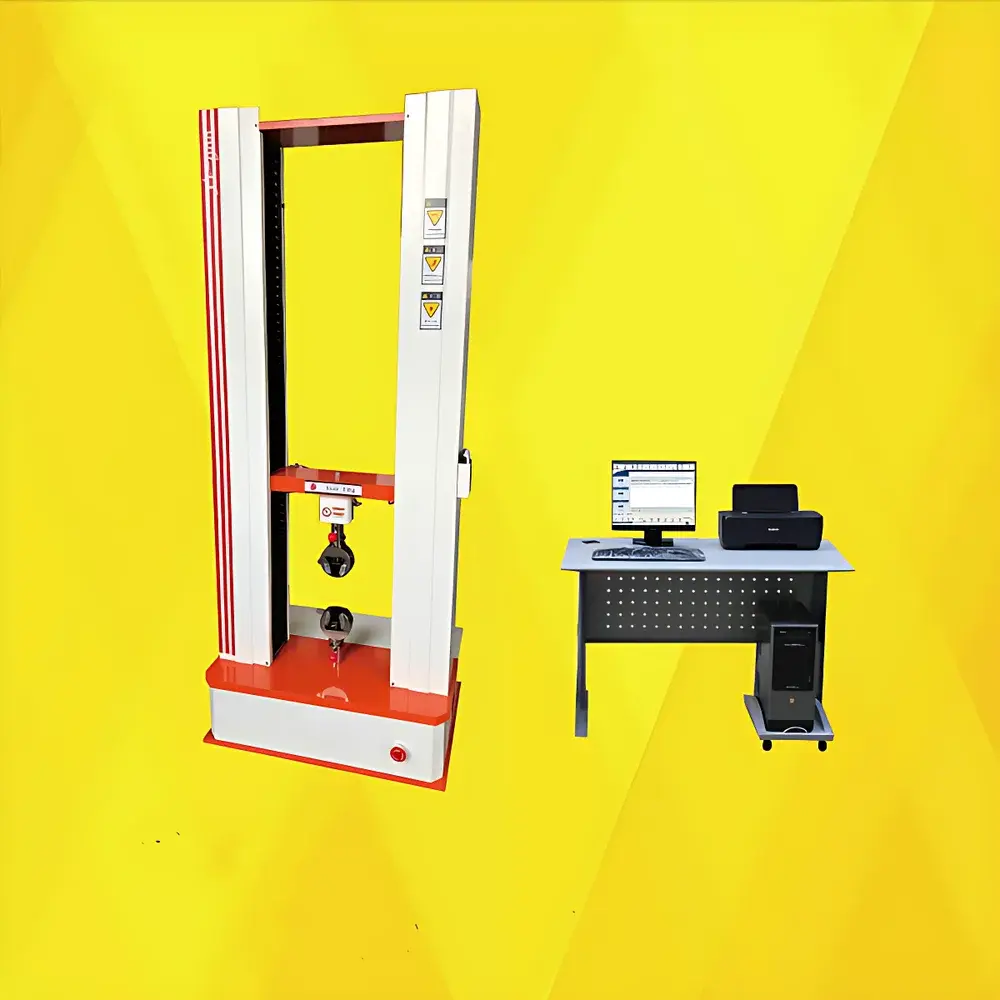
Beiguang Precision BWN-5KN Microcomputer-Controlled Electronic Universal Testing Machine
| Brand | Beiguang Precision Instrument |
|---|---|
| Origin | Beijing, China |
| Manufacturer Type | Direct Manufacturer |
| Product Category | Domestic |
| Model | BWN-5KN |
| Price | USD 3,500 (FOB) |
| Instrument Type | Electromechanical Universal Testing Machine |
| Max Test Load | 0–5 kN |
| Force Resolution | Constant Across Full Scale |
| Effective Force Range | 2–100% of Full Scale |
| Force Accuracy | ±1% of Indicated Value |
| Crosshead Speed Range | 0.05–500 mm/min (Infinitely Variable) |
| Displacement Resolution | 0.01 mm |
| Speed Control Accuracy | ±0.5% |
| Displacement Accuracy | ±0.5% |
| Tensile Stroke | 0–1000 mm (Excluding Fixtures) |
| Power Supply | 220 V AC, 50 Hz |
| Operating System | Windows XP (Legacy Software Environment) |
Overview
The Beiguang Precision BWN-5KN is a microprocessor-controlled electromechanical universal testing machine engineered for high-reproducibility mechanical characterization of metallic, polymeric, composite, and elastomeric materials. It operates on the principle of controlled axial force application via a precision ball-screw-driven crosshead system, with load measurement performed by a high-stability strain-gauge-based load cell and displacement monitored via an optical encoder. The system complies with fundamental test methodology frameworks defined in ASTM E4, ASTM E8/E8M, ISO 6892-1, ISO 527-1, and GB/T 228.1–2021, supporting standardized tensile, compression, flexural, peel, and shear testing protocols. Designed for laboratory and quality control environments, the BWN-5KN delivers traceable, repeatable results across diverse material classes without hydraulic fluid or pneumatic dependencies—ensuring low maintenance, zero contamination risk, and consistent energy efficiency.
Key Features
- Full-scale digital closed-loop control architecture integrating a proprietary AD800 universal test controller card for synchronized load and displacement regulation
- High-rigidity dual-column frame with hardened chrome-plated ball screw and precision arc-synchronous reduction gearbox for minimal backlash and thermal drift
- Auto-ranging load sensing with constant resolution across 0–5 kN; no manual range switching required during multi-stage tests
- Programmable crosshead velocity profiles—including ramp, dwell, and step modes—with real-time feedback compensation to maintain ±0.5% speed fidelity
- Dual-limit protection: hardware-based mechanical stops complemented by software-defined travel boundaries to prevent over-travel damage
- Overload shutdown triggered at 103–105% of rated capacity, ensuring sensor integrity and operator safety per IEC 61000-6-2 EMC requirements
- Integrated environmental resilience: low-noise operation (<65 dB(A)), dust-resistant enclosure design, and ambient temperature tolerance from 10–35 °C
Sample Compatibility & Compliance
The BWN-5KN accommodates standard specimen geometries per ISO 527, ASTM D638, and GB/T 1040 series—including dog-bone, straight-bar, and film-strip configurations—using interchangeable wedge-action, pneumatic, or hydraulic grips (fixtures sold separately). Its modular fixture interface supports ASTM D1876 T-peel, ASTM D903 loop tack, and ISO 11338-2 tear testing with appropriate accessories. While the base system meets general-purpose mechanical testing requirements, full GLP/GMP compliance necessitates optional audit-trail-enabled firmware upgrades and 21 CFR Part 11–compliant electronic signature modules. Calibration certificates traceable to NIM (National Institute of Metrology, China) are available upon request, and annual verification aligns with JJG 139–2014 national metrological verification regulations.
Software & Data Management
The legacy Windows XP–based testing software provides real-time graphical display of stress–strain, load–displacement, and time-based curves with dynamic scaling and cursor-assisted point interrogation. Data acquisition occurs at ≥100 Hz sampling rate, enabling accurate yield point detection and modulus calculation via tangent/secant methods. Test sequences—including multi-step cyclic loading, hold-to-strain, and rate-controlled rupture—are pre-configurable and stored as reusable templates. Export formats include CSV, XLSX, and RTF; report generation supports user-defined headers, logo insertion, and automatic inclusion of statistical summaries (mean, SD, CV%). Raw data files are timestamped and digitally signed to support basic data integrity requirements under ISO/IEC 17025 Clause 7.5. For modern OS compatibility, virtualized deployment via Windows 7/10 LTSB is validated and documented.
Applications
This system serves as a primary mechanical testing platform in R&D laboratories and QC departments across multiple sectors: tensile strength and elongation-at-break evaluation of thermoplastic films in packaging validation; yield behavior analysis of aluminum alloys in aerospace component qualification; compression modulus determination of PU foams for automotive seating; adhesion strength quantification of pressure-sensitive tapes per PSTC-101; and flexural rigidity assessment of fiber-reinforced composites per ASTM D7264. Educational institutions utilize it for undergraduate materials science labs due to its intuitive interface and pedagogical alignment with standard mechanics-of-materials curricula. Its robust construction and wide speed range also enable quasi-static creep and relaxation studies when paired with extended-duration test protocols.
FAQ
Is the BWN-5KN compatible with Windows 10 or 11?
The native software was developed for Windows XP; however, verified operation under Windows 10 LTSB (via compatibility mode and driver signing overrides) is supported with technical documentation provided.
What calibration standards does the load cell conform to?
The 5 kN load cell is factory-calibrated per JJG 144–2007 (Chinese national verification regulation), with optional NIST-traceable recalibration services available.
Can the system perform cyclic fatigue testing?
Yes—within its speed and stroke limits—using programmable waveform sequencing (e.g., sinusoidal, triangular, trapezoidal) up to 5 Hz, though dedicated servo-hydraulic systems are recommended for high-cycle (>10⁵ cycles) applications.
Does the machine meet ISO 17025 requirements for accredited testing labs?
The base configuration satisfies measurement uncertainty and repeatability criteria; full accreditation requires documented procedures, personnel training records, environmental monitoring logs, and external inter-laboratory comparison participation.
What maintenance intervals are recommended for long-term reliability?
Lubrication of ball screws and gearboxes every 6 months; optical encoder cleaning quarterly; annual load cell verification; and biannual firmware backup and system diagnostics per manufacturer’s preventive maintenance checklist.



