
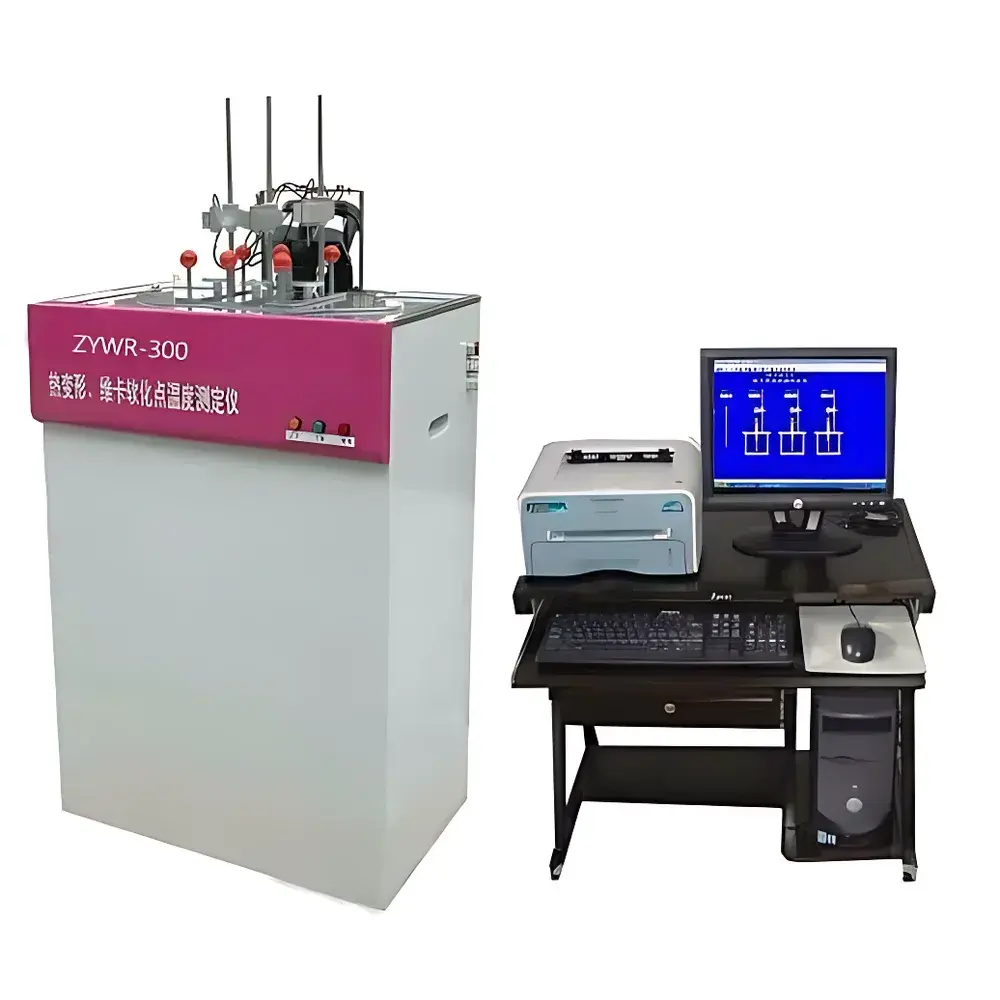
North Guang BWR-300 Digital Heat Deflection Temperature & Vicat Softening Point Tester
| Brand | North Guang Precision Instrument |
|---|---|
| Origin | Beijing, China |
| Manufacturer Type | Direct Manufacturer |
| Country of Origin | China |
| Model | BWR-300 |
| Temperature Range | Ambient to 300 °C |
| Heating Rate Options | 120 ±5 °C/h or 50 ±3 °C/h |
| Temperature Resolution | 0.01 °C |
| Temperature Accuracy | ±0.5 °C |
| Deformation Measurement | Capacitive Linear Encoder (Grating-Type Digital Dial Indicator) |
| Deformation Range | −0.1 mm to 5.0 mm |
| Deformation Accuracy | ±0.01 mm |
| Sample Stations | Three independent test stations per bath |
| Heating Medium | Methyl Silicone Oil (flash point ≥300 °C, kinematic viscosity 200 cSt at 25 °C, 20 L required) |
| Heating Power | 2.5 kW |
| Cooling Methods | Natural air cooling above 150 °C |
| Load Mass (Plunger + Rod) | 88 g |
| Vicat Test Loads | 10 N ±0.2 N (Class A) or 50 N ±1 N (Class B) |
| HDT Flexural Stress Options | 0.45 MPa, 1.80 MPa, or 8.00 MPa (per ISO 75 and ASTM D648) |
| Power Supply | AC 220 V ±10%, 50 Hz, 30 A |
Overview
The North Guang BWR-300 Digital Heat Deflection Temperature (HDT) & Vicat Softening Point Tester is an engineered solution for standardized thermal performance evaluation of thermoplastic and thermosetting polymers, elastomers, composites, and electrically insulating materials. It operates on two internationally recognized principles: the heat deflection temperature method (ASTM D648 / ISO 75), which measures the temperature at which a standard test specimen deflects under a specified flexural load; and the Vicat softening temperature method (ASTM D1525 / ISO 306), which determines the temperature at which a needle of defined geometry penetrates a material under a fixed load. Both methods rely on controlled thermal ramping in a silicone oil bath, precise mechanical loading, and high-resolution displacement sensing—ensuring traceable, repeatable results aligned with quality assurance and regulatory compliance requirements across R&D, QC, and certification labs.
Key Features
- Triple-station test configuration enables concurrent HDT and Vicat testing under identical thermal conditions, improving throughput and inter-test comparability.
- Patented negative-pressure ventilation system eliminates visible fumes during high-temperature testing—no external fume hood or exhaust ducting required—maintaining laboratory air quality and operator safety.
- Integrated rapid water-cooling module (self-contained, no tap connection needed) reduces cooldown time from 300 °C to 100 °C in under 15 minutes, supporting high-volume testing workflows.
- Capacitive grating-based digital dial indicators deliver 0.01 mm resolution and ±0.01 mm repeatability, capturing sub-micron-scale deformation onset critical for early-stage softening detection.
- Microprocessor-controlled dual-rate heating (120 ±5 °C/h and 50 ±3 °C/h) with real-time PID feedback ensures compliance with ISO 75-2:2013 Annex A and ASTM D648 Section 7.2 temperature ramp tolerances.
- Full computer interface supports automated test initiation, live data logging, curve fitting, and pass/fail flagging against user-defined acceptance thresholds.
Sample Compatibility & Compliance
The BWR-300 accommodates standard rectangular bars (ASTM D648: 127 mm × 13 mm × 3–4.3 mm; ISO 75: 80 mm × 10 mm × 4 mm) and flat discs (ISO 306: Ø10 mm × 3–6 mm thick). It supports all three HDT stress levels (0.45, 1.80, and 8.00 MPa) and both Vicat load classes (10 N and 50 N), enabling full conformance with GB/T 1633–2000, GB/T 1634.1–2019, GB/T 8802–2001, ISO 75-1:2013, ISO 75-2:2013, ISO 306:2013, and ASTM D648–22. The instrument’s thermal uniformity (±0.5 °C across bath volume) and mechanical stability meet GLP audit requirements for documented test integrity.
Software & Data Management
The embedded Windows-based control software provides real-time visualization of temperature vs. deformation curves, automatic endpoint detection (e.g., 0.34 mm deflection for HDT, 1 mm penetration for Vicat), and export-ready reports in CSV, PDF, and XML formats. Audit trails record operator ID, timestamp, calibration events, parameter changes, and raw sensor values—fully compliant with FDA 21 CFR Part 11 requirements when deployed with networked authentication and electronic signature modules. Data archives are encrypted and version-controlled, supporting long-term trend analysis and ISO/IEC 17025 accreditation documentation.
Applications
This tester serves as a core qualification tool in polymer formulation labs evaluating thermal stability of polypropylene copolymers, PEEK composites, PVC compounds, and bio-based resins. In manufacturing QA environments, it verifies batch-to-batch consistency of injection-molded automotive interior parts, medical device housings, and electrical enclosures. Regulatory submission packages for UL 94, IEC 60695, and RoHS-compliant materials routinely include HDT/Vicat data generated on instruments meeting the metrological rigor of the BWR-300. Universities utilize its reproducible platform for teaching polymer physics concepts including glass transition kinetics and viscoelastic yield behavior.
FAQ
What heating medium is required—and why methyl silicone oil?
Methyl silicone oil with a flash point ≥300 °C and kinematic viscosity of 200 cSt is mandatory to ensure thermal stability, low volatility, and uniform heat transfer across the 300 °C operating range. Mineral oils or glycols are prohibited due to oxidation risk and inconsistent thermal gradients.
Can the instrument perform both HDT and Vicat tests simultaneously?
Yes—three independent sample stations allow concurrent execution of up to three HDT tests, three Vicat tests, or mixed configurations (e.g., two HDT + one Vicat), all sharing the same calibrated thermal environment.
Is the deformation measurement system traceable to national standards?
Each capacitive grating indicator is factory-calibrated against NIST-traceable length standards, with certificate of calibration included. Annual recalibration services are available through North Guang’s ISO/IEC 17025-accredited service center.
Does the system support automated reporting for ISO/IEC 17025 compliance?
Yes—the software generates reports containing instrument ID, operator name, environmental conditions, raw data tables, statistical summaries, uncertainty estimates, and digital signatures—fully satisfying Clause 7.8.2 of ISO/IEC 17025:2017.
What maintenance is required for long-term accuracy?
Monthly verification of temperature uniformity (using three calibrated PT100 probes), biannual cleaning of oil bath and load rods, and annual recalibration of displacement sensors and thermal controllers are recommended per the maintenance log provided in the user manual.
Related Products






