
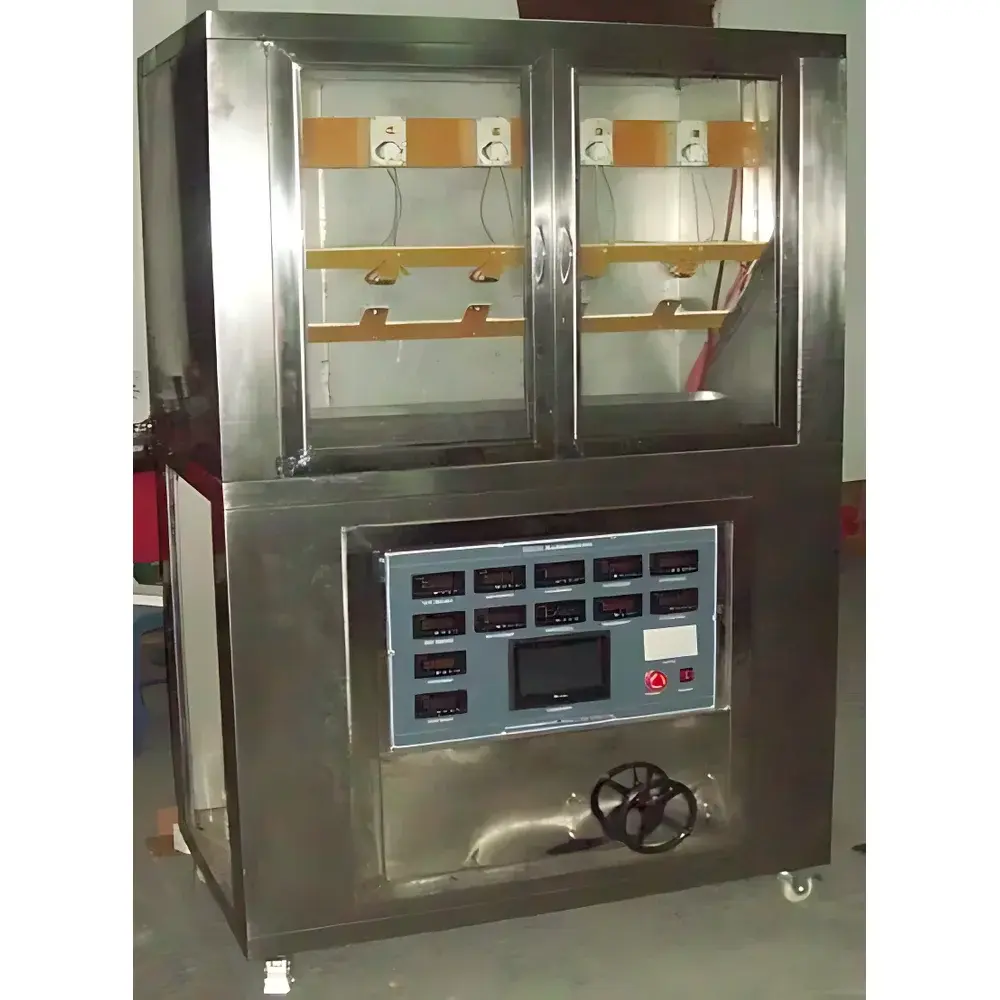
Beiguang Jingyi BLD-6000V High-Voltage Tracking Resistance Tester
| Brand | Beiguang Jingyi / All Precision Instrument |
|---|---|
| Origin | Beijing, China |
| Manufacturer Type | Direct Manufacturer |
| Product Origin | Domestic (China) |
| Model | BLD-6000V |
| Voltage Range | 100–6000 V AC/DC (continuously adjustable) |
| Electrode Material | Stainless steel (0.5 mm thick) |
| Electrode Spacing | 50.0 ± 0.1 mm |
| Test Duration | Up to 6 hours per cycle |
| Droplet Accuracy | < ±0.2% |
| Droplet Flow Rate | 0.00185–20 mL/min (adjustable via Lead Fluid peristaltic pump) |
| Current Cutoff Threshold | 60 mA |
| Voltage Stability | ±1% |
| Test Stations | 5 parallel samples |
| Control System | Siemens PLC + Weinview HMI touchscreen |
| Reporting | Auto-generated test report with thermal printer output |
| Chamber Volume | 0.56 m³ (900 × 650 × 950 mm) |
| Enclosure Material | SUS304 stainless steel (brushed finish) |
| Contaminant Reservoir | 316 stainless steel with sealed lid |
| Weight | ~200 kg |
| Compliance | GB/T 6553–2003, IEC 60587:1984 |
Overview
The Beiguang Jingyi BLD-6000V High-Voltage Tracking Resistance Tester is an engineered system for evaluating the comparative resistance of solid insulating materials to electrical tracking and erosion under controlled high-voltage stress and contaminant exposure. It operates on the principle of simulating real-world degradation mechanisms—specifically, surface tracking initiated by conductive electrolyte droplets bridging electrodes across an inclined insulating specimen under sustained AC or DC voltage. This test method replicates failure modes observed in low-voltage distribution components exposed to humid, dusty, or chemically contaminated environments—such as relay sockets, switch housings, contactor bases, and terminal blocks—where leakage currents may initiate carbonized conductive paths, leading to short circuits, thermal runaway, or ignition. The instrument conforms strictly to the electrotechnical test methodology defined in GB/T 6553–2003 and its international counterpart IEC 60587:1984, which specify standardized procedures for applying graded voltages (e.g., 2.5 kV, 3.5 kV, 4.5 kV), calibrated contaminant solution flow rates, and precise electrode geometry to assess material performance in severe service conditions.
Key Features
- Five independent, parallel test stations enable simultaneous evaluation of five specimens—enhancing statistical reliability and throughput for qualification testing.
- High-stability AC/DC high-voltage source (up to 6000 V, ±1% regulation) with programmable ramping and automatic current-limit cutoff at 60 mA to prevent uncontrolled arcing or specimen combustion.
- Precision peristaltic dosing system (Lead Fluid brand) delivering contaminant solution at flow rates from 0.00185 to 20 mL/min, with volumetric accuracy better than ±0.2%—critical for reproducible contamination kinetics.
- Robust mechanical architecture: S304 stainless steel test chamber (brushed finish), 316 stainless steel sealed contaminant reservoir, and corrosion-resistant stainless steel electrodes (0.5 mm thickness, 50.0 ± 0.1 mm spacing).
- Integrated control platform combining Siemens S7-series PLC logic with Weinview 7-inch capacitive touchscreen HMI—supporting parameter configuration, real-time monitoring, event logging, and GLP-compliant audit trail generation.
- Thermal printer embedded in the front panel provides immediate hardcopy of pass/fail status, elapsed time, applied voltage, current profile, and droplet count per test—eliminating post-test manual transcription errors.
Sample Compatibility & Compliance
The BLD-6000V accommodates standard rectangular specimens (typically 100 × 100 × 3–6 mm) mounted at a fixed 45° ± 2° inclination, as mandated by GB/T 6553–2003 and IEC 60587. Specimen mounting fixtures ensure consistent electrode alignment and eliminate positional variance across all five stations. The system supports common contaminant solutions—including ammonium chloride (NH₄Cl) and sodium formate (HCOONa)—delivered via inert plastic or glass reservoirs to avoid ion leaching. All hardware and software design elements align with regulatory expectations for test equipment used in safety-critical component certification. While not inherently 21 CFR Part 11 compliant out-of-the-box, the PLC-based data logging architecture supports optional validation packages for GMP/GLP environments requiring electronic signature, audit trail, and data integrity controls.
Software & Data Management
Control firmware implements deterministic cyclic logic: voltage application, timed droplet initiation, continuous current monitoring, and automated termination upon either 6-hour completion or 60 mA threshold breach. Each test cycle generates a timestamped dataset containing voltage setpoint, actual output voltage, real-time current reading (sampled at 10 Hz), cumulative droplet count, and elapsed duration. Reports are structured in plain-text CSV format for traceability and imported into LIMS or QA databases. The HMI interface allows password-protected user roles (Operator, Technician, Administrator), configurable test templates, and export of raw logs via USB port. No cloud connectivity or remote telemetry is implemented—ensuring data sovereignty and network isolation in regulated laboratory settings.
Applications
This tester serves as a core qualification tool for materials engineers and safety compliance laboratories evaluating polymeric insulation systems—including thermosets (epoxy, phenolic), thermoplastics (PC, PBT, PA66), and filled composites—prior to UL 746A, IEC 60695-2-10/11/12, or GB 4943.1 certification. It is routinely deployed in R&D labs optimizing flame-retardant additives, in QC departments verifying batch-to-batch consistency of molded parts, and in third-party testing facilities conducting accredited tracking index (CTI) determinations per IEC 60112. Typical end-use validation targets include PCB edge connectors, EV battery busbar housings, photovoltaic junction box enclosures, and industrial motor terminal covers—components where long-term dielectric integrity under pollution stress directly impacts functional safety and fire risk classification.
FAQ
What standards does the BLD-6000V fully comply with?
It is designed and verified against GB/T 6553–2003 and IEC 60587:1984 for high-voltage tracking resistance testing. Additional alignment with IEC 60112 (for CTI determination) and ASTM D3638 is achievable via procedural adaptation.
Can the instrument operate in DC mode for specific material evaluations?
Yes—voltage output is switchable between AC (48–62 Hz) and DC, supporting comparative studies of polarity-dependent tracking behavior in asymmetric polymer systems.
Is calibration documentation provided with shipment?
Each unit ships with a factory calibration certificate covering high-voltage output, current sensing, and droplet volume accuracy—traceable to national metrology institutes (NIM, China).
How is specimen contamination controlled during multi-sample testing?
Each of the five test stations uses isolated fluid paths with dedicated peristaltic pump heads and non-metallic tubing to prevent cross-contamination and ensure identical droplet dynamics across all positions.
What maintenance intervals are recommended for long-term stability?
Electrode cleaning after every 10 test cycles; annual verification of high-voltage transformer insulation resistance and PLC firmware revision update per manufacturer bulletin.



