
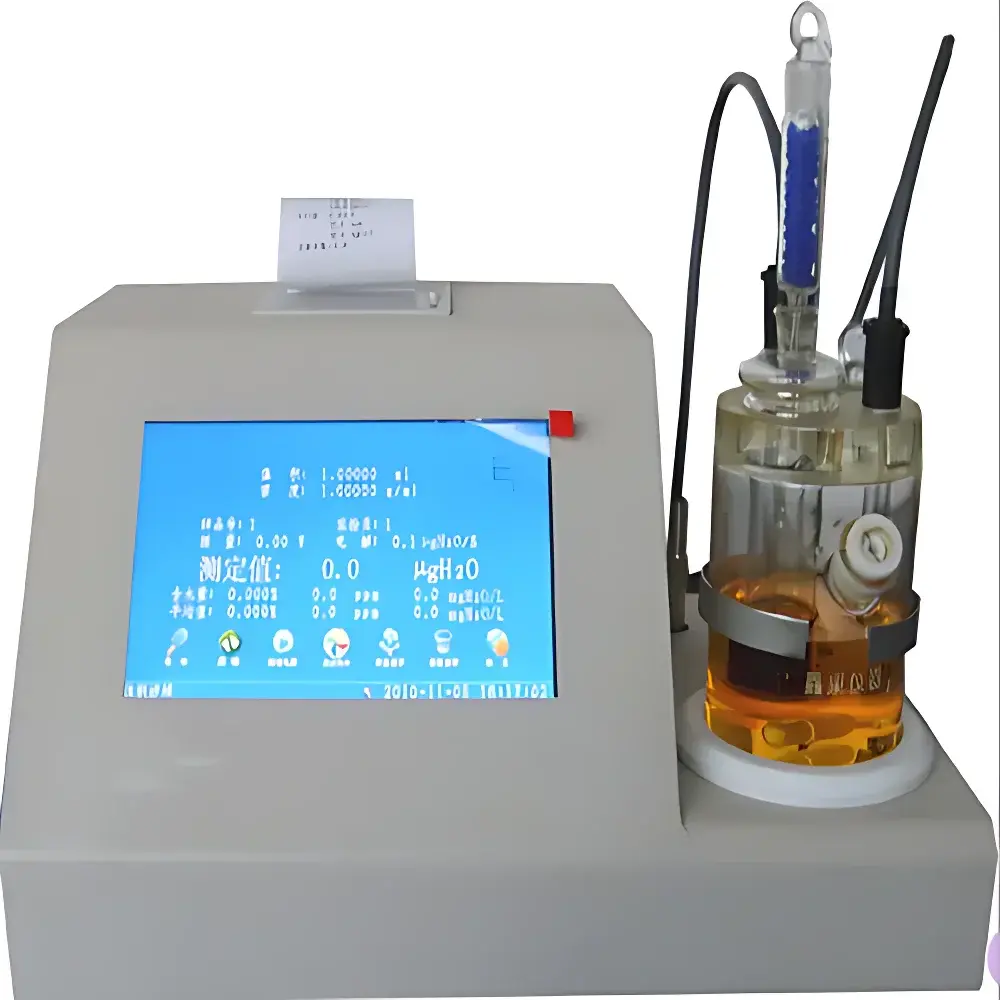
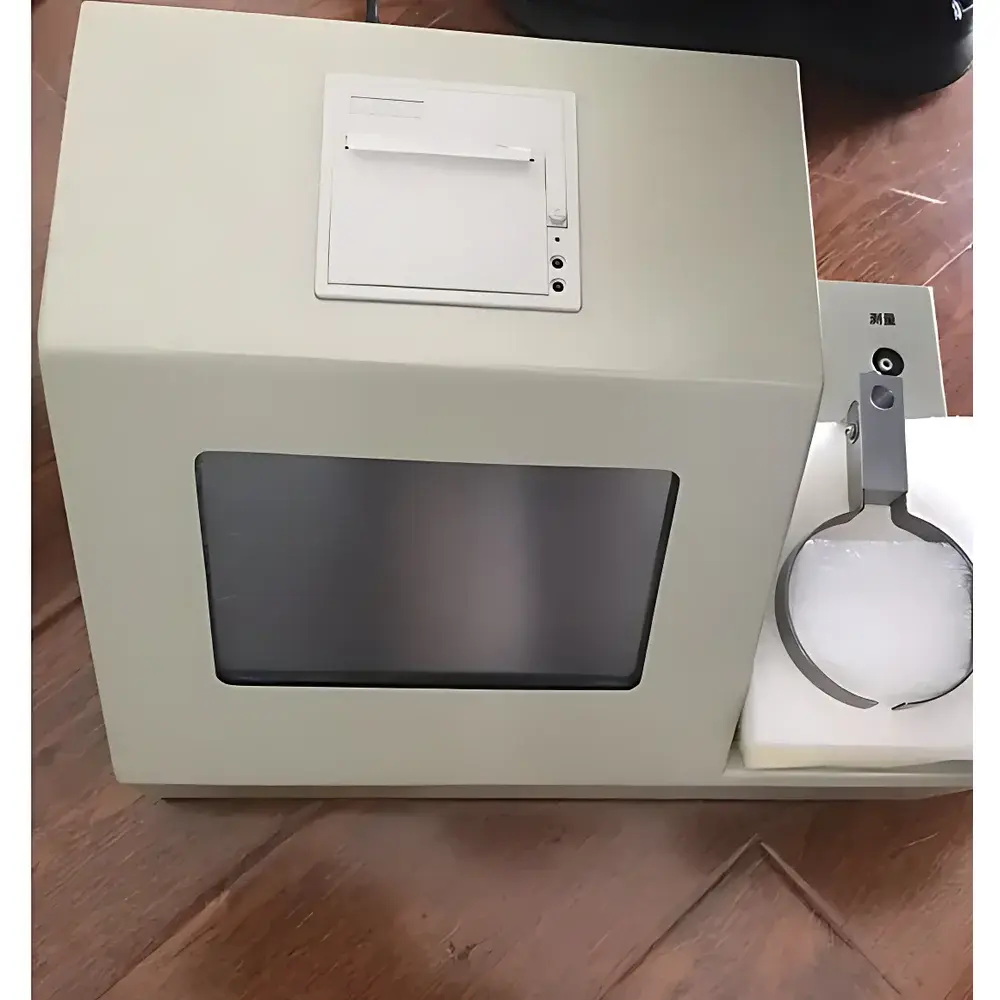
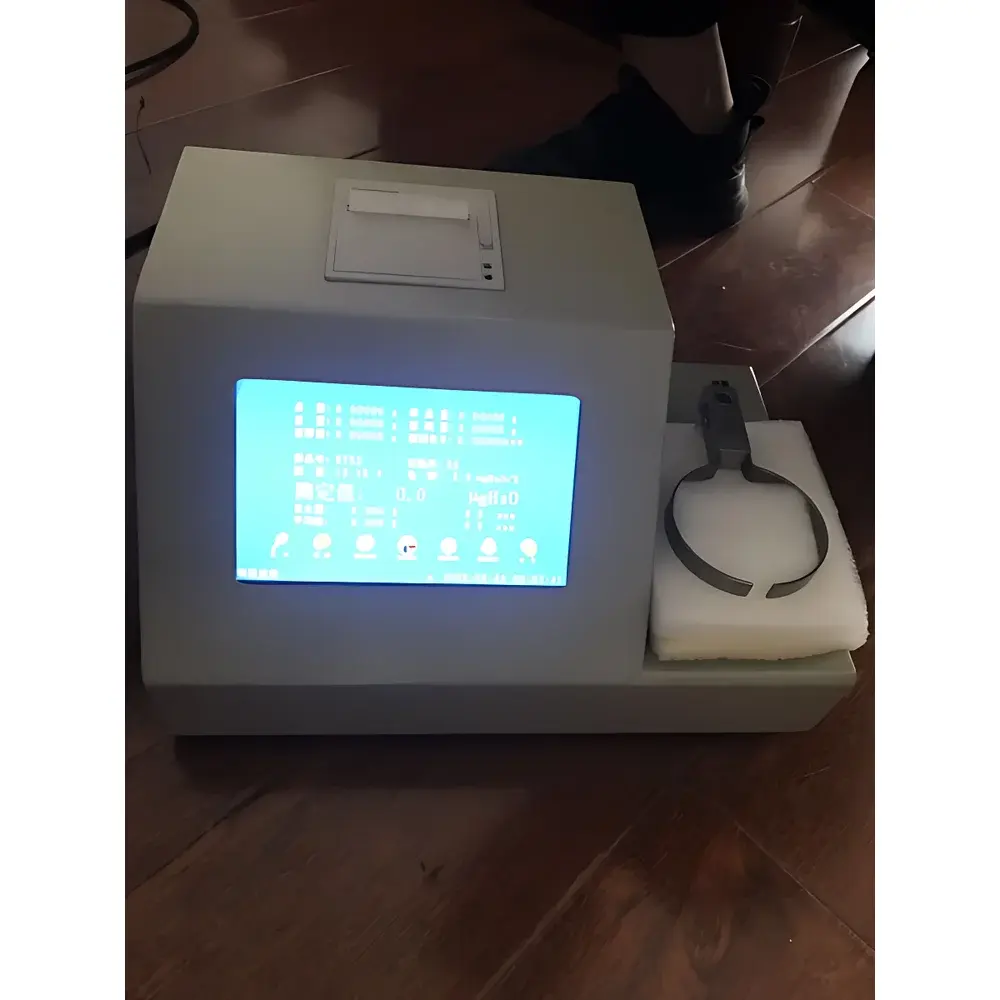
Beiguang Jingyi BSF-082 Automated Coulometric Karl Fischer Moisture Analyzer
| Brand | Beiguang Jingyi / All Precision Instrument |
|---|---|
| Origin | Beijing, China |
| Manufacturer Type | OEM Manufacturer |
| Country of Origin | China |
| Model | BSF-082 |
| Price | USD 3,500 (FOB Beijing) |
| Measurement Principle | Coulometric Karl Fischer Titration |
| Display | 7-inch color TFT LCD touchscreen (Chinese UI) |
| Resolution | 0.1 µg H₂O (0.1 ppm) |
| Measurement Range | 0.1 µg – 200 mg H₂O (0.1 ppm – 100% w/w) |
| Electrolysis Current | 0–400 mA (auto-controlled) |
| Accuracy | ≤ ±0.2% for samples ≥1 mg H₂O |
| Data Storage | 256 test records |
| Power Supply | AC 220 V ±11 V, 50 Hz ±2.5 Hz |
| Power Consumption | 60 W |
| Operating Temperature | 5–45 °C |
| Relative Humidity | ≤80% RH |
| Dimensions | 350 × 230 × 180 mm |
| Weight | 8 kg |
| Compliance | GB/T 7600, GB 6283, SH/T 0246, SH/T 0255, USP <921>, EP 2.5.12, ASTM D6304, ISO 760 |
Overview
The Beiguang Jingyi BSF-082 Automated Coulometric Karl Fischer Moisture Analyzer is engineered for high-precision, trace-level water quantification in liquid, viscous, and soluble solid samples using the coulometric (electrochemical) Karl Fischer titration principle. Unlike volumetric KF systems, this instrument generates iodine electrochemically at the anode via controlled current—ensuring stoichiometric accuracy, minimal reagent consumption, and exceptional sensitivity down to 0.1 µg H₂O. Its microprocessor-driven architecture integrates real-time current regulation, adaptive endpoint detection, and automatic background drift compensation—critical for reproducible analysis in low-moisture matrices such as lithium battery electrolytes, pharmaceutical excipients, and high-purity solvents. Designed for routine QC laboratories and R&D facilities, the BSF-082 delivers metrological traceability aligned with ISO/IEC 17025 requirements when operated under documented SOPs.
Key Features
- Coulometric KF measurement with auto-adjusting electrolysis current (0–400 mA), enabling dynamic response to sample water load and minimizing over-titration artifacts.
- 7-inch capacitive touchscreen interface with native Chinese-language prompts, intuitive workflow navigation, and context-sensitive parameter entry (e.g., sample mass, dilution factor, density).
- Integrated thermal printer supporting GLP-compliant hardcopy output: date/time stamp, operator ID (manual entry), sample ID, result (µg H₂O, ppm, % w/w, mg/L), and statistical summary (mean, SD, n).
- Onboard data management: stores up to 256 complete test records—including raw titration curves, endpoint voltage profiles, drift correction logs, and user-modified parameters.
- Comprehensive self-diagnostic suite: real-time monitoring of electrode status, cell contamination, reagent exhaustion, and ambient humidity impact; alerts displayed with actionable remediation guidance.
- Multi-mode sample introduction: volume injection (0.5–100 µL syringes), gravimetric weighing (via external balance interface), and pre-dilution protocols—all with automated unit conversion and concentration back-calculation.
Sample Compatibility & Compliance
The BSF-082 accommodates a broad spectrum of sample types per ICH Q5C, USP , and EP 2.5.12 guidelines: hydrocarbons (e.g., gasoline, jet fuel), polar aprotic solvents (acetonitrile, DMF), pharmaceutical intermediates, polymer precursors (polyether polyols), battery-grade LiPF₆ solutions, and agrochemical formulations. It meets or exceeds performance criteria specified in 26 national standards—including GB/T 7600 (transformer oil), GB 6283 (general chemical products), SH/T 0246 (light petroleum), and GB/T 11146 (crude oil). For regulated environments, audit trails (via optional PC software) support 21 CFR Part 11 compliance when paired with electronic signatures and role-based access control.
Software & Data Management
The analyzer operates autonomously but interfaces seamlessly with Windows-based desktop software (supplied on included CD) for advanced data export (CSV, PDF), trend analysis, calibration verification logs, and multi-instrument fleet reporting. All stored records include immutable timestamps, operator annotations, and metadata (reagent lot number, cell cleaning history, ambient conditions). Exported datasets retain full traceability to original titration curves and endpoint determination algorithms—essential for FDA inspection readiness and ISO 17025 accreditation audits.
Applications
- Quality control of transformer oils and insulating fluids per GB/T 7600 and ASTM D1533.
- Moisture verification in lithium-ion battery electrolyte formulations where <10 ppm H₂O is critical to SEI stability.
- Pharmaceutical raw material release testing per USP and Chinese Pharmacopoeia IV (2020 Ed.) Section 0832.
- Water content validation in fluorinated refrigerants (HFC-134a, R-32) per GB/T 18826 and ISO 15502.
- Process monitoring of polyurethane catalysts and silicone monomers where residual moisture affects polymerization kinetics.
- Environmental testing of ethanol-gasoline blends (E10, E85) per GB/T 8350 and ASTM D7467.
FAQ
What is the minimum detectable water mass?
The instrument achieves a resolution of 0.1 µg H₂O, validated per ISO 8655-6 gravimetric verification protocols.
Does it support GLP-compliant electronic record keeping?
Yes—when used with the optional PC software, all data are stored with time-stamped, non-erasable audit trails meeting ALCOA+ principles.
Can it analyze solid samples directly?
Solid samples require dissolution in KF-compatible solvents (e.g., chloroform/methanol); optional solid sample kit includes sealed vials and adapter for headspace injection.
How often must the electrolyte be replaced?
Typical reagent lifetime is 1–2 weeks under continuous use; the system monitors anode/cathode solution conductivity and triggers visual alerts at 85% depletion.
Is method validation support available?
Beiguang Jingyi provides IQ/OQ documentation templates, linearity verification protocols (5-point calibration from 100 µg to 10 mg H₂O), and repeatability test reports per ISO 5725-2.



