
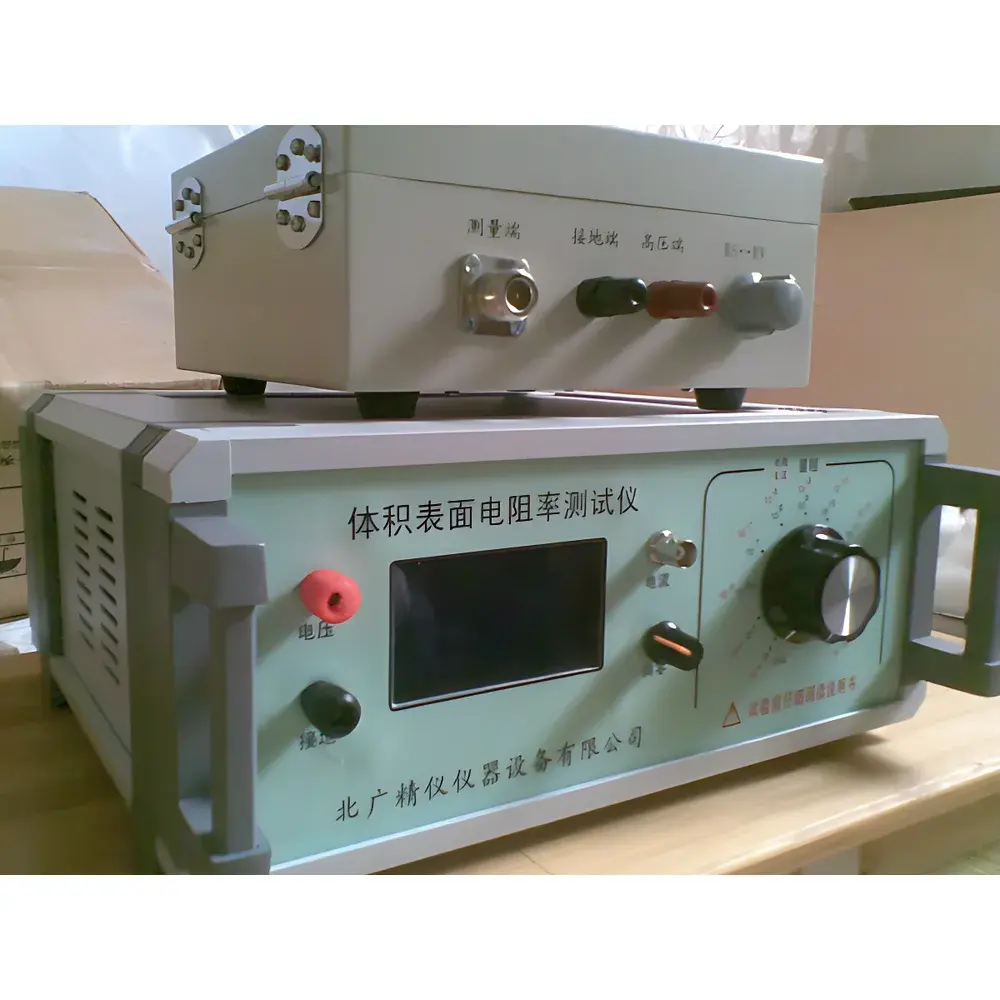
Beiguang Precision BEST-121 Volume Resistivity Tester for Solid Insulating Materials
| Brand | Beiguang Precision Instrument |
|---|---|
| Origin | Beijing, China |
| Manufacturer Type | Direct Manufacturer |
| Model | BEST-121 |
| Test Voltage Range | DC 10 V, 50 V, 100 V, 250 V, 500 V, 1000 V |
| Resistance Measurement Range | 1×10⁴ Ω to 1×10¹⁸ Ω |
| Current Measurement Range | 2×10⁻⁴ A to 1×10⁻¹⁶ A |
| Compliance | GB/T 1410–2006 |
Overview
The Beiguang Precision BEST-121 Volume Resistivity Tester is an engineered solution for precise, traceable measurement of volume resistivity and surface resistivity in solid insulating materials—primarily polymers, ceramics, composites, and laminates used in electrical insulation, aerospace, electronics packaging, and high-voltage component manufacturing. Based on the constant-voltage direct-current (DC) method per GB/T 1410–2006, the instrument applies a stabilized test voltage across a defined electrode configuration (typically guarded three-terminal or concentric ring electrodes), measures the resulting leakage current through the bulk material, and computes volume resistivity (ρ) using the standardized formula: ρ = R × (A / t), where R is measured resistance, A is effective electrode area, and t is specimen thickness. Its design emphasizes metrological integrity over speed: ultra-high input impedance (>10¹⁸ Ω), low-noise electrometer-grade current sensing, and thermally stable voltage sources ensure reproducible measurements across 14 decades of resistance—critical for qualifying materials against IEC 60093, ASTM D257, and ISO 3915 compliance frameworks.
Key Features
- Dual simultaneous digital display of resistance (Ω) and leakage current (A), eliminating manual calculation and reducing operator error.
- Six selectable DC test voltages (10 V, 50 V, 100 V, 250 V, 500 V, 1000 V) to match application-specific stress conditions—from low-field screening to high-field dielectric qualification.
- Extended measurement range: 1×10⁴ Ω to 1×10¹⁸ Ω with resolution down to 0.1% of full scale; current sensitivity extends to 100 fA (1×10⁻¹⁶ A), enabling detection of minute conduction currents in highly resistive dielectrics.
- Integrated guarding circuitry minimizes surface leakage and stray capacitance effects, improving accuracy for low-conductivity specimens.
- Compact benchtop form factor (W×D×H ≈ 320×280×120 mm) with lightweight aluminum chassis, optimized for lab space efficiency without compromising thermal stability or electromagnetic shielding.
- No external coefficient multiplication required: all readings are auto-scaled and displayed directly in engineering units (Ω, MΩ, GΩ, TΩ, PΩ), streamlining data recording and reducing transcription errors.
Sample Compatibility & Compliance
The BEST-121 is validated for use with rigid and semi-rigid solid dielectrics ≥0.5 mm thick and ≥25 mm in diameter (or equivalent rectangular geometry). It supports standard electrode configurations per GB/T 1410–2006—including two-electrode (for surface resistivity), three-electrode (guarded for volume resistivity), and concentric ring setups. When paired with calibrated electrodes and controlled environmental chambers (23 °C ± 2 °C, 50% RH ± 5%), it meets the repeatability requirements (<±5%) and reproducibility criteria (<±15%) specified in ASTM D257 Annex A1 for high-resistance measurements. The instrument’s voltage source stability (<0.1% over 1 hour) and current measurement linearity (±0.5% of reading from 1 nA to 100 µA) support GLP-compliant documentation workflows. While not inherently 21 CFR Part 11–certified, its analog output and RS-232 interface enable integration into validated LIMS or ELN systems when configured with audit-trail-enabled software.
Software & Data Management
The BEST-121 operates as a standalone instrument with front-panel control and real-time dual-display readout. For enhanced traceability, optional PC connectivity via RS-232 enables ASCII-formatted data streaming (resistance, current, voltage, timestamp) to third-party acquisition software (e.g., LabVIEW, MATLAB, or custom Python scripts). Raw data export supports CSV or TXT formats compatible with statistical process control (SPC) platforms. No proprietary software is bundled; this design ensures long-term data accessibility, avoids vendor lock-in, and simplifies validation in regulated environments where software qualification must be performed by the end user per FDA guidance.
Applications
- Quality control of polymer insulators (e.g., polyethylene, PTFE, silicone rubber) in cable jacketing and transformer bushings.
- R&D evaluation of nanocomposite dielectrics incorporating carbon nanotubes or metal oxides for tunable conductivity.
- Failure analysis of aged or moisture-contaminated insulating films in printed circuit board substrates.
- Verification of anti-static additives in packaging plastics per ANSI/ESD S20.20 requirements.
- Baseline characterization of ceramic substrates (alumina, zirconia) prior to metallization in hybrid microelectronics.
FAQ
What standards does the BEST-121 comply with?
It is designed and verified per GB/T 1410–2006 and aligns with the measurement principles of ASTM D257, IEC 60093, and ISO 3915. Full conformance requires proper electrode setup, environmental control, and calibration traceability.
Can the instrument measure both volume and surface resistivity?
Yes—volume resistivity requires a guarded three-electrode system; surface resistivity uses a two-electrode configuration. Electrode selection and specimen preparation must follow GB/T 1410–2006 clauses 6 and 7 respectively.
Is calibration certification included?
A factory calibration report (traceable to national standards) is provided with each unit. NIST-traceable calibration certificates and annual recalibration services are available upon request.
What is the recommended maintenance schedule?
No routine internal maintenance is required. Clean electrodes with isopropyl alcohol before each use; verify open-circuit resistance (>10¹⁹ Ω) and short-circuit current (<1 fA) monthly using the built-in self-test function.
Does the instrument support automated testing sequences?
Not natively—but its RS-232 interface allows full remote control (voltage selection, start/stop, data readout) via SCPI-like commands, enabling integration into automated test stands or custom script-driven workflows.
Related Products



