
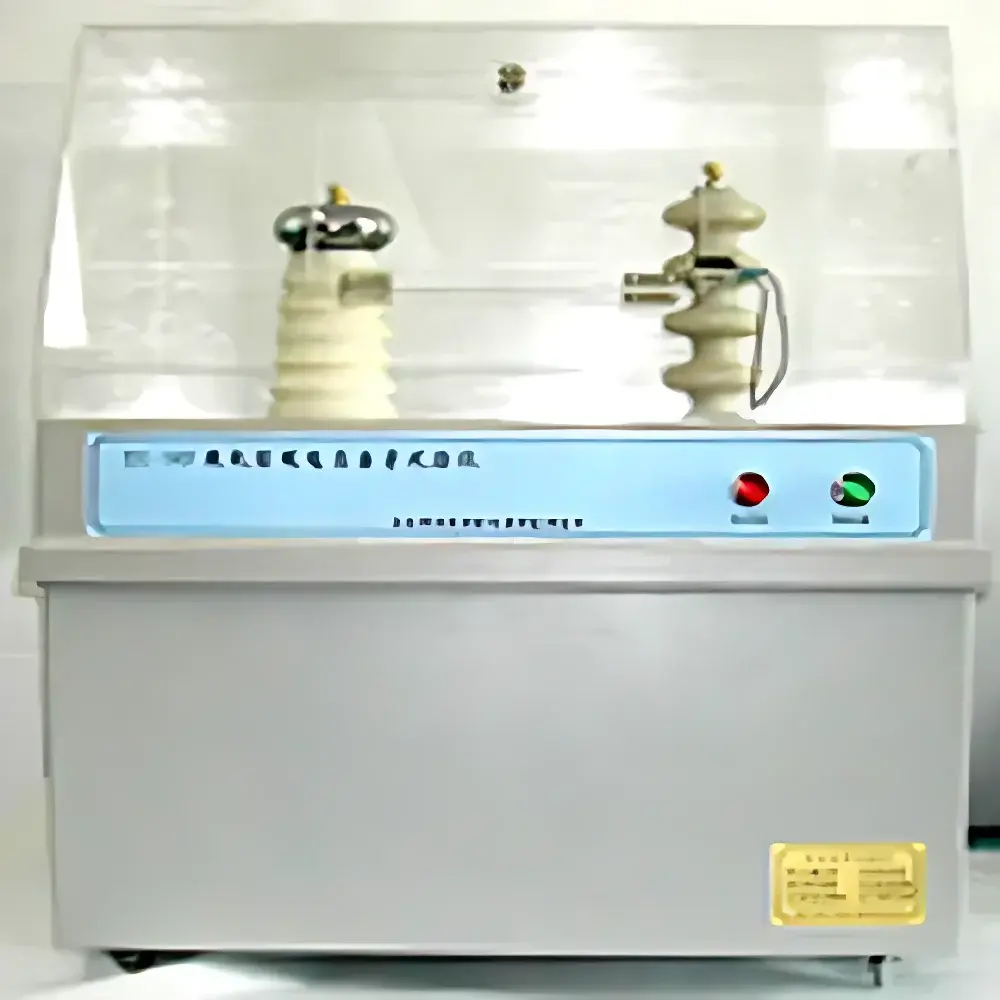
Beiguang Jingyi BDJC-50KV Industrial-Frequency Dielectric Withstand Voltage Tester
| Brand | Beiguang Jingyi / All Precision Instrument |
|---|---|
| Origin | Beijing, China |
| Manufacturer Type | OEM Manufacturer |
| Product Origin | Domestic (China) |
| Model | BDJC-50KV |
| Pricing | Upon Request |
Overview
The Beiguang Jingyi BDJC-50KV Industrial-Frequency Dielectric Withstand Voltage Tester is a precision high-voltage test system engineered for determining the dielectric breakdown strength and voltage withstand capability of solid insulating materials under AC (50 Hz) or DC stress conditions. It operates on the principle of controlled voltage ramping—applying a steadily increasing electric field across a standardized electrode configuration until electrical breakdown occurs—thereby quantifying the material’s intrinsic dielectric integrity. Designed in strict accordance with international electrotechnical standards—including ASTM D149, IEC 60243-1, and GB/T 1408.1—the instrument delivers repeatable, traceable, and auditable results essential for quality assurance, R&D validation, and regulatory compliance in electrical insulation engineering.
Key Features
- Programmable voltage output: AC/DC 0–50 kV, continuously adjustable with ±1% accuracy per full-scale reading
- Multi-mode voltage ramp control: Uniform ramp (100–5000 V/s), stepwise gradient, and fixed-duration withstand testing
- Dual-test medium compatibility: Air-gap and oil-immersed configurations (standardized transformer oil bath included)
- Integrated safety architecture: Six-layer hardware protection including overvoltage cutoff, overcurrent interruption (<0.05 s response), loss-of-voltage lockout, leakage current detection, short-circuit isolation, and discharge alarm
- Physical interlock system: Interlocked test chamber door, mechanical reset switch, HV circuit breaker, and main power disconnect—all compliant with IEC 61010-1 functional safety requirements
- Microprocessor-controlled digital regulation: Solid-state, contactless voltage regulation eliminates mechanical wear and ensures long-term stability
- Real-time data acquisition: Simultaneous recording of applied voltage (kV), leakage current (mA), time-to-breakdown (ms), and waveform dynamics
Sample Compatibility & Compliance
The BDJC-50KV supports standardized test specimens per GB/T 1408.1, ASTM D149, and IEC 60243-1, including rigid plastics, elastomers, laminates, ceramics, glass, insulating varnishes, and polymer films. Electrode sets conform to Type 1 (flat disc) and Type 2 (spherical cap) geometries as specified in ISO 2577 and GB/T 1695. The system accommodates both ambient air and dielectric oil environments, enabling comparative evaluation of surface vs. bulk breakdown behavior. All calibration and verification procedures are traceable to national metrology institutes; each unit ships with an accredited calibration certificate issued by a CNAS-accredited laboratory or client-designated metrology provider. The design meets electromagnetic compatibility (EMC) Class B requirements per GB/T 18268.1 and includes dedicated grounding provisions (≥1.5 m buried copper rod) to suppress radiated emissions during arc events.
Software & Data Management
The proprietary Windows-based control software provides full experimental lifecycle management. Users define test parameters—including ramp rate, hold time, pass/fail thresholds, and electrode geometry—via intuitive GUI. During operation, the software logs synchronized voltage-current-time traces, renders real-time Lissajous-type curves, and flags breakdown events with timestamped waveform snapshots. Post-test, datasets support overlay comparison across multiple samples, statistical analysis (mean, std. dev., Weibull distribution fitting), and export to CSV, Excel, or PDF. Audit trail functionality records operator ID, parameter changes, calibration events, and system faults—fully compliant with GLP and 21 CFR Part 11 requirements when deployed with user authentication and electronic signature modules. Password-protected access levels ensure role-based control over test execution, data modification, and report generation.
Applications
This tester serves critical functions across electrical manufacturing, polymer R&D, and certification laboratories. Typical use cases include qualification of insulating coatings for motor windings, validation of cable jacketing polymers per IEC 60811, assessment of printed circuit board substrates (e.g., FR-4), screening of encapsulation resins for high-voltage electronics, and comparative dielectric performance benchmarking of ceramic dielectrics in capacitor development. In academic settings, it supports fundamental studies on Townsend discharge mechanisms, space charge accumulation, and thermal runaway initiation in polymeric dielectrics. Its dual AC/DC capability enables investigation of frequency-dependent breakdown phenomena relevant to power electronics and pulsed-power systems.
FAQ
Is a higher maximum voltage rating always preferable when selecting a dielectric tester?
No. Optimal measurement accuracy occurs when the expected breakdown voltage falls within 67–90% of the instrument’s full-scale range. Selecting excessive headroom introduces unnecessary cost, complexity, and electromagnetic interference without improving resolution or reliability.
Does higher output current improve test validity?
Not inherently. Breakdown current is determined by specimen impedance and arc physics—not instrument specification. Excessive current (>100 mA) increases EMI risk and may mask subtle pre-breakdown phenomena; typical recommended range is 40–100 mA for reproducible arc initiation without destructive energy deposition.
What calibration traceability does this system provide?
Each unit includes a factory calibration certificate traceable to China National Institute of Metrology (NIM) or equivalent national metrology institute. Optional third-party certification (e.g., NIST-traceable) is available upon request.
Can the system operate under GLP or GMP audit conditions?
Yes—when configured with user authentication, electronic signatures, and full audit trail logging, the software complies with FDA 21 CFR Part 11 and ISO/IEC 17025 documentation requirements.
What electrode configurations are supported out-of-the-box?
Two standardized electrode sets per GB/T 1408.1: 25 mm diameter brass discs (Type 1) and 12.5 mm radius spherical caps (Type 2), both supplied with stainless-steel holders and alignment fixtures.



