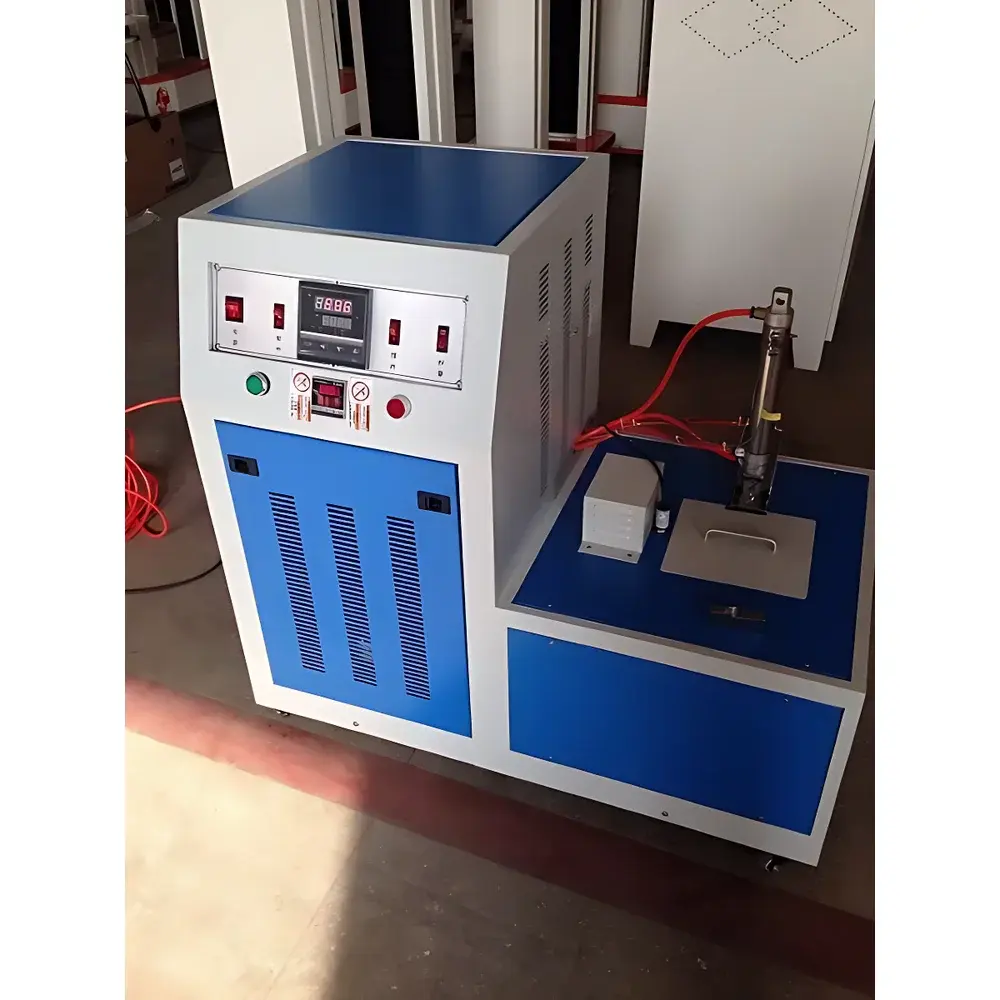
Beiguang Jingyi XCY Low-Temperature Brittleness Impact Tester for Elastomers

| Brand | Beiguang Jingyi / All Precision Instrument |
|---|---|
| Origin | Beijing, China |
| Manufacturer Type | Direct Manufacturer |
| Country of Origin | China |
| Model | XCY |
| Temperature Control Range | Ambient to −70 °C (ambient ≤ 25 °C) |
| Temperature Stability | ±0.3 °C |
| Cooling Rate | ~2.5 °C/min (0 °C to −30 °C) |
| Internal Chamber Dimensions | 280 × 170 × 120 mm (L × W × H) |
| Sample Capacity | 1 specimen per test cycle |
| Digital Timer Range | 0–99 min, 1-s resolution |
| Cooling Medium | Ethanol or other non-freezing liquid |
| Stirring Motor Power | 8 W |
| Power Supply | 220–240 V AC, 50 Hz, 1.5 kW |
Ask about pricing, availability and specifications.
Overview
The Beiguang Jingyi XCY Low-Temperature Brittleness Impact Tester for Elastomers is a precision-controlled thermal-mechanical testing system engineered to determine the brittle temperature (Tb) of vulcanized rubber, thermoplastic elastomers, and other flexible polymeric materials. Based on the principle of standardized impact-induced fracture under cryogenic conditions, the instrument subjects conditioned specimens to a defined mechanical impact—typically via a falling hammer or pendulum mechanism—while immersed in a precisely stabilized low-temperature bath. The brittle temperature is defined as the highest temperature at which ≥50% of tested specimens exhibit visible cracking or splitting upon impact, in accordance with internationally harmonized test protocols. This parameter serves as a critical indicator of low-temperature serviceability, enabling comparative evaluation of formulation robustness, polymer backbone flexibility, plasticizer efficiency, and crosslink density effects. The XCY system implements a dual-zone refrigeration architecture with forced convection circulation, ensuring uniform thermal distribution across the test chamber and minimizing thermal gradients that could compromise result reproducibility.
Key Features
- High-stability cryogenic control system capable of maintaining temperatures from ambient down to −70 °C with ±0.3 °C accuracy over extended dwell periods
- Programmable cooling profile with segmented ramp rates optimized for energy efficiency and thermal shock mitigation
- Stainless-steel internal chamber (280 × 170 × 120 mm) designed for chemical resistance and long-term dimensional stability under repeated thermal cycling
- Digital timer with 1-second resolution supports precise dwell time control prior to impact, essential for standard-compliant conditioning
- Integrated stirring motor (8 W) ensures homogeneous coolant temperature throughout the bath volume, reducing localized stratification
- Compliant with mechanical safety standards for enclosed cryogenic impact testing, including guarded access and emergency cutoff circuitry
- Designed for compatibility with ASTM D746, ISO 974, GB/T 5470–2008, and GB/T 1682–2014 test methods
Sample Compatibility & Compliance
The XCY tester accommodates standard dumbbell-shaped or rectangular specimens (per GB/T 5470 and ISO 974) cut from molded or extruded elastomer compounds. Specimen dimensions are typically 20–25 mm in length, 5–6 mm in width, and 2–3 mm in thickness—dimensions aligned with international practice for statistical reliability and stress concentration consistency. The system supports both single-specimen and multi-batch sequential testing configurations, with strict adherence to preconditioning requirements (e.g., minimum 30-minute dwell at target temperature prior to impact). All operational parameters—including temperature setpoint, dwell duration, and impact energy—are traceable and configurable to satisfy GLP-compliant laboratory documentation workflows. The instrument’s thermal performance and mechanical repeatability have been verified against reference materials certified per NIST-traceable calibration protocols, supporting audit readiness for ISO/IEC 17025-accredited laboratories.
Software & Data Management
While the base XCY model operates via front-panel digital controls, optional RS-232 or USB interfaces enable integration with external data acquisition systems. Users may log temperature profiles, dwell times, and pass/fail outcomes into LIMS-compatible CSV or Excel formats. For regulated environments, the system supports manual entry of operator ID, sample ID, and environmental conditions into structured test records—fully compatible with FDA 21 CFR Part 11 requirements when paired with validated electronic lab notebook (ELN) software. Firmware updates maintain alignment with evolving national and international test method revisions, including recent amendments to GB/T 5470 and ASTM D746 regarding impact velocity tolerances and specimen mounting fixtures.
Applications
This instrument is routinely deployed in R&D laboratories evaluating low-temperature resilience of automotive sealing compounds, aerospace O-rings, medical tubing formulations, and footwear outsoles. Quality control labs use it for incoming raw material verification, batch release testing of compounded rubber stocks, and accelerated aging correlation studies. It further supports failure analysis investigations—such as field failures attributed to winter brittleness—by correlating Tb shifts with changes in cure system, filler loading, or antioxidant depletion. In academic settings, the XCY facilitates structure-property relationship studies linking glass transition behavior (measured via DSC) to macroscopic impact fracture thresholds.
FAQ
What standards does the XCY tester comply with?
It meets the technical requirements of GB/T 1682–2014, GB/T 5470–2008, HG 2-162–1965, ASTM D746, and ISO 974.
Is ethanol the only acceptable cooling medium?
No—other non-freezing, non-corrosive liquids with suitable thermal conductivity and viscosity (e.g., aqueous ethylene glycol mixtures) may be used, provided they do not degrade chamber seals or stirrer components.
Can the XCY be used for non-rubber materials?
Yes—it is applicable to thermoplastics, foams, and certain composites where low-temperature embrittlement is a design constraint, provided specimens conform to dimensional and mounting specifications in relevant standards.
How is temperature uniformity verified within the chamber?
Calibration includes multi-point probe mapping using NIST-traceable platinum resistance thermometers at nine spatial locations across the working volume, per ISO/IEC 17025 clause 6.4.3.
Does the system include impact energy calibration certification?
Impact energy is mechanically fixed per standard fixture geometry; users must verify hammer mass and drop height periodically using calibrated mass and length standards—documentation templates are provided in the operator manual.
More from Beiguang Jingyi / All Precision Instrument
View all Beiguang Jingyi / All Precision Instrument products → Beiguang Jingyi BWN-3KN High-Precision Electromechanical Tensile Testing Machine for Polymeric Materials
- Beiguang Jingyi BN-10KN Universal Tensile Testing Machine
- Beiguang Jingyi GDAT-70MHz High-Frequency Dielectric Constant Analyzer
- Beiguang Jingyi BWN-5000N Geotextile Tensile and Puncture Testing Machine