
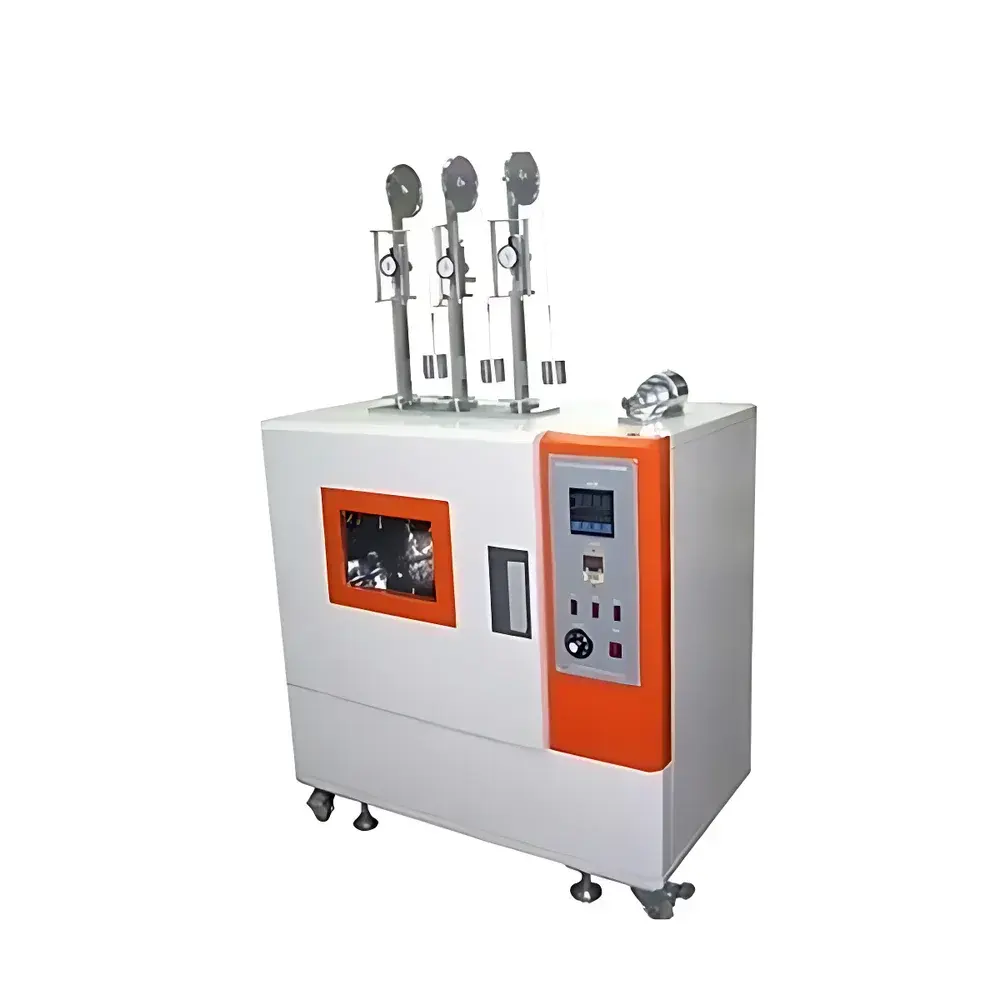
North Guang Precision Instrument BMD-100 Microcomputer-Controlled Martens Heat Resistance Tester
| Brand | North Guang Precision Instrument / All Precision Instrument |
|---|---|
| Origin | Beijing, China |
| Manufacturer Type | Manufacturer |
| Country of Origin | China |
| Model | BMD-100 |
| Price | USD 1,280 (FOB Beijing) |
| Max. Temperature Uniformity | ≤2 °C across heating chamber |
| Heating Rates | 50 ±3 °C/h and 10 ±2 °C per 12 min |
| Temperature Sensor Accuracy | ±1 °C |
| Specimen Dimensions | (120 ±1) mm × (15 ±0.2) mm × (10 ±0.2) mm (thickness >10 mm machined to 10 mm) |
| Load Application | 50 ±0.2 kgf/cm² |
| Initial Test Temperature | 30 ±10 °C |
| Effective Beam Span | 56 ±1 mm |
| Internal Chamber Dimensions | 350 × 400 × 400 mm |
Overview
The North Guang Precision Instrument BMD-100 Microcomputer-Controlled Martens Heat Resistance Tester is a standardized thermal deformation evaluation system engineered for the determination of the Martens heat resistance temperature (HRT) of rigid polymeric materials—including thermoplastics, engineering plastics, elastomers, and cable insulation compounds—according to ISO 2507-2, ASTM D1525, and GB/T 1699–2003 and GB/T 1035–2008. The instrument operates on the principle of cantilever beam deflection under constant static load while subjected to controlled, linear thermal ramping. As temperature increases, polymer softening induces measurable bending in a simply supported rectangular specimen; the temperature at which deflection reaches 0.21 mm (or 0.32 mm, depending on standard selection) is recorded as the Martens HRT. This method provides a reproducible, non-destructive assessment of short-term thermal stability under mechanical constraint—critical for material qualification in automotive, electrical insulation, and construction applications where dimensional integrity at elevated service temperatures is essential.
Key Features
- Microprocessor-based closed-loop temperature control with PID algorithm ensures stable thermal ramping profiles compliant with both 50 ±3 °C/h and 10 ±2 °C/12 min rate specifications.
- High-resolution optical grating displacement transducer (0.001 mm resolution) integrated into three independent deformation measurement units enables simultaneous multi-specimen testing with traceable linearity and long-term drift stability.
- Triple-load station configuration with calibrated dead-weight loading system (50 ±0.2 kgf/cm²) guarantees consistent stress application across all test positions; each station includes precision-ground contact probes and adjustable support spans.
- Uniform heating chamber (350 × 400 × 400 mm internal volume) features insulated double-wall construction, forced-air convection, and distributed heater zones to maintain ≤2 °C spatial temperature deviation throughout the working zone.
- Integrated data acquisition module synchronizes temperature, time, and deflection signals at 10 Hz sampling rate; raw data exported in CSV format for post-test analysis and audit trail generation.
Sample Compatibility & Compliance
The BMD-100 accommodates standard bar specimens measuring (120 ±1) mm × (15 ±0.2) mm × (10 ±0.2) mm, with optional machining capability for thicker stock. Materials tested include but are not limited to PVC, ABS, PA6/66, PBT, PC, PP, PE, silicone rubber, and cross-linked polyethylene (XLPE). All operational parameters meet the metrological requirements of GB/T 1699, GB/T 1035, ISO 2507-2:2022, and ASTM D1525–21. The system supports GLP-compliant workflows through timestamped data logging, user-access-level controls, and electronic signature-ready reporting—fully compatible with laboratory quality management systems requiring 21 CFR Part 11–aligned documentation practices.
Software & Data Management
The proprietary Windows-based control software provides real-time visualization of temperature ramps and deflection curves, automatic endpoint detection per selected standard, and configurable pass/fail thresholds. Each test record includes embedded metadata: operator ID, calibration certificate IDs (temperature sensor, load cell, displacement transducer), environmental conditions (ambient T/RH), and hardware firmware version. Audit logs track all parameter modifications, report exports, and user logins. Export options include PDF reports with embedded calibration certificates, Excel-compatible datasets, and XML files for LIMS integration. Software validation documentation (IQ/OQ protocols) is available upon request for regulated environments.
Applications
- Quality assurance of thermoplastic compounds prior to extrusion or injection molding release.
- Comparative thermal performance screening during polymer formulation development.
- Verification of heat resistance compliance for flame-retardant cable sheathing materials (IEC 60811-2-1).
- Technical specification validation for automotive interior trim components exposed to dashboard-level thermal cycling.
- Supporting technical dossiers for CE marking and UL recognition submissions where HRT serves as a key thermal index.
FAQ
What standards does the BMD-100 comply with?
The instrument meets the physical and procedural requirements of GB/T 1699–2003, GB/T 1035–2008, ISO 2507-2:2022, and ASTM D1525–21.
Can the system be calibrated independently by the user?
Yes—temperature sensors, load cells, and displacement transducers are field-calibratable using NIST-traceable reference standards; calibration certificates and procedures are supplied with each unit.
Is the software compatible with Windows 10/11 and networked lab environments?
Yes—the software runs natively on 64-bit Windows 10/11 and supports TCP/IP-based remote monitoring and centralized data aggregation via LAN.
What maintenance is required for long-term accuracy?
Annual verification of thermal uniformity and load application accuracy is recommended; optical grating sensors require only periodic dust removal—no lubrication or alignment needed.
Does the system support automated report generation for regulatory audits?
Yes—PDF reports include digital signatures, calibration traceability, and full audit trails meeting GLP, GMP, and FDA 21 CFR Part 11 requirements.



