
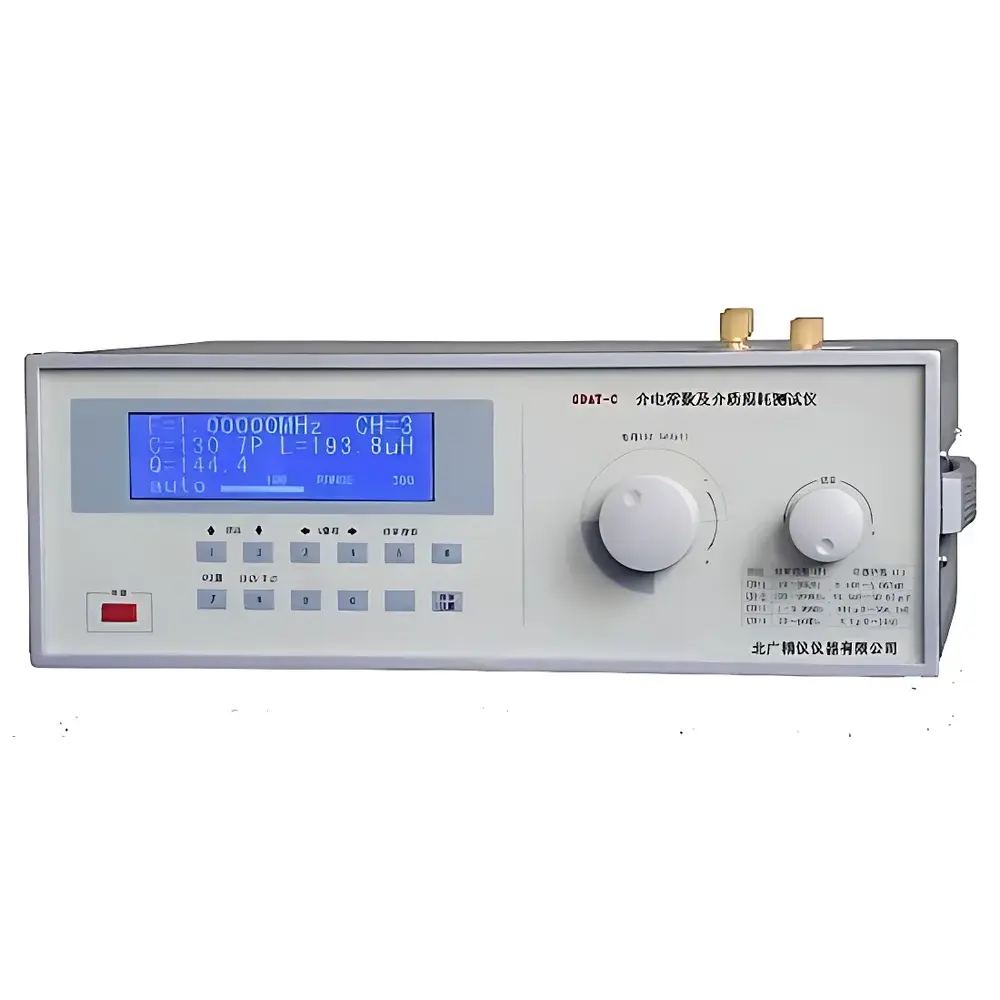
Beijing North Guang GDAT-C Digital Q-Meter for Dielectric Constant and Dissipation Factor Measurement
| Brand | Beijing North Guang Precision Instrument |
|---|---|
| Origin | Beijing, China |
| Manufacturer Type | Direct Manufacturer |
| Model | GDAT-C |
| Frequency Range | 1 kHz – 70 MHz (DDS Synthesized) |
| Q Range | 1–1000 (Resolution: 0.1 Q) |
| Tuning Capacitance | 40–500 pF (±1% or ±0.5 pF) |
| Residual Inductance | ~30 nH |
| Dimensions | 415 × 180 × 170 mm |
| Weight | 6.5 kg |
| Compliance | JJF 1073–2000, GB/T 1409–2006, GB/T 1693–2007, ASTM D150, IEC 60250 |
Overview
The Beijing North Guang GDAT-C Digital Q-Meter is a precision impedance measurement instrument engineered for high-frequency characterization of passive components and dielectric materials. Operating on the principle of series resonance, it measures the quality factor (Q), inductance (L), capacitance (C), and dissipation factor (tan δ) by analyzing voltage ratio across resonant circuits. Its core architecture integrates a direct digital synthesis (DDS) signal source capable of stable, low-distortion output from 1 kHz to 70 MHz—ensuring traceable frequency accuracy and amplitude stability critical for reproducible RF and microwave material evaluation. Designed specifically for laboratories engaged in electrical insulation research, polymer development, and RF component qualification, the GDAT-C serves as both a high-precision Q-meter and a calibrated platform for dielectric spectroscopy when paired with the BH916D dielectric test fixture.
Key Features
- DDS-based signal generation with five-digit frequency resolution and continuous digital tuning across 1 kHz–70 MHz
- Automatic resonance search function—simultaneously locates resonant frequency and optimal tuning capacitance for rapid Q extraction
- Dual-mode capacitance control: sensor-based analog readout (GDAT-A variant) and stepper-motor-driven precision adjustment (GDAT-C variant), enabling sub-pF resolution (±0.2 pF microtuning range)
- Q-value display with 0.1 Q resolution, auto-ranging across three scales (100/316/999), and programmable Q pre-set with GO/NO-GO pass-fail indication
- Low residual inductance (~30 nH) minimizes systematic error in high-frequency Q measurements, supporting reliable evaluation up to 70 MHz
- Integrated LCD interface presenting real-time parameters: Q, frequency, tuning status, and measurement mode—eliminating manual interpolation or external calculation
Sample Compatibility & Compliance
The GDAT-C, when used with the BH916D dielectric test fixture, supports standardized evaluation of solid and liquid insulating materials per internationally recognized protocols. The BH916D employs a precision micrometer-adjustable parallel-plate capacitor (Φ38 mm or Φ50 mm electrodes, gap resolution ±0.002 mm, max spacing ≥8 mm) to establish controlled electric field geometry. Material permittivity (εr) and loss tangent (tan δ) are derived from comparative Q-value shifts measured with and without the specimen, combined with dimensional inputs per ASTM D150, IEC 60250, GB/T 1409–2006, and GB/T 1693–2007. The system’s inherent repeatability and documented calibration traceability to JJF 1073–2000 ensure data integrity for GLP-compliant reporting and regulatory submissions involving dielectric performance validation.
Software & Data Management
While the GDAT-C operates as a standalone benchtop instrument with full front-panel digital readout, its architecture supports integration into automated test environments via standard analog/digital I/O interfaces (RS-232 optional). All displayed parameters—including Q, frequency, capacitance, and pass/fail status—are accessible as ASCII-formatted serial outputs, enabling direct logging into LIMS or custom QA databases. For users requiring audit-ready records, the instrument’s deterministic measurement sequence and fixed algorithmic computation (based on series-resonance voltage-ratio derivation) satisfy foundational requirements for 21 CFR Part 11 compliance when deployed with validated host software and procedural controls. No proprietary drivers or closed-format files are generated—raw parameter streams remain fully interpretable and exportable.
Applications
- Characterization of polymer films, ceramics, and composite laminates for high-frequency PCB substrate selection
- Quality control of capacitor dielectrics (e.g., ceramic multilayer, polymer film) during R&D and production
- Quantification of moisture absorption effects on epoxy resin systems via tan δ drift at fixed frequencies
- Resonator design validation—including distributed capacitance and unloaded Q estimation for RF filters and antenna matching networks
- Evaluation of transformer oil and silicone gels under AC stress conditions per IEEE C57.106 guidelines
- Academic research in ferroelectric hysteresis modeling, where εr(f) dispersion curves inform domain-wall dynamics hypotheses
FAQ
What standards does the GDAT-C + BH916D system comply with?
It conforms to JJF 1073–2000 (China national calibration specification for HF Q-meters), GB/T 1409–2006 and GB/T 1693–2007 (Chinese standards for dielectric constant and loss tangent), ASTM D150 (Standard Test Methods for Dielectric and Resistivity Properties of Solid Electrical Insulating Materials), and IEC 60250 (Measurement of the Dielectric Properties of Solid Electrical Insulating Materials at Power, Audio and Radio Frequencies Including Meter Wave Lengths).
Can the GDAT-C measure liquid samples?
Yes—when used with appropriate electrode configurations (e.g., guarded coaxial cells or modified BH916D fixtures), it supports quantitative tan δ and εr determination of insulating liquids such as transformer oils, silicone fluids, and dielectric coolants, provided sample conductivity remains below 10−9 S/m to avoid conductive-loss dominance.
Is the instrument suitable for GMP-regulated environments?
As a Class II metrological instrument with documented calibration procedures, traceable reference standards, and deterministic measurement algorithms, it may be incorporated into GMP workflows when supported by site-specific IQ/OQ documentation, periodic verification against certified reference materials, and electronic record controls aligned with Annex 11 expectations.
What is the typical measurement uncertainty for tan δ at 1 MHz?
Under controlled lab conditions (23 °C ±1 °C, RH < 50%, shielded environment), the combined standard uncertainty for tan δ is ≤ ±(5% of reading + 2×10⁻⁴), primarily limited by electrode edge effects and thickness measurement repeatability—not instrument electronics.
Does the system support temperature-controlled testing?
The base GDAT-C and BH916D are ambient-temperature instruments; however, they are mechanically compatible with commercial environmental chambers (e.g., ESPEC or Angelantoni units) that accommodate the 415 mm width and permit feedthrough connections for temperature sensors and bias lines—enabling extended-temperature permittivity profiling with user-defined thermal ramp protocols.



