
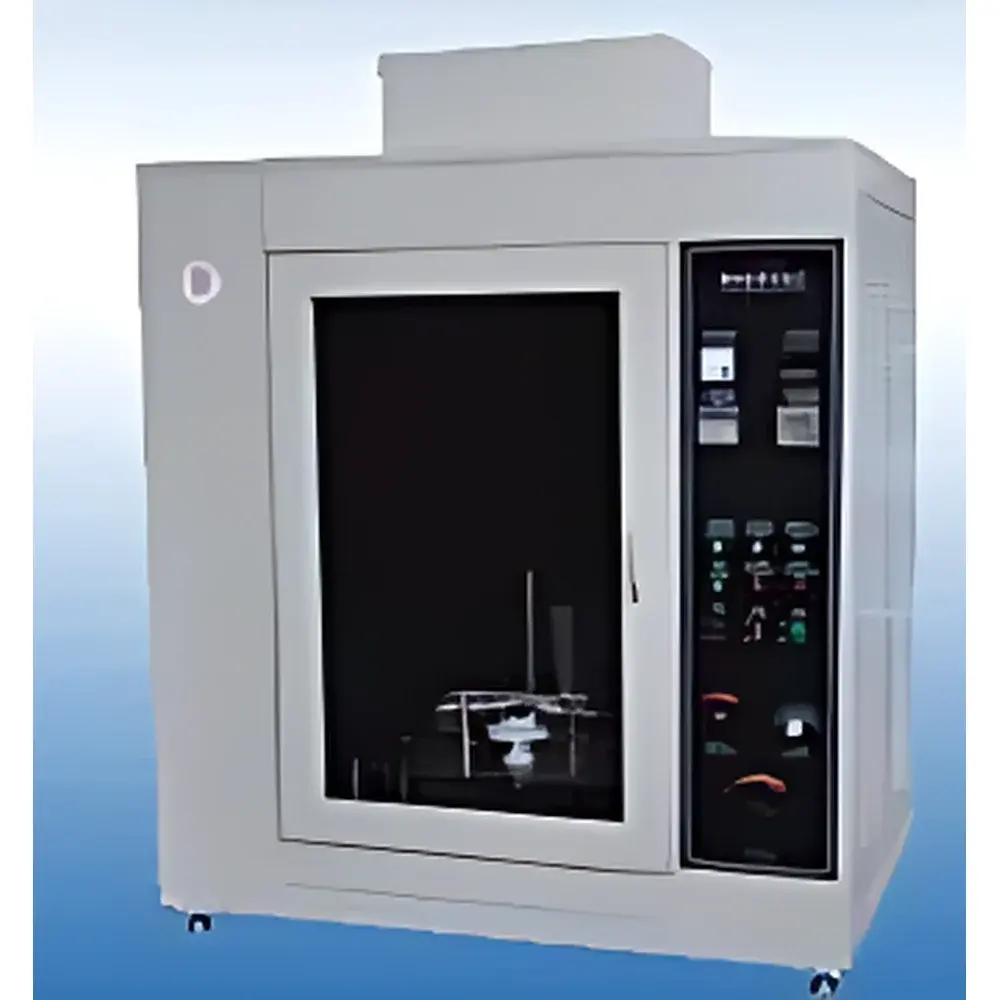
North Guang Precision Instrument BD-60 Tracking Resistance Tester
| Brand | North Guang Precision Instrument |
|---|---|
| Origin | Beijing, China |
| Manufacturer Type | Direct Manufacturer |
| Country of Origin | China |
| Model | BD-60 |
| Test Voltage Range | 100–600 V AC (rms), digitally adjustable and displayed |
| Voltage Accuracy | ±1.5% of reading (rms) |
| Electrode Configuration | Dual platinum (5.0 ± 0.1 mm × 2.0 ± 0.1 mm × ≥12 mm) and brass electrodes, tip angle 30° ± 2°, tip width 0.01–0.1 mm, inter-electrode angle 60° ± 5°, spacing 4.0 ± 0.1 mm, applied force 1.00 ± 0.05 N |
| Dropping System | Programmable timer with presettable drop count |
| 50-drop duration | 24.5 ± 2 min |
| droplet volume | 20 drops = 0.380–0.489 g, 50 drops = 0.997–1.147 g |
| nozzle-to-sample height | 35 ± 5 mm |
| Short-Circuit Current Adjustment | 1.0 ± 0.1 A (rms), digital display, ±1% accuracy |
| Ambient Operating Conditions | 0–40 °C, ≤80% RH, non-corrosive, low-vibration environment |
| Power Supply | AC 220 V ± 2%, 50 Hz ± 1%, 1 kVA |
| Enclosure | 1.2 mm thick 304 stainless steel, standard volume 0.5 m³ (1100 × 1150 × 550 mm) |
| Sample Support | ≥4 mm thick tempered glass plate |
| Airflow Control | 0.2 m/s laminar flow (integrated ventilation system) |
| Compliance Standards | IEC 60112:2003, UL 746A, ASTM D3638-92, DIN 53480, GB/T 4207 |
Overview
The North Guang Precision Instrument BD-60 Tracking Resistance Tester is an electromechanical test system engineered for the standardized evaluation of electrical tracking resistance in solid insulating materials under controlled contamination and voltage stress conditions. It operates on the principle of inducing progressive carbonized conductive paths—termed “tracking”—on material surfaces via repeated electrolytic droplet application and high-voltage exposure. This method quantifies two critical safety indices: the Comparative Tracking Index (CTI) and the Proof Tracking Index (PTI), both defined in IEC 60112:2003 and widely adopted across global electrical safety certification frameworks. The instrument replicates real-world failure mechanisms observed in end-use environments—including humid, dusty, or chemically contaminated enclosures—where leakage currents initiate localized thermal degradation, leading to insulation breakdown and potential fire hazard. Its design adheres strictly to the geometric, electrical, and procedural constraints specified in international standards, ensuring metrological traceability and inter-laboratory reproducibility.
Key Features
- Precisely machined platinum and brass electrodes conforming to IEC 60112 dimensional tolerances: (5.0 ± 0.1) mm × (2.0 ± 0.1) mm × (≥12) mm, with chisel-tip geometry (30° ± 2° angle, 0.01–0.1 mm flat width) and fixed 60° ± 5° inter-electrode orientation.
- Digital, rms-sensing voltage control (100–600 V AC) with ±1.5% measurement uncertainty and integrated overcurrent protection triggered at (0.5 ± 10%) A rms after a (2 ± 10%) s delay—enabling precise fault detection per standard-defined thresholds.
- Programmable droplet delivery system with calibrated volumetric accuracy: 20-drop mass 0.380–0.489 g; 50-drop mass 0.997–1.147 g; repeatable 50-drop timing of 24.5 ± 2 minutes; nozzle height maintained at 35 ± 5 mm using included stainless-steel gauge.
- Stainless-steel test chamber (1.2 mm 304 grade) with forced-air ventilation (0.2 m/s laminar flow) to stabilize ambient humidity and dissipate thermal byproducts during extended testing cycles.
- Modular mechanical design supporting multiple chamber volumes (0.1 m³, 0.5 m³, or custom 0.75 m³) and interchangeable sample support plates (≥4 mm tempered glass) to accommodate diverse specimen geometries and mounting requirements.
- Comprehensive electrical safety architecture including isolated high-voltage circuitry, grounded chassis, emergency stop switch, and visual/audible fault indicators compliant with EN 61010-1 requirements for laboratory equipment.
Sample Compatibility & Compliance
The BD-60 accommodates flat, rigid specimens up to 100 mm × 100 mm × 10 mm in dimension, with surface planarity verified prior to test initiation. Compatible material classes include thermosetting and thermoplastic engineering resins (e.g., PBT, PA66, epoxy composites), laminated sheet goods, molded insulators, PCB substrates, and elastomeric sealing components. All operational parameters—including electrode pressure (1.00 ± 0.05 N), solution composition (0.1% ammonium chloride + 0.02% non-ionic surfactant per IEC 60112), and environmental conditioning—are aligned with mandatory clauses of IEC 60112:2003, UL 746A Section 21, ASTM D3638-92, DIN 53480, and GB/T 4207. The system supports full audit trails for GLP and GMP-regulated environments when paired with external data logging hardware meeting FDA 21 CFR Part 11 electronic record requirements.
Software & Data Management
While the BD-60 operates as a standalone benchtop instrument with analog-digital hybrid controls, it integrates seamlessly with third-party PC-based data acquisition systems via RS-232 or USB-to-serial interface. Real-time voltage, current, elapsed time, and drop count are output as ASCII-formatted telemetry streams, enabling synchronization with LabVIEW, MATLAB, or custom Python scripts for automated pass/fail analysis and statistical reporting. Test logs—including operator ID, specimen ID, solution batch number, ambient temperature/humidity, and final CTI/PTI classification—can be exported in CSV or PDF format for inclusion in regulatory submissions (e.g., UL File Reviews, CE Technical Documentation, or IECEx Certification Dossiers). Optional firmware upgrades provide timestamped event logging with ISO 8601-compliant UTC stamps and SHA-256 hash verification for data integrity assurance.
Applications
- Qualification testing of polymeric housings and terminal blocks used in IP65-rated industrial controllers per UL 508 and IEC 61800-5-1.
- Material screening for automotive ECU enclosures exposed to under-hood condensation and road-salt aerosols, referenced against ISO 60068-2-30 and SAE J1211.
- Validation of flame-retardant additives in halogen-free cable jacketing compounds per IEC 60754-2 and EN 50267-2-1.
- Design verification of medical device power supply insulation barriers compliant with IEC 60601-1 Clause 8.8.3 (dielectric strength and tracking resistance).
- Supplier qualification audits for aerospace-grade connectors (AS50881) where CTI ≥ 600 V is mandated for Class F insulation systems.
- Root-cause analysis of field failures involving arc-tracking on printed circuit board assemblies contaminated with flux residues or metallic particulates.
FAQ
What standards does the BD-60 fully support out-of-the-box?
The BD-60 is factory-configured and mechanically validated for IEC 60112:2003, UL 746A, ASTM D3638-92, DIN 53480, and GB/T 4207. Calibration certificates reference NIST-traceable voltage and current standards.
Can the instrument be used with alternative test solutions beyond ammonium chloride?
Yes—electrode and nozzle configurations allow substitution with other IEC-specified electrolytes (e.g., 0.1% sodium formate per Annex B of IEC 60112), provided solution viscosity and surface tension remain within ±5% of reference values to maintain droplet formation consistency.
Is third-party calibration and certification available?
North Guang Precision Instrument provides ISO/IEC 17025-accredited calibration services through authorized regional partners, including full uncertainty budgets for voltage, current, time, and mass measurements per ILAC-MRA guidelines.
How is operator safety ensured during high-voltage operation?
The system incorporates dual redundant interlocks: a physical door switch that de-energizes HV circuits upon chamber opening, and a software-enforced timeout that terminates voltage application if no valid drop sequence is initiated within 60 seconds of test start.
Does the BD-60 meet electromagnetic compatibility (EMC) requirements for laboratory use?
Yes—the enclosure provides ≥40 dB shielding attenuation from 30 MHz to 1 GHz, and conducted emissions comply with CISPR 11 Group 1, Class B limits, verified per EN 61326-1 for laboratory electrical equipment.
Related Products



