
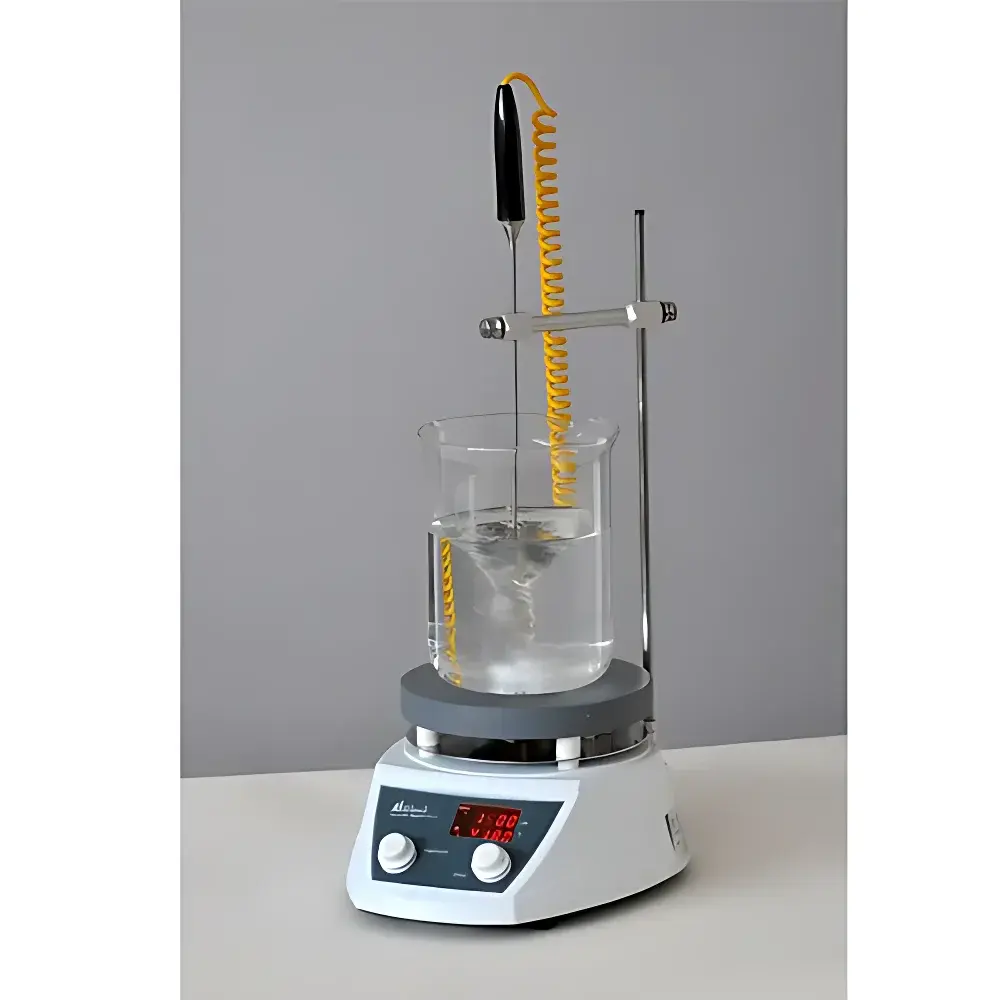
Otisience AM-6250B Digital Magnetic Stirrer with Heating
| Brand | Otisience |
|---|---|
| Model | AM-6250B |
| Type | Magnetic Stirrer |
| Max. Stirring Volume | 5–10 L |
| Speed Range | 0–1500 rpm |
| Temperature Control Range | Ambient to 300 °C |
| Heating Plate Max. Temp. | 350 °C |
| Control Accuracy | ±0.5 °C |
| External PT100 Sensor Support | Yes |
| Heating Power | 300 W ±10% |
| Heating Plate Diameter | 150 mm |
| Dimensions (W×D×H) | 198 × 225 × 115 mm |
| Weight | 2.4 kg |
| Power Supply | 220 V / 50 Hz |
| Construction | Anodized Aluminum Heating Plate with PTFE Coating |
| Thermal Insulation | Dual-layer Bottom Insulation |
| Drive Motor | DC Brushless Motor |
| Control Method | Analog Knob + Digital PID Controller |
Overview
The Otisience AM-6250B Digital Magnetic Stirrer with Heating is an engineered laboratory instrument designed for precise, reproducible mixing and temperature-controlled sample preparation in analytical, pharmaceutical, chemical, and life science laboratories. It operates on the principle of magnetic coupling: a rotating permanent magnet—driven by a brushless DC motor beneath a thermally stable heating plate—generates a time-varying magnetic field that induces rotational motion in a magnetic stir bar placed inside a non-magnetic vessel (e.g., glass or plastic). Simultaneously, resistive heating elements embedded in the aluminum heating plate deliver uniform thermal energy, enabling simultaneous stirring and temperature regulation up to 300 °C (plate surface up to 350 °C). The unit integrates digital PID temperature control with analog speed adjustment, ensuring minimal thermal overshoot (<1 °C) and stable rotational output across the full 0–1500 rpm range—even under variable line voltage conditions. Its compact footprint (198 × 225 × 115 mm), low mass (2.4 kg), and dual-layer bottom insulation make it suitable for benchtop use in regulated environments where thermal safety, positional stability, and electromagnetic compatibility are critical.
Key Features
- Brushless DC motor drive ensures consistent torque delivery and long-term operational reliability without carbon brush wear or electrical noise interference.
- Digital PID temperature controller with ±0.5 °C accuracy over the ambient-to-300 °C range; supports external PT100 probe input for direct solution-phase temperature feedback and closed-loop regulation.
- Heating plate constructed from precision-machined anodized aluminum with a chemically resistant PTFE coating—resistant to acids, bases, and organic solvents; optimized for rapid thermal response and uniform heat distribution.
- 150 mm diameter heating surface accommodates standard round-bottom flasks (up to 10 L volume with appropriate stir bar geometry) and flat-bottom vessels with high thermal mass.
- Analog speed knob provides intuitive, tactile control with continuous 0–1500 rpm adjustment; speed remains unaffected by fluctuations in mains voltage (±10% tolerance).
- Dual-layer thermal insulation beneath the heating plate minimizes conductive heat loss to the base housing, improving energy efficiency and reducing external surface temperature during extended operation.
- Compliant with IEC 61010-1:2010 safety standards for electrical equipment for measurement, control, and laboratory use.
Sample Compatibility & Compliance
The AM-6250B is compatible with borosilicate glass (e.g., Pyrex®), polypropylene, PTFE, and quartz reaction vessels. It supports magnetic stir bars ranging from 20 mm to 80 mm in length, including coated (PTFE or glass-encapsulated) variants for aggressive media. The unit meets essential requirements for GLP-compliant workflows: temperature setpoint logging (via optional RS232/USB interface with third-party software), traceable calibration via external PT100, and mechanical design that prevents accidental contact between heating surface and operator. While not intrinsically rated for hazardous locations, its sealed electronics and grounded chassis comply with EN 61326-1 for electromagnetic immunity in laboratory settings. No CE marking is affixed; users must verify regional conformity prior to deployment in EU-regulated facilities.
Software & Data Management
The AM-6250B operates as a standalone instrument with no built-in data logging or network connectivity. However, its analog speed control and digital temperature display are fully compatible with external acquisition systems. When used with an external PT100 sensor, the unit’s temperature output signal can be routed to a data logger or SCADA system supporting 0–10 V or 4–20 mA analog inputs. Optional firmware-enabled communication modules (sold separately) provide RS232 or USB virtual COM port interfaces, allowing integration into LIMS or electronic lab notebook (ELN) platforms for audit-trail generation per FDA 21 CFR Part 11 requirements—provided the host software implements user authentication, electronic signatures, and change history tracking.
Applications
- Homogenization of viscous polymer solutions and nanoparticle suspensions prior to rheological or DLS analysis.
- Controlled heating and mixing during synthesis of metal-organic frameworks (MOFs) and sol-gel precursors.
- Standardized dissolution testing in pharmaceutical QC labs per USP , where precise bath temperature and agitation consistency are mandatory.
- Preparation of calibration standards and buffer solutions requiring thermal equilibration and gas saturation (e.g., CO₂-sparged Tris-HCl).
- Accelerated aging studies of lubricants and coatings under elevated temperature and shear stress.
- Supporting ASTM D2196 viscosity measurements using Brookfield-type spindles when paired with a calibrated viscometer stand.
FAQ
Does the AM-6250B support bidirectional (forward/reverse) stirring?
No. The unit provides unidirectional rotation only, optimized for laminar flow induction and thermal homogeneity in cylindrical vessels.
Can the heating plate temperature exceed 300 °C during operation?
Yes—the plate surface may reach up to 350 °C, but the instrument’s digital controller limits programmed solution temperature to 300 °C when using the external PT100 probe for safety-critical applications.
Is the PTFE coating on the heating plate resistant to hydrofluoric acid (HF)?
No. While PTFE exhibits broad chemical resistance, it is not recommended for prolonged exposure to concentrated HF or molten alkali metals. Use quartz or HF-resistant ceramic hotplates for such applications.
What is the recommended maintenance interval for the AM-6250B?
No scheduled maintenance is required. Wipe the PTFE surface with isopropyl alcohol after each use; inspect stir bars for chipping or demagnetization quarterly; verify PT100 calibration annually against a NIST-traceable reference thermometer.
Does Otisience provide ISO/IEC 17025-accredited calibration certificates?
Calibration services are available through authorized service centers; however, formal accreditation is provided only upon request and subject to additional documentation and turnaround time.



