
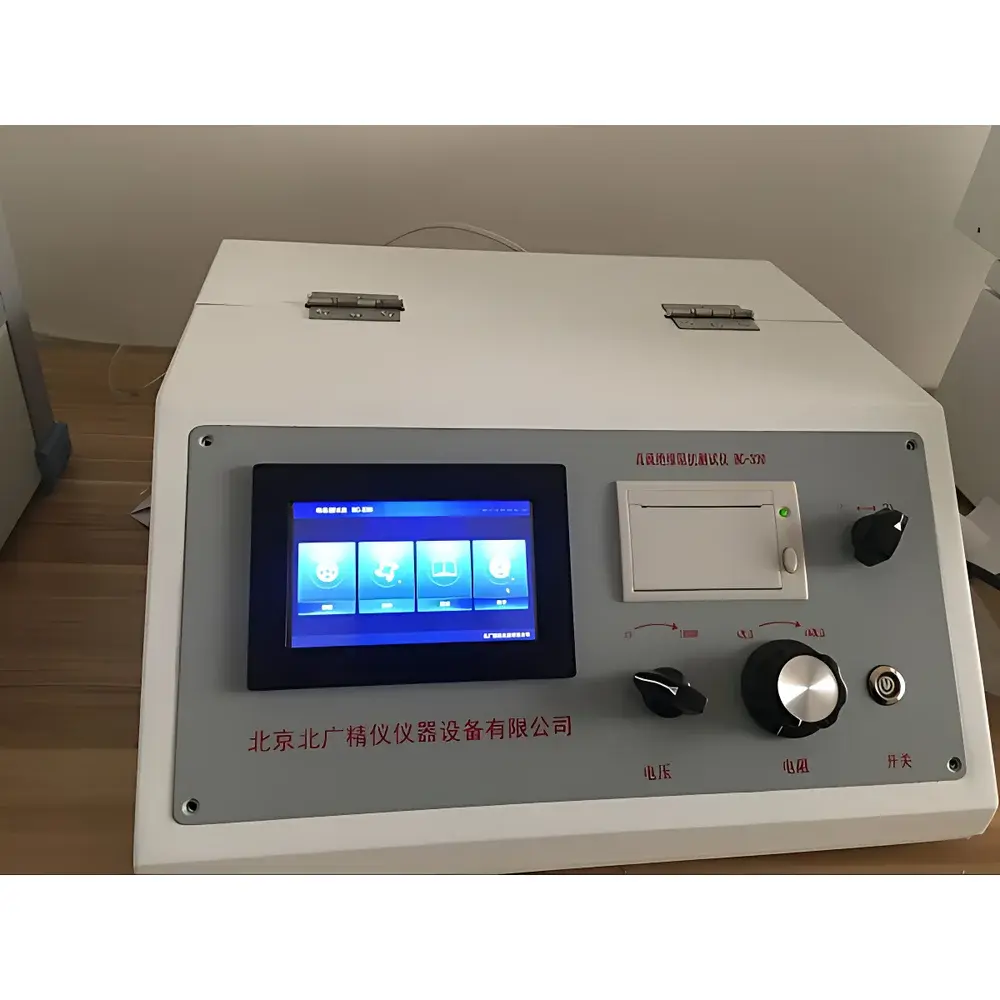
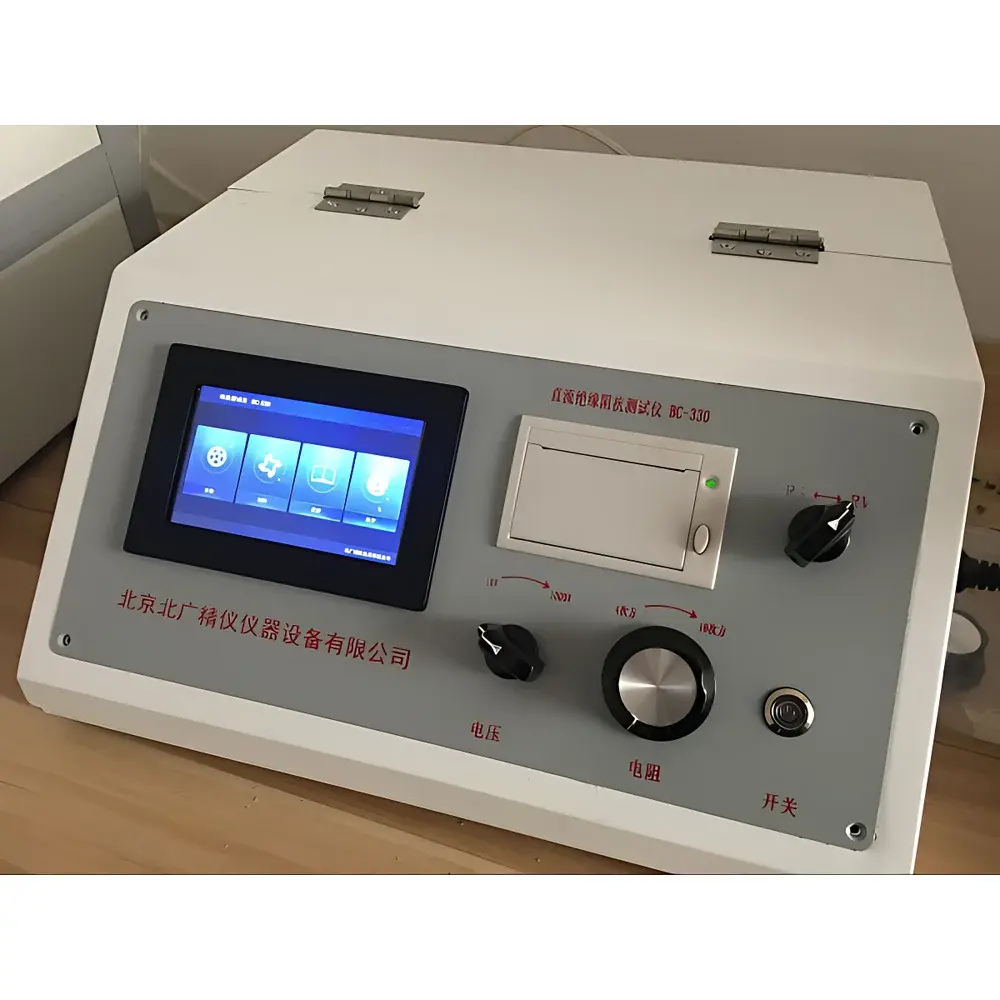
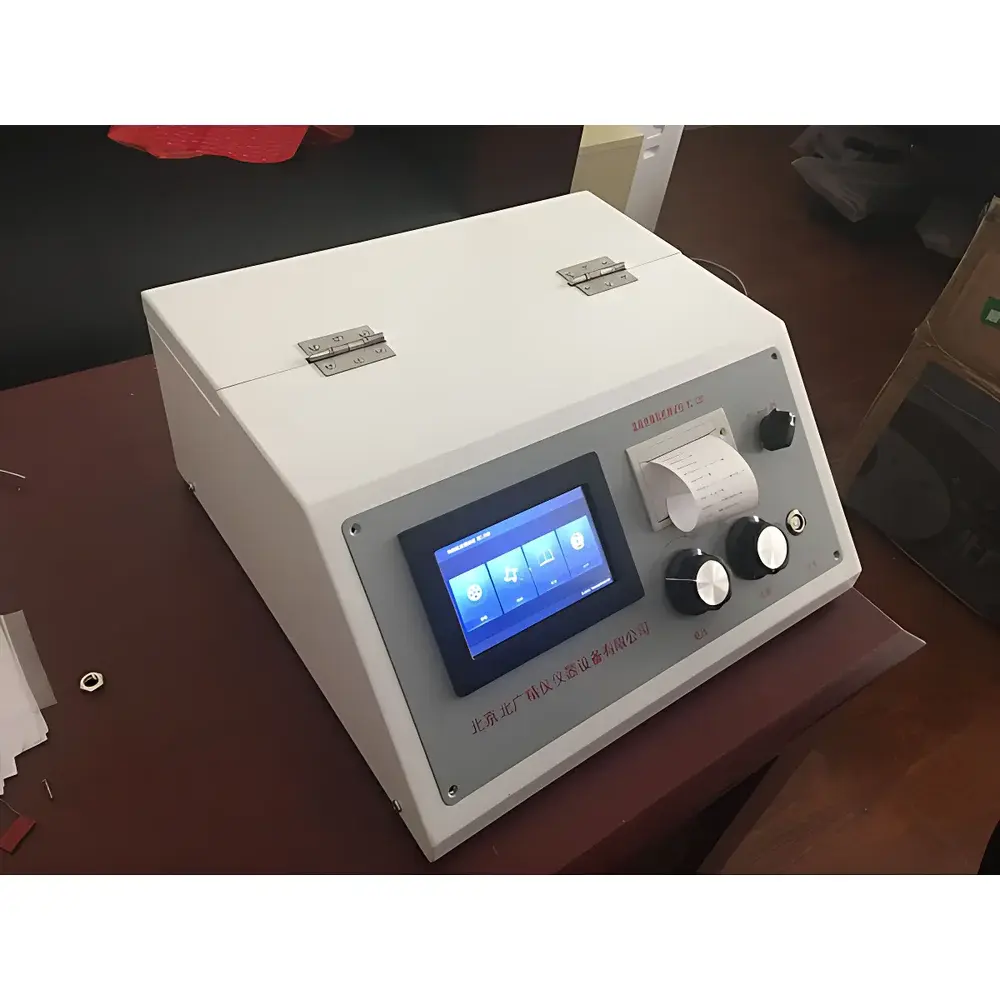
Beiguang Jingyi BC-330 High-Resistance Meter for Volume and Surface Resistivity Testing of Electrical Insulating Papers
| Brand | Beiguang Jingyi / All Precision Instrument |
|---|---|
| Origin | Beijing, China |
| Manufacturer Type | Direct Manufacturer |
| Product Origin | Domestic (China) |
| Model | BC-330 |
| Price | USD 2,500 (FOB Beijing) |
Overview
The Beiguang Jingyi BC-330 High-Resistance Meter is an engineered solution for precise measurement of volume resistivity (ρv) and surface resistivity (ρs) of solid insulating materials—specifically optimized for electrical insulation papers used in transformers, capacitors, cables, and high-voltage equipment. It operates on the principle of direct-current (DC) voltage application with guarded electrode configuration per IEC 60093 and ASTM D257 methodologies, ensuring minimal leakage current interference and high reproducibility in high-resistance regimes. The instrument applies selectable test voltages from 10 V to 1000 V across six discrete steps, enabling compliance-driven testing under standardized electric field strengths. Its measurement architecture integrates a guarded input stage, electrometer-grade current sensing (10−18 A resolution), and real-time calculation of resistivity using geometric correction factors derived from electrode configuration (e.g., concentric ring, parallel plate, or two-terminal). Designed for laboratory and QC environments, the BC-330 meets the metrological requirements for Class II accuracy per GB/T 1410–2006 and supports traceable calibration against NIST-traceable reference resistors.
Key Features
- Wide resistance measurement range: 1 × 10⁶ Ω to 1 × 10²⁰ Ω with <±3% full-scale accuracy at 1018 Ω
- Ultra-low current detection capability: down to 1 × 10⁻¹⁸ A, essential for evaluating aged or moisture-sensitive insulation papers
- Integrated shielded test chamber: co-located main unit and Faraday cage eliminate parasitic resistance from interconnect cabling and environmental electrostatic coupling
- Multi-mode operation: manual, timed auto-test, and programmable sequence modes with user-defined dwell time (1 s–9999 s)
- Touchscreen HMI with dual-input support: handwriting recognition + soft-key selection for material ID, operator name, lab ID, and test conditions
- Onboard data management: stores up to 60 test records indexed by date/time stamp; supports recall, export via USB, and thermal printing with ISO/IEC 17025-compliant metadata
- Configurable display interface: real-time toggle between resistance (Ω), resistivity (Ω·cm or Ω/sq), current (A), and applied voltage (V)
Sample Compatibility & Compliance
The BC-330 accommodates standard electrode fixtures for volume resistivity (ASTM D257 Figure 2, GB/T 1410 three-electrode system) and surface resistivity (ASTM D257 Figure 3, GB/T 1410 two-electrode guard ring). Compatible sample forms include sheet-type insulation papers (thickness 0.05–0.5 mm), laminated cellulose composites, and resin-impregnated pressboards. Optional accessories extend applicability to powders (via dielectric cell) and low-conductivity liquids (per GB 1672–8). The system conforms to over 25 national and international standards—including GB/T 1410–2006, ASTM D257–99 (Reapproved 2020), IEC 60093, ISO 3915, and GJB 105–1998Z—making it suitable for GLP-regulated laboratories, transformer OEM quality control, and third-party certification bodies. Full audit trail functionality satisfies FDA 21 CFR Part 11 requirements when paired with validated software protocols.
Software & Data Management
The included Windows-compatible PC software (v3.2) enables remote instrument control, batch test scripting, statistical analysis (mean, SD, CV%), and automated report generation in PDF or Excel format. Each record embeds timestamp, operator ID, environmental temperature/humidity (when external sensor is connected), electrode geometry, applied voltage, and raw current/resistance values. Data encryption and role-based access control align with ISO/IEC 17025:2017 clause 7.5.2 for result integrity. Calibration certificates—generated directly from the software—include uncertainty budgets calculated per GUM (JCGM 100:2008) and are exportable as CSV for LIMS integration. Firmware updates are delivered via signed USB packages with SHA-256 verification.
Applications
- Quality assurance of kraft paper, DMD composite papers, and polyimide-laminated insulation systems in power transformer manufacturing
- Evaluation of moisture absorption effects on resistivity decay during accelerated aging per IEC 60270 and IEEE C57.104
- Validation of anti-static treatment efficacy on industrial filter papers and cleanroom documentation substrates
- R&D screening of nanocomposite insulation papers containing SiO2, Al2O3, or cellulose nanocrystals
- Compliance testing for GB 12014–2019 (anti-static workwear), GB/T 22042–2008 (footwear), and GB 50611–2010 (ESD-safe facility design)
FAQ
Does the BC-330 meet ASTM D257 requirements for guarded electrode measurements?
Yes—the integrated shielded enclosure and three-terminal electrode interface fully satisfy ASTM D257 Section 7.3 for guarded configurations.
Can resistivity be calculated automatically for non-standard sample thicknesses?
Yes—users input actual thickness and electrode dimensions via touchscreen; the instrument applies geometric correction in real time per Equation 1 of GB/T 1410–2006.
Is calibration traceable to national standards?
Yes—factory calibration uses 1012 Ω to 1016 Ω reference resistors certified to CNAS-CL01 (equivalent to ISO/IEC 17025) with uncertainty ≤0.5% k=2.
What environmental conditions affect measurement stability?
Ambient humidity >50% RH or temperature gradients >1°C/min may induce surface conduction artifacts; we recommend operation at 23 ±2°C and 50 ±5% RH per IEC 60243-1.
Is the thermal printer compliant with 21 CFR Part 11 for electronic records?
When used with validated software mode and enabled audit trail, printed reports include digital signature hash, operator ID, and timestamp—meeting Part 11 Subpart B requirements for signed output.



