
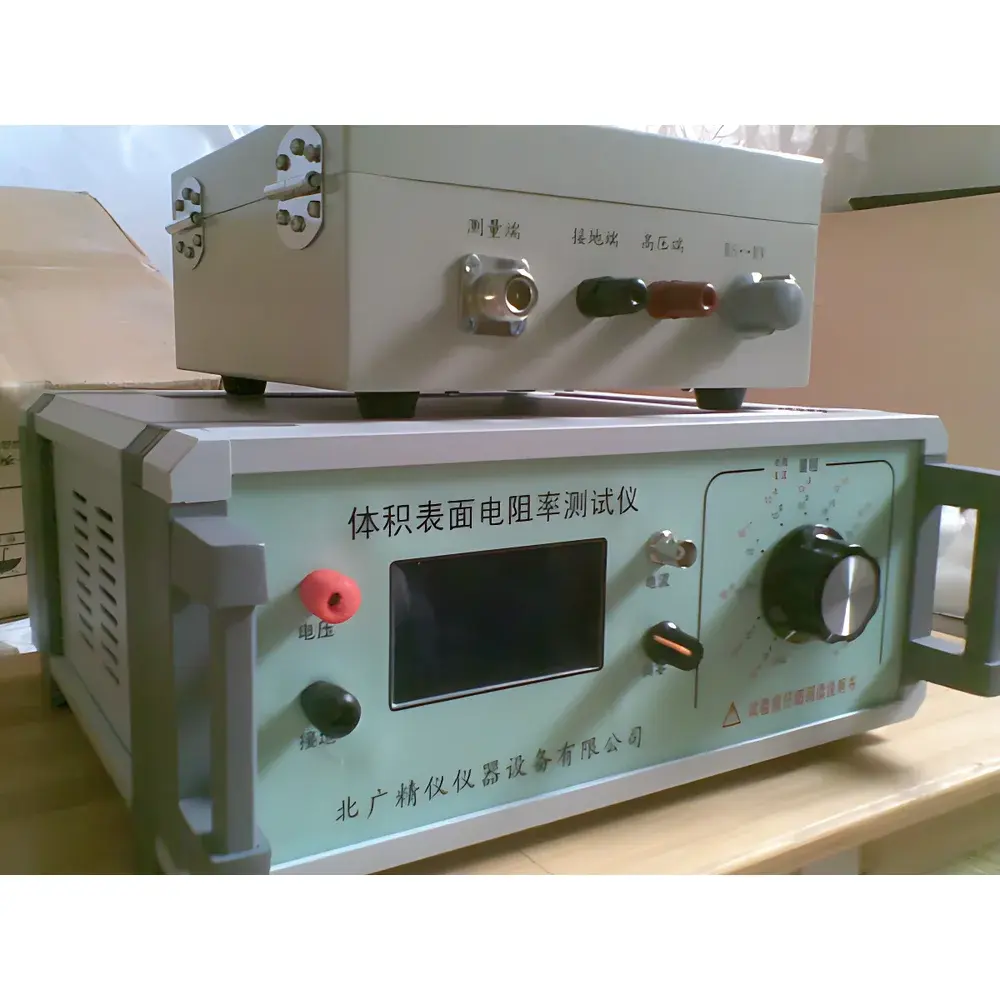
Beijing North Guang Precision Instrument BEST-121 High-Resistance Volume Resistivity Tester for Solids, Liquids, Pastes, and Powders
| Brand | Beijing North Guang Precision Instrument (All Precision Instrument) |
|---|---|
| Origin | Beijing, China |
| Manufacturer Type | OEM Manufacturer |
| Product Category | Domestic (China-made) |
| Model | BEST-121 |
| Pricing | Upon Request |
| Resistance Range | 1×10⁴ Ω to 1×10¹⁸ Ω |
| Current Range | 1×10⁻¹⁶ A to 2×10⁻⁴ A |
| Test Voltages | DC 10 V / 50 V / 100 V / 250 V / 500 V / 1000 V (±5% accuracy) |
| Basic Accuracy | ±1% of reading |
| Display | Digital LCD |
| Operating Environment | 0–40 °C, RH <80% |
| Power Supply | AC 220 V, 50 Hz, ~5 W |
| Dimensions | 285 × 245 × 120 mm |
| Weight | ~2.5 kg |
Overview
The Beijing North Guang Precision Instrument BEST-121 High-Resistance Volume Resistivity Tester is a precision electrometric instrument engineered for quantitative measurement of volume resistivity (ρv) and surface resistivity (ρs) in insulating and semiconducting materials. It operates on the principle of constant-voltage direct-current (DC) resistive measurement using a guarded three-electrode configuration—compliant with ASTM D257, IEC 62631-3-1, and GB/T 1410—enabling accurate separation of bulk conduction from surface leakage paths. Designed specifically for heterogeneous material forms—including rigid solids, viscous pastes, free-flowing powders, and low-conductivity liquids—the system delivers stable, reproducible readings across an ultra-wide resistance range (10⁴ Ω to 10¹⁸ Ω), supporting standardized evaluation of electrical insulation integrity under controlled environmental conditions.
Key Features
- Guarded three-terminal architecture with dedicated guard (G) terminal to eliminate surface leakage errors during volume resistivity measurement
- Programmable DC test voltages: 10 V, 50 V, 100 V, 250 V, 500 V, and 1000 V—each calibrated to ±5% tolerance per IEC 61000-4-5
- Dual-range high-impedance electrometer capable of resolving currents from 1×10⁻¹⁶ A to 2×10⁻⁴ A with ±1% basic accuracy
- Integrated digital LCD display with auto-ranging and real-time stability indication
- Compact benchtop design (285 × 245 × 120 mm; ~2.5 kg) optimized for QC laboratories, R&D facilities, and ISO/IEC 17025-accredited testing environments
- Compliance with Q/TPGG 7-2008 enterprise standard for high-resistance meters, aligned with functional safety requirements of IEC 61010-1
Sample Compatibility & Compliance
The BEST-121 accommodates diverse physical states without modification: solid slabs or molded specimens (per ASTM D1711), liquid samples in guarded electrode cells (e.g., ASTM D1169-compliant cells), powdered materials compacted under defined pressure (per ISO 3915), and non-drip pastes applied between parallel-plate electrodes. All measurements adhere to internationally recognized protocols governing preconditioning (GB/T 10580, ISO 291), environmental control (23 °C ±2 °C, 50% RH ±5%), and charging time (1 min minimum for ρv < 10¹⁰ Ω·m; extended dwell up to 60 min for ultra-high-resistivity materials). The instrument supports traceable calibration against NIST-traceable high-value resistors and meets essential requirements for GLP-compliant documentation when paired with external data loggers.
Software & Data Management
While the BEST-121 operates as a standalone analog/digital hybrid meter, its output signal (0–10 V analog or RS-232 serial) is compatible with third-party LIMS and laboratory data acquisition systems. When integrated into regulated environments (e.g., pharmaceutical excipient qualification or aerospace composite certification), users may configure audit trails, user access levels, and electronic signatures via compliant SCADA platforms. Though native firmware does not implement FDA 21 CFR Part 11 controls, the device’s deterministic analog front-end and fixed voltage steps ensure repeatable, non-alterable raw measurements—satisfying foundational data integrity expectations under ISO/IEC 17025 Clause 7.7.
Applications
- Quality control of polymer insulators, ceramic substrates, and epoxy encapsulants in electronics manufacturing
- Volume resistivity validation of battery separator films, conductive pastes, and dielectric greases
- Material screening for electrostatic discharge (ESD)-safe packaging polymers and antistatic additives
- Research-grade characterization of nanocomposites, carbon-black-filled elastomers, and ionically doped ceramics
- Regulatory testing per UL 746C, MIL-STD-202 Method 302, and IEC 60243-1 for high-voltage insulation systems
FAQ
What sample geometries are supported for volume resistivity measurement?
Standard configurations include ASTM D1711-compliant circular plates (25 mm or 50 mm diameter), rectangular bars (up to 100 mm length), and liquid cells with defined electrode gap (1 mm–5 mm). Powder testing requires a compaction die meeting ISO 3915 specifications.
Can the instrument measure temperature-dependent resistivity?
Yes—when coupled with a certified thermostatic bath (e.g., Julabo F25) and temperature-controlled electrode fixture, the BEST-121 enables resistivity profiling from 0 °C to 40 °C per IEC 60243-2 Annex B.
Is the guard terminal mandatory for all measurements?
It is strictly required for volume resistivity determination per ASTM D257 Section 8. For surface resistivity only, the guard may be omitted—but results must be reported with explicit notation of unguarded methodology.
How is electrical safety ensured during 1000 V operation?
The unit incorporates double-insulated housing, interlocked HV output terminals, and automatic discharge circuitry (<5 s decay to <60 V post-test), conforming to IEC 61010-1 CAT II 1000 V overvoltage category.
Does the instrument support automated compliance reporting?
No native report generation is embedded; however, ASCII-formatted serial output allows direct import into Excel, Python pandas workflows, or validated LIMS platforms for automated certificate-of-analysis generation.



