
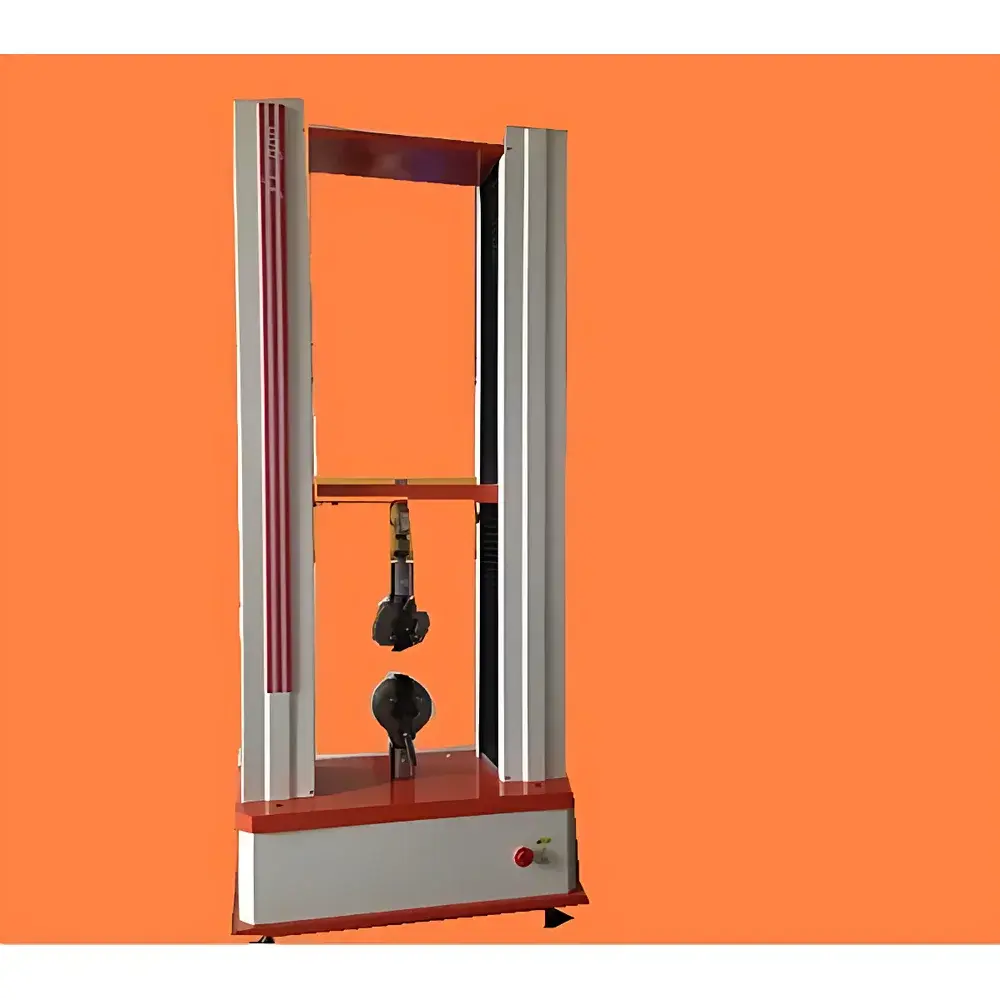
All Precision Instrument BWN-5-10KN Electronic Universal Testing Machine
| Key | Brand: All Precision Instrument |
|---|---|
| Origin | Beijing, China |
| Manufacturer Type | Direct Manufacturer |
| Model | BWN-5-10KN |
| Max Load Capacity | 10 kN |
| Accuracy Class | 0.5 |
| Force Measurement Range | 0.4–100% of full scale |
| Force Resolution | 1/200,000 of full scale (fixed, no range switching) |
| Effective Test Width | 400 mm (customizable) |
| Effective Tensile Travel | 800 mm (customizable) |
| Test Speed Range | 50–300 mm/min |
| Displacement & Strain Measurement Accuracy | ±0.5% of reading |
| Drive System | Servo Motor + Precision Ball Screw |
| Power Supply | 220 V / 380 V, 50 Hz |
| Power Consumption | 0.75 kW (typical) |
| Net Weight | ~300 kg |
| Compliance | GB/T 16491–2008, ASTM E4, ISO 7500-1, EN 10002-2 |
Overview
The All Precision Instrument BWN-5-10KN Electronic Universal Testing Machine is a statically loaded, servo-controlled mechanical testing system engineered for high-reproducibility tensile, compression, flexural, shear, peel, tear, puncture, and adhesion evaluation of metallic, polymeric, composite, and elastomeric materials. It operates on the principle of controlled displacement actuation via a precision ball screw driven by a closed-loop servo motor, with force feedback from a calibrated load cell and position feedback from an optical encoder. The system complies with international static mechanical testing standards including ISO 7500-1 (Class 0.5), ASTM E4 (verification of force-measuring systems), EN 10002-2, and GB/T 16491–2008—ensuring traceable metrological integrity across global QA/QC and R&D laboratories. Designed for structural rigidity and thermal stability, its monolithic frame minimizes deflection under load, while the dual-speed crosshead control enables both rapid positioning and fine-load ramping—critical for capturing yield onset, plastic deformation, and fracture behavior in compliance with standardized test protocols.
Key Features
- 0.5-class accuracy per ISO 7500-1 and GB/T 16491–2008, validated across the full 0.4–100% force range
- Fixed-resolution force measurement at 1/200,000 of full scale—no auto-ranging artifacts or resolution loss at low loads
- Electronically programmable crosshead speed (50–300 mm/min) with independent fast/slow modes and jog control
- Integrated electronic limit switches and overload protection (110% F.S.) for operator and specimen safety
- Modular load cell architecture: standard single-range 10 kN sensor; optional multi-sensor configuration for extended dynamic range
- Adjustable test width (standard 400 mm) and vertical travel (standard 800 mm), configurable to accommodate ASTM D638 dog-bone specimens or ISO 527 multipurpose bars
- Self-aligning grips with mechanical wedge action and replaceable jaw faces for consistent stress distribution
- Thermally stable cast-iron base and reinforced steel column assembly to suppress vibration and minimize parasitic compliance
Sample Compatibility & Compliance
The BWN-5-10KN accommodates flat, round, and tubular specimens per ASTM D638, ISO 527, GB/T 1040, ASTM D882 (thin films), ASTM D1938 (tear propagation), ASTM F88 (seal strength), ISO 37 (vulcanized rubber), and GB/T 7753 (adhesive peel). Its modular fixture interface supports standardized tensile grips, compression platens, three-point bend fixtures, shear adapters, and peel test jigs—all mechanically aligned to within ±0.1° angular deviation. Regulatory alignment includes full support for GLP-compliant audit trails, FDA 21 CFR Part 11–ready software logs (when paired with compliant PC configuration), and test method validation documentation per ISO/IEC 17025 requirements. Calibration certificates are issued with NIST-traceable reference standards and uncertainty budgets per ISO/IEC 17025 Annex A.5.
Software & Data Management
The system integrates with All Precision Instrument’s proprietary Windows-based test control and analysis suite, supporting real-time force–displacement–strain acquisition at ≥1 kHz sampling rate. Software modules include automated test sequence scripting (ASTM D882 Mode I peel, ISO 37 Type 2 dumbbell), modulus calculation (tangent, secant, chord), yield point detection (0.2% offset, automatic inflection), and hysteresis loop analysis for viscoelastic characterization. Raw data exports to CSV, Excel, and XML formats; graphical overlays enable comparative analysis across batches or material grades. Audit trail functionality records user ID, timestamp, parameter changes, and calibration events—fully compliant with internal quality management systems requiring ISO 9001:2015 Clause 8.5.2 and GMP Annex 11 prerequisites.
Applications
This instrument serves routine mechanical property quantification in polymer processing labs (e.g., tensile strength of injection-molded PP, elongation-at-break of TPU films), metal fabrication QA (yield strength of aluminum 6061-T6, compressive modulus of sintered stainless steel), packaging R&D (peel strength of laminated pouch seals per ASTM F904), biomedical device testing (tensile properties of braided PTFE vascular grafts per ISO 7198), and academic materials science (stress–strain mapping of nanocomposites, interfacial adhesion energy via T-peel per ASTM D1876). Its repeatability (<0.8% RSD on 10 replicate HDPE tensile tests) and inter-laboratory comparability make it suitable for proficiency testing programs and supplier qualification audits.
FAQ
Does the BWN-5-10KN meet ISO/IEC 17025 calibration requirements?
Yes—calibration is performed using certified reference standards traceable to NIST or CNAS-accredited providers, with documented measurement uncertainty and as-found/as-left reports.
Can the system perform cyclic loading or fatigue tests?
No—this is a static-only universal tester; fatigue testing requires dedicated servo-hydraulic or electromagnetic resonance systems.
Is third-party verification available for ASTM E4 compliance?
Yes—All Precision Instrument partners with ILAC-MRA signatory calibration labs offering on-site verification per ASTM E4 Annex A2.
What maintenance intervals are recommended for long-term accuracy retention?
Lubrication of ball screw and bearings every 6 months; load cell recalibration annually or after 10,000 cycles; optical encoder cleaning quarterly.
Are custom fixtures available for non-standard specimen geometries?
Yes—engineering drawings and application-specific fixture design services are offered under NDA, with lead time of 4–6 weeks.



