
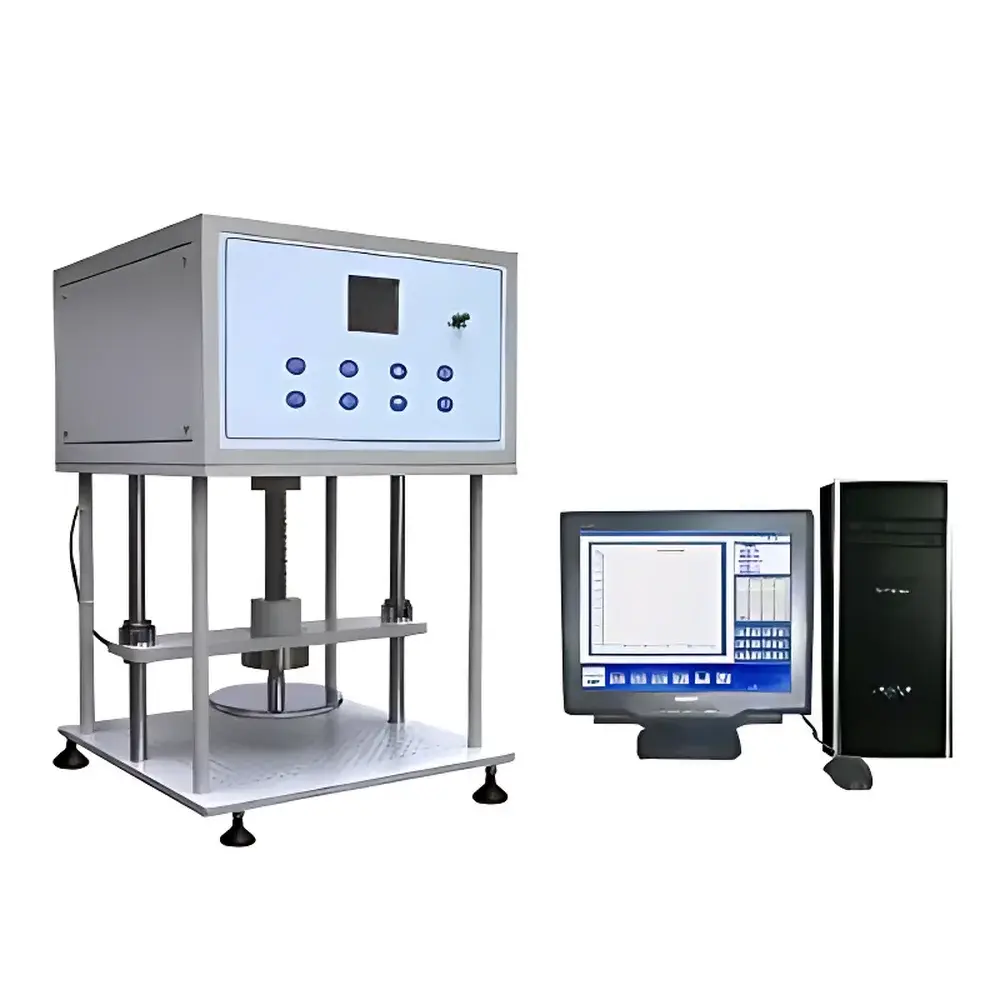
Beiguang Precision Instrument HMYX-200 Computer-Controlled Sponge and Flexible Foam Indentation Hardness Tester
| Brand | Beiguang Precision Instrument |
|---|---|
| Origin | Beijing, China |
| Manufacturer Type | OEM Manufacturer |
| Model | HMYX-200 |
| Test Speed | 100 mm/min |
| Force Measurement Range | 0–2000.0 N |
| Force Resolution | 0.25 N |
| Measurement Accuracy | < ±1% FS |
| Compliance Standards | GB/T 10807–2006, GB/T 10802–2006 |
Overview
The Beiguang Precision Instrument HMYX-200 is a microprocessor-driven, computer-controlled indentation hardness tester engineered for precise mechanical characterization of flexible polymeric foams—including soft polyurethane (PU), polyester, latex, and viscoelastic foams—according to standardized quasi-static compression protocols. It operates on the principle of controlled axial displacement of a rigid, flat-ended indenter (typically 200 cm² or 50 cm² per GB/T 10807–2006) into a conditioned foam specimen at a constant rate of 100 mm/min, measuring the resistive force required to achieve specified indentation depths (e.g., 25%, 40%, or 65% of original thickness under Methods A, B, and C). The system implements a closed-loop load-cell feedback architecture with high-stiffness frame design to minimize deflection-induced error, ensuring repeatability ≤ ±0.8% across replicate tests under ISO 1798 and ASTM D3574–22 harmonized conditions.
Key Features
- Automated zeroing sequence initiated upon test start command—eliminates baseline drift from thermal or mechanical relaxation.
- Programmable return-to-origin motion post-test, synchronized with load-unload cycle completion to preserve specimen integrity during batch testing.
- Auto-ranging load sensor system with dual-range transducers (e.g., 0–200 N and 0–2000 N), enabling seamless switching without manual recalibration.
- Adjustable crosshead speed (10–500 mm/min, factory-set default 100 mm/min) compliant with method-specific requirements in GB/T 10807–2006 Annexes A–C.
- Digital force calibration traceable to national metrology standards via internal shunt calibration routine and external verification port.
- Multi-mode control interface supporting force-controlled, displacement-controlled, and strain-controlled test profiles—configurable via software-defined test templates.
- Real-time dynamic plotting of force vs. displacement curves with 100 Hz data acquisition and timestamped metadata embedding (operator ID, environmental temp/humidity, sample ID).
- Hardware-enforced dual-limit protection: programmable software travel limits + redundant mechanical end-stop switches prevent over-travel damage.
- Overload cutoff circuitry halts actuation immediately when measured load exceeds 105% of selected range—preserving sensor linearity and structural integrity.
Sample Compatibility & Compliance
The HMYX-200 accommodates standard test specimens per GB/T 10807–2006: rectangular blocks (380 mm × 380 mm × 50 mm minimum) or cylindrical cores (Ø150 mm × 50 mm), preconditioned at 23 ± 2°C and 50 ± 5% RH for ≥16 h. It supports all three indentation hardness methodologies defined in the standard: Method A (25% indentation), Method B (40%), and Method C (65%), each requiring distinct dwell times (e.g., 30 s ± 1 s after target depth attainment). The instrument’s firmware embeds calculation logic for derived metrics including initial slope (modulus approximation), plateau force (hardness index), and recovery ratio (post-dwell rebound). All test reports include audit-ready metadata fields compliant with GLP documentation requirements, and raw data export formats (CSV, XML) support integration into LIMS environments meeting FDA 21 CFR Part 11 electronic record criteria.
Software & Data Management
The proprietary Windows-based control suite provides ISO/IEC 17025-aligned test sequencing, with role-based user access levels (Operator, Technician, Administrator) and full electronic signature capability. Each test generates a digitally signed PDF report containing: specimen identification, environmental logs, force-displacement curve with annotated inflection points, tabulated hardness values (N), statistical summaries (mean, SD, CV%), and pass/fail status against specification limits. Raw time-series datasets are stored in HDF5 format with embedded calibration certificates and firmware version stamps. Software supports automated batch processing of up to 99 samples with barcode-scanned ID input, and includes built-in tools for curve smoothing (Savitzky-Golay filter), derivative analysis (dF/dδ), and comparative overlay of historical datasets. Export modules comply with ASTM E1447–21 for materials testing data interchange.
Applications
This tester serves quality assurance laboratories in foam manufacturing, automotive seating R&D, furniture certification bodies, and mattress compliance testing facilities. Typical use cases include: validation of raw material consistency across PU slabstock batches; correlation of indentation hardness with long-term fatigue performance (per ASTM D3574 fatigue cycles); benchmarking against OEM specifications for seat cushioning (e.g., Ford WSS-M99P30-A2, GMW14351); verification of flame-retardant foam modifications that may alter compressive response; and regulatory submission testing for CE-marked medical support surfaces (EN 1970:2021). Its modular sensor architecture also permits adaptation for related soft-material evaluations—including compression set (ISO 1856), resilience (ASTM D3574 Method D), and creep compliance—when paired with optional environmental chambers or extended-duration controllers.
FAQ
What standards does the HMYX-200 fully support for foam indentation testing?
It natively implements GB/T 10807–2006 (Methods A, B, C) and GB/T 10802–2006 for soft polyurethane foam classification, with firmware-calculated outputs aligned to ASTM D3574–22 and ISO 2439:2019 equivalency tables.
Can the system be validated for GMP/GLP-regulated environments?
Yes—the software includes 21 CFR Part 11-compliant audit trails, electronic signatures, and calibration certificate management; hardware meets IEC 61000-4 EMC immunity requirements for laboratory deployment.
Is third-party calibration certification available?
Factory calibration is performed using NIST-traceable deadweight standards; accredited third-party calibration (e.g., CNAS-certified labs) is supported via documented procedures and calibration certificate import functionality.
What maintenance intervals are recommended for long-term accuracy?
Annual verification of load cell linearity and crosshead speed accuracy is advised; daily warm-up and zero-check routines are embedded in the startup protocol.
Does the system support non-standard indenter geometries?
Standard configuration uses a 200 cm² flat platen per GB/T 10807; custom platens (e.g., circular Ø150 mm, conical tips) can be mechanically integrated with updated calibration maps.



