
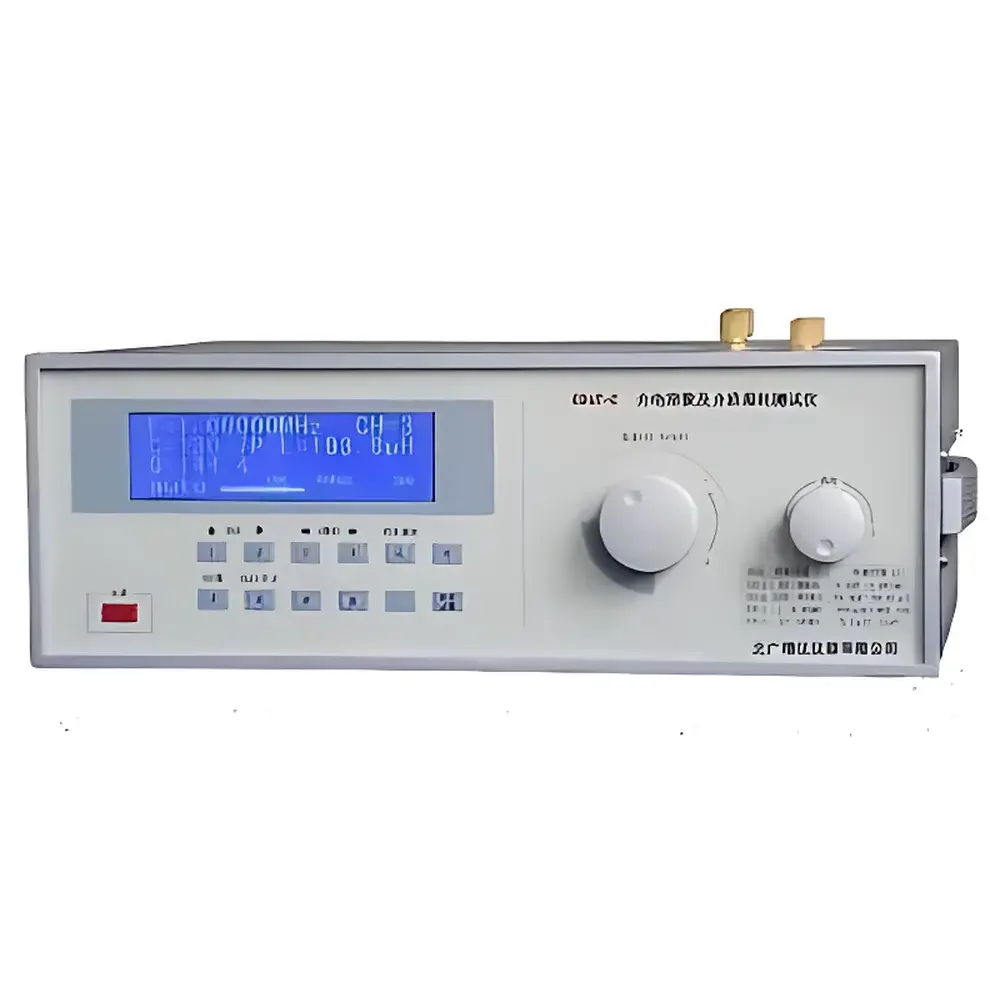
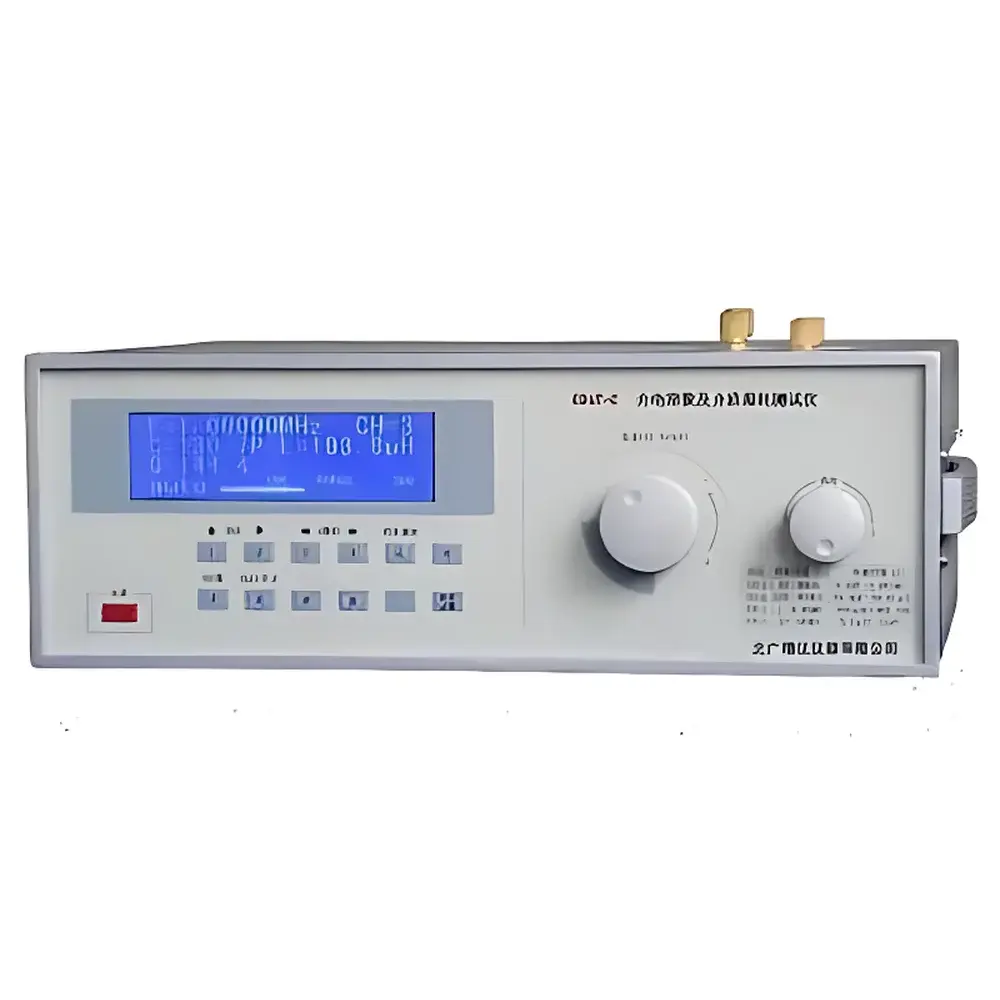
North Guang Precision Instruments GDAT-C Dielectric Constant and Dissipation Factor Analyzer
| Brand | North Guang Precision Instruments |
|---|---|
| Origin | Beijing, China |
| Manufacturer Type | Direct Manufacturer |
| Model | GDAT-C |
| Frequency Range | 10 kHz – 50 MHz |
| Q-Factor Measurement Range | 2–1023 |
| Capacitance Measurement Range | 1–460 pF (Direct), 30–500 pF (Main Tuning) |
| Inductance Measurement Range | 14.5 nH – 8.14 H |
| Accuracy | ±1% for C > 150 pF |
| Frequency Stability | ±3×10⁻⁵ ±1 digit |
| Power Supply | 220 V ±22 V, 50 Hz ±2.5 Hz |
| Power Consumption | ~25 W |
| Net Weight | ~7 kg |
| Dimensions (L×W×H) | 380 × 132 × 280 mm |
| Compliance | GB/T 1409–2006 |
Overview
The North Guang Precision Instruments GDAT-C Dielectric Constant and Dissipation Factor Analyzer is a precision impedance measurement system engineered for high-accuracy characterization of dielectric properties in solid and powdered insulating materials. It operates on the principle of high-frequency resonant cavity perturbation and series/parallel resonance methods, enabling direct determination of complex permittivity (ε* = ε′ − jε″) and loss tangent (tan δ = ε″/ε′) across a broad frequency spectrum from 10 kHz to 50 MHz. Unlike broadband impedance analyzers relying on vector network analysis, the GDAT-C employs a digitally stabilized, frequency-synthesized oscillator coupled with automatic resonance tracking and Q-factor quantification—making it especially suitable for routine QC testing of ceramics, polymer composites, epoxy resins, capacitor dielectrics, and advanced functional oxides where reproducible tan δ and ε′ values at discrete industrial frequencies (e.g., 1 MHz, 10 MHz) are required per GB/T 1409–2006.
Key Features
- Automated resonance search and Q-value ranging with five fixed Q-scale bands (30, 100, 300, 1000) plus auto-ranging mode for optimal signal-to-noise ratio across wide dynamic ranges.
- Digital frequency locking with ±3×10⁻⁵ stability and fine-resolution frequency stepping across four virtual bands: 10–99.9999 kHz, 100–999.999 kHz, 1–9.99999 MHz, and 10–60 MHz.
- Integrated main capacitance tuning (30–500 pF) with calibrated vernier scale and absolute capacitance readout (1–460 pF direct range) traceable to NIST-equivalent reference standards.
- Low-residual-inductance test circuit architecture minimizing stray reactance errors—critical for accurate ε″ extraction at frequencies above 1 MHz.
- Onboard microcontroller-based control system supporting preset Q-threshold validation (5–1000), automatic amplitude stabilization, and real-time digital display of Q, C, L, and resonant frequency.
- Compact benchtop form factor (380 × 132 × 280 mm) with low power draw (~25 W) and robust EMI-shielded enclosure compliant with IEC 61000-4 immunity requirements.
Sample Compatibility & Compliance
The GDAT-C supports standardized electrode configurations per GB/T 1409–2006—including parallel-plate, coaxial, and guarded-electrode fixtures—for flat, disk-shaped, or pelletized specimens (diameter up to 50 mm, thickness 0.5–5 mm). It is routinely deployed in laboratories evaluating alumina, zirconia, barium titanate, PTFE composites, silicone rubber, and glass-reinforced laminates. The instrument meets national metrological verification requirements for dielectric property testers in China and provides data traceability aligned with ISO/IEC 17025 documentation practices. While not certified to ASTM D150 or IEC 60250 out-of-the-box, its measurement methodology is fully compatible with those standards when used with appropriate calibration procedures and reference materials (e.g., fused quartz, air-dielectric standards).
Software & Data Management
The GDAT-C operates as a standalone hardware platform without proprietary PC software. All measurements are displayed locally via high-contrast LED indicators for Q, C, L, and f₀. For integration into GLP/GMP environments, users may log readings manually or interface the analog output signals (Q and frequency) to external DAQ systems. Though no built-in audit trail or electronic signature functionality is included, the instrument’s deterministic analog-digital hybrid architecture ensures full repeatability under controlled environmental conditions (0–40 °C, RH < 80%). When deployed in regulated settings, laboratories typically implement SOPs requiring daily verification using certified reference capacitors and documented operator training—consistent with FDA 21 CFR Part 11 data integrity expectations for non-computerized systems.
Applications
- Quality control of ceramic capacitor dielectrics (e.g., X7R, NP0 formulations) for ε′ consistency and tan δ drift monitoring across batch production.
- R&D evaluation of high-k and low-k polymer nanocomposites for microelectronics packaging and 5G antenna substrates.
- Characterization of insulating varnishes, impregnating resins, and transformer oil simulants under simulated service frequencies.
- Academic research on ferroelectric phase transitions, dipole relaxation mechanisms, and interfacial polarization in layered heterostructures.
- Validation of material specifications against procurement standards such as MIL-STD-202 or IPC-TM-650 Method 2.5.1.
FAQ
What standards does the GDAT-C comply with?
The instrument is designed and verified per GB/T 1409–2006, the Chinese national standard for measuring permittivity and dielectric loss of electrical insulating materials at power, audio, and radio frequencies.
Can the GDAT-C measure liquid or film samples?
Yes—when equipped with optional liquid cells or thin-film holders meeting parallel-plate geometry requirements defined in GB/T 1409–2006 Annex B.
Is calibration certificate included with shipment?
A factory calibration report is provided; however, formal accredited calibration (e.g., CNAS) requires third-party service due to metrological traceability requirements.
How is temperature control handled during measurement?
The GDAT-C does not include integrated thermal control; ambient temperature must be maintained between 0–40 °C per specification, and users should stabilize sample temperature externally if thermally sensitive measurements are required.
What accessories are supplied as standard?
One main unit, nine calibrated inductors (ranging from 0.125 µH to 25 mH), and one universal shielded test fixture with adjustable electrode spacing.



