
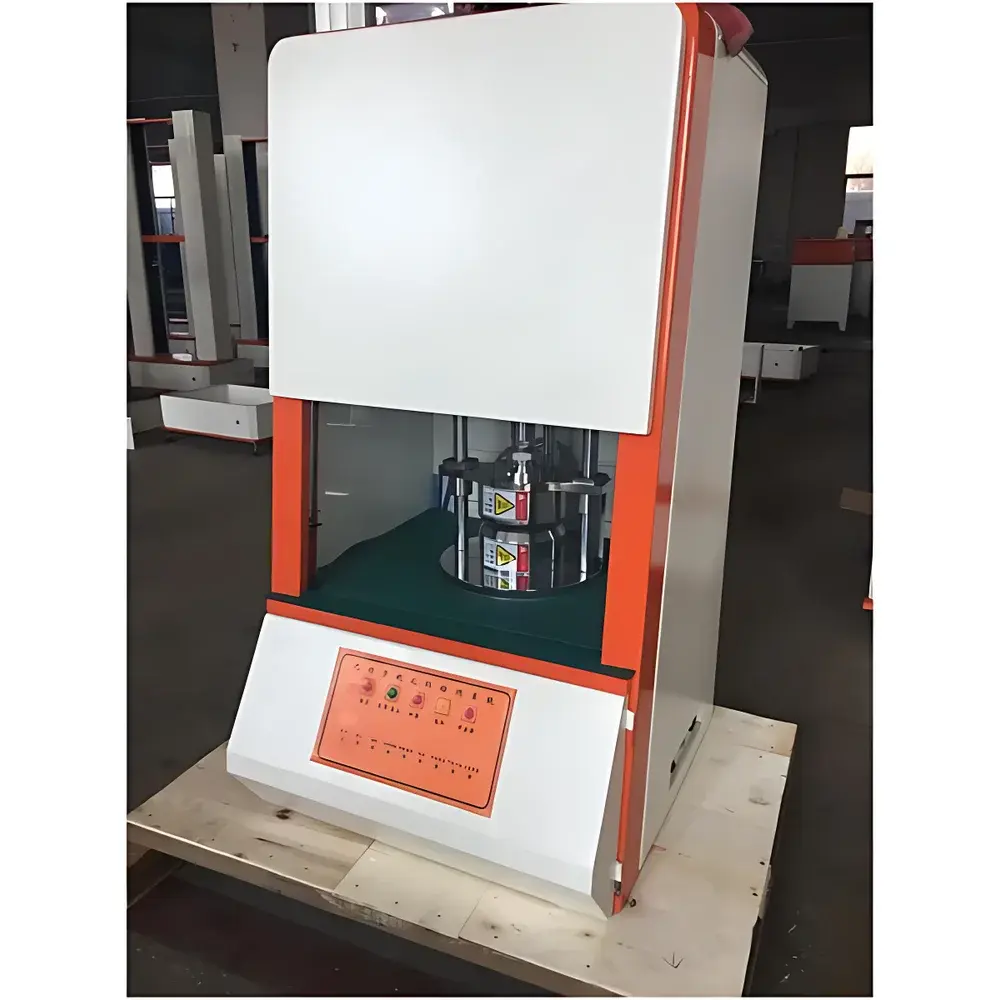
Beiguang Jingyi BG-8105 Silicone Rubber Oscillating Disk Curemeter (Rotorless Rheometer)
| Brand | Beiguang Jingyi / All Precision Instrument |
|---|---|
| Origin | Beijing, China |
| Manufacturer Type | Direct Manufacturer |
| Country of Origin | China |
| Model | BG-8105 |
| Torque Range | 0–20 N·m |
| Torque Resolution | 0.001 N·m |
| Temperature Control Range | 0–200 °C |
| Temperature Accuracy | ≤ ±0.3 °C |
| Temperature Resolution | 0.1 °C |
| Oscillation Frequency | 1.7 Hz |
| Deflection Angle | ±0.5° or ±1.0° |
| Cavity Material | Cr6WV tool steel |
| Compliance | GB/T 16584, ISO 6502, UNI standards |
| Data Interface | RS232 |
| Software Platform | Vulcanize-105 + Windows XP-based acquisition and analysis suite |
Overview
The Beiguang Jingyi BG-8105 Silicone Rubber Oscillating Disk Curemeter is a precision rotorless rheometer engineered for the quantitative characterization of uncured silicone rubber compounds during vulcanization. It operates on the principle of oscillatory shear rheometry in a sealed, temperature-controlled cavity—applying a small sinusoidal torsional strain to the sample while measuring the resulting torque response. This enables real-time tracking of viscoelastic property evolution—including minimum torque (ML), maximum torque (MH), scorch time (T10), and optimum cure times (T30, T50, T60, T90)—in strict accordance with internationally recognized test standards including GB/T 16584, ISO 6502, and Italian UNI specifications. Unlike traditional rotor-type instruments, the BG-8105 eliminates mechanical wear and sample slippage artifacts through its oscillating disk design, delivering superior repeatability and long-term calibration stability across high-volume QC laboratories and R&D facilities.
Key Features
- High-resolution torque transduction system (0–20 N·m range, 0.001 N·m resolution) ensures detection of subtle crosslinking onset and plateau formation.
- Intelligent digital PID temperature controller with auto-tuning capability maintains cavity temperature within ±0.3 °C across the full 0–200 °C operating range; temperature resolution is 0.1 °C.
- Oscillation mechanism driven by a stepper motor coupled with amplitude adjustment hardware supports dual deflection modes (±0.5° and ±1.0°) at a fixed frequency of 1.7 Hz—optimized for silicone elastomer kinetics.
- Cr6WV alloy cavity conforms to GB/T 16584–1996 dimensional and metallurgical requirements, ensuring thermal homogeneity, corrosion resistance, and long service life under repeated thermal cycling.
- Integrated RS232 serial interface enables bidirectional communication with host PC running Vulcanize-105 software—supporting automated data logging, curve overlay, zoom, differential analysis, and ASTM/ISO-compliant report generation.
- Dual-mode operation: fully software-controlled via mouse-driven GUI or manual initiation via front-panel tactile buttons—designed for ergonomic workflow integration in regulated environments.
Sample Compatibility & Compliance
The BG-8105 is validated for use with silicone rubbers, fluorosilicones, and other heat-curable elastomers exhibiting low to medium viscosity prior to cure. Its sealed cavity design minimizes oxidative degradation and volatile loss during extended isothermal tests. The instrument meets essential regulatory prerequisites for materials testing in quality assurance settings: compliance with GB/T 16584 (Chinese national standard), ISO 6502 (international rubber vulcanization characterization standard), and UNI 7720 (Italian equivalent). While not FDA 21 CFR Part 11–certified out-of-the-box, raw torque vs. time datasets exported in CSV or XML format are compatible with validated LIMS or ELN platforms supporting electronic signature and audit trail requirements under GLP/GMP frameworks.
Software & Data Management
Vulcanize-105 is a Windows XP–based application developed specifically for the BG-8105 platform. It provides synchronized acquisition of torque, temperature, and time signals at configurable sampling intervals (default: 100 ms). Data files include embedded metadata—operator ID, sample ID, test date/time, cavity temperature setpoint, oscillation amplitude, and calibration coefficients—enabling traceability per ISO/IEC 17025 Clause 7.7. The software supports multi-curve comparison with offset correction, derivative calculation (dTorque/dt), and automatic Tx point identification using user-adjustable slope thresholds. Export options include PDF reports with embedded graphs, Excel-compatible spreadsheets, and image snapshots (BMP/PNG). All raw data files are stored in non-proprietary binary format with header documentation, facilitating third-party algorithmic reprocessing.
Applications
- Optimization of peroxide- and platinum-catalyzed cure cycles for medical-grade liquid silicone rubber (LSR).
- Batch-to-batch consistency verification in high-volume production of silicone gaskets, seals, and encapsulants.
- Accelerated aging studies correlating scorch time (T10) with storage stability under ambient and elevated temperature conditions.
- Formulation screening of filler systems (e.g., fumed silica loading), inhibitor packages, and co-agents affecting crosslink density development.
- Technical support for ISO 10993–biocompatibility testing protocols requiring documented vulcanization profiles.
- Academic research into kinetic modeling of silicone network formation using Arrhenius-derived activation energy calculations from isothermal runs at multiple temperatures.
FAQ
What standards does the BG-8105 comply with?
It complies with GB/T 16584, ISO 6502, and UNI 7720 for rotorless vulcanization testing of elastomers.
Can the instrument be integrated into a networked laboratory data system?
Yes—via RS232 interface and standardized data export formats (CSV, XML), it supports integration with LIMS, ELN, or custom QA databases.
Is the cavity material resistant to aggressive silicone catalysts?
Yes—the Cr6WV tool steel cavity offers high hardness (>60 HRC), thermal stability up to 250 °C, and resistance to chemical attack from platinum complexes and organic peroxides.
Does the system support variable oscillation frequencies?
No—the BG-8105 operates exclusively at 1.7 Hz, as specified in GB/T 16584 and ISO 6502 for comparative cure characterization.
What is the recommended maintenance interval for torque sensor calibration?
Annual recalibration against NIST-traceable torque standards is advised; routine verification using certified reference springs is supported via software diagnostic mode.
Related Products



