
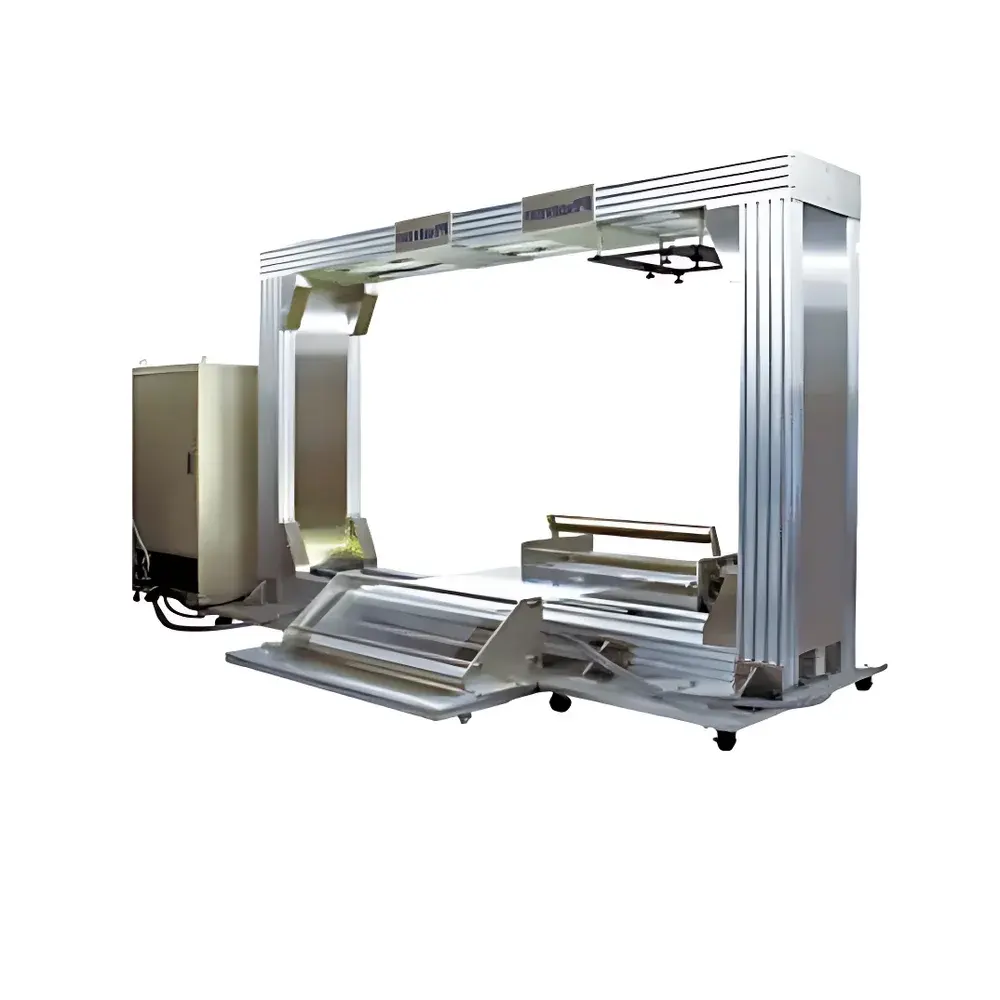
Photonic Lattice KAMAKIRI STS-LS Birefringence Measurement System
| Brand | Photonic Lattice |
|---|---|
| Origin | Japan |
| Model | KAMAKIRI STS-LS |
| Output Parameters | Retardation [nm], Fast-Axis Orientation [°] |
| Measurement Wavelength | 543 nm (customizable) |
| Birefringence Range | 0–260 nm |
| Conveyor Speed Compatibility | Up to ~30 m/min (customizable) |
| Repeatability | <1 nm |
| Field of View | Full-width, full-length imaging |
| Optional Lens Expansion | Available |
| Custom Width Support | Systems scalable to >5 m web width |
Overview
The Photonic Lattice KAMAKIRI STS-LS is a high-speed, non-contact birefringence measurement system engineered for real-time in-line monitoring of optical anisotropy in transparent polymeric films and rigid substrates. Based on quantitative polarimetric imaging using monochromatic (543 nm) laser illumination and precision rotating waveplate analysis, the STS-LS captures spatially resolved retardation (in nanometers) and fast-axis orientation (in degrees) across the entire web width and length. Unlike point-scanning or spot-based polarimeters, this system employs full-field imaging optics coupled with high-dynamic-range polarization cameras, enabling continuous, pixel-level birefringence mapping at production line speeds—up to 30 meters per minute. Its design targets process-critical applications where residual stress, molecular orientation, or thermal history directly impact optical performance, such as in phase-difference compensation films (TAC, PC, PMMA, COC), protective layers (PET, PEN, PS, PI), molded resin components, and specialty glass substrates.
Key Features
- Real-time full-width birefringence imaging: Captures retardation and axis orientation simultaneously across the entire web without mechanical scanning.
- LIVE visualization interface: Color-mapped retardation distribution updated at video frame rates; intuitive hue-saturation-value (HSV) encoding enables immediate visual assessment of stress gradients and alignment uniformity.
- Automated pass/fail classification: Configurable threshold logic triggers OK/NG alerts during live acquisition, supporting integration into automated quality gate systems.
- High metrological stability: Achieves sub-nanometer repeatability (<1 nm) under controlled environmental conditions, validated per internal calibration protocols traceable to NIST-traceable reference standards.
- Modular optical architecture: Optional lens kits extend field-of-view coverage; custom optical trains support web widths exceeding 5 meters, accommodating wide-format roll-to-roll and sheet-fed configurations.
- Robust industrial enclosure: IP54-rated housing with vibration-damping mounts and temperature-stabilized optical path, suitable for factory-floor deployment near extrusion, coating, or thermoforming stations.
Sample Compatibility & Compliance
The STS-LS is optimized for optically transparent, isotropic-to-anisotropic transition materials with thicknesses ranging from 10 µm to 5 mm. It supports continuous web substrates including cellulose triacetate (TAC), polycarbonate (PC), polymethyl methacrylate (PMMA), cyclic olefin copolymer (COC), polyethylene terephthalate (PET), polyethylene naphthalate (PEN), polystyrene (PS), polyimide (PI), and thermally tempered or chemically strengthened glass. The system complies with ISO 11477 (plastics — determination of birefringence), ASTM D899 (standard test method for retardation of transparent plastics), and supports audit-ready data generation aligned with GLP and GMP documentation requirements. Optional firmware modules enable 21 CFR Part 11-compliant electronic signatures and audit trail logging for regulated pharmaceutical or display manufacturing environments.
Software & Data Management
The proprietary STS Control Suite provides a Windows-based platform for instrument control, real-time visualization, and post-acquisition analysis. Raw polarization state data are stored in HDF5 format with embedded metadata (timestamp, conveyor speed, calibration ID, user annotations). Batch export supports CSV, TIFF (16-bit), and MATLAB .mat formats. Advanced analysis tools include line-profile extraction, statistical zone reporting (mean ± std dev per defined ROI), temporal trend charts, and correlation with upstream process parameters via OPC UA or Modbus TCP interfaces. All software modules undergo annual verification against NIST SP 800-53 security controls and support role-based access control (RBAC) for multi-user laboratories.
Applications
- Roll-to-roll manufacturing of optical compensation films: Monitoring molecular orientation drift during stretching, annealing, or UV curing processes.
- Quality assurance of protective cover films: Detecting localized stress-induced birefringence from slitting, laminating, or adhesive application.
- Thermoforming validation: Quantifying residual stress distribution in molded acrylic or polycarbonate lenses and light guides.
- Glass tempering process optimization: Mapping surface vs. bulk stress profiles in chemically strengthened display glass.
- R&D of novel birefringent polymers: Correlating processing conditions (draw ratio, quench rate, anneal temperature) with spatial retardation maps.
FAQ
What wavelength is used for measurement, and can it be modified?
The standard configuration uses a stabilized 543 nm He–Ne laser source. Custom wavelengths—including 405 nm, 633 nm, or broadband LED-based setups—are available upon request to match material absorption characteristics or regulatory requirements.
Is the system compatible with existing factory automation networks?
Yes. The STS-LS supports Ethernet/IP, PROFINET, and OPC UA protocols for seamless integration into MES or SCADA platforms. Digital I/O signals (OK/NG, trigger in/out) are provided via isolated 24 V DC terminals.
How is calibration maintained during long-term operation?
The system includes automated daily self-calibration routines using built-in reference retarders. Full recalibration—performed annually by certified Photonic Lattice service engineers—includes polarization state analyzer verification and spatial uniformity mapping.
Can the system measure curved or textured surfaces?
Flat, smooth, transparent surfaces are optimal. For mildly curved substrates (radius >1 m), optional telecentric lenses minimize perspective distortion. Surface roughness exceeding Ra = 0.1 µm may reduce signal-to-noise ratio and require empirical correction models.
What training and documentation are provided with installation?
On-site commissioning includes 2-day operator and maintenance technician training. Documentation comprises ISO 9001-certified installation qualification (IQ), operational qualification (OQ), user manuals, calibration certificates, and a complete set of electrical and mechanical schematics.




