
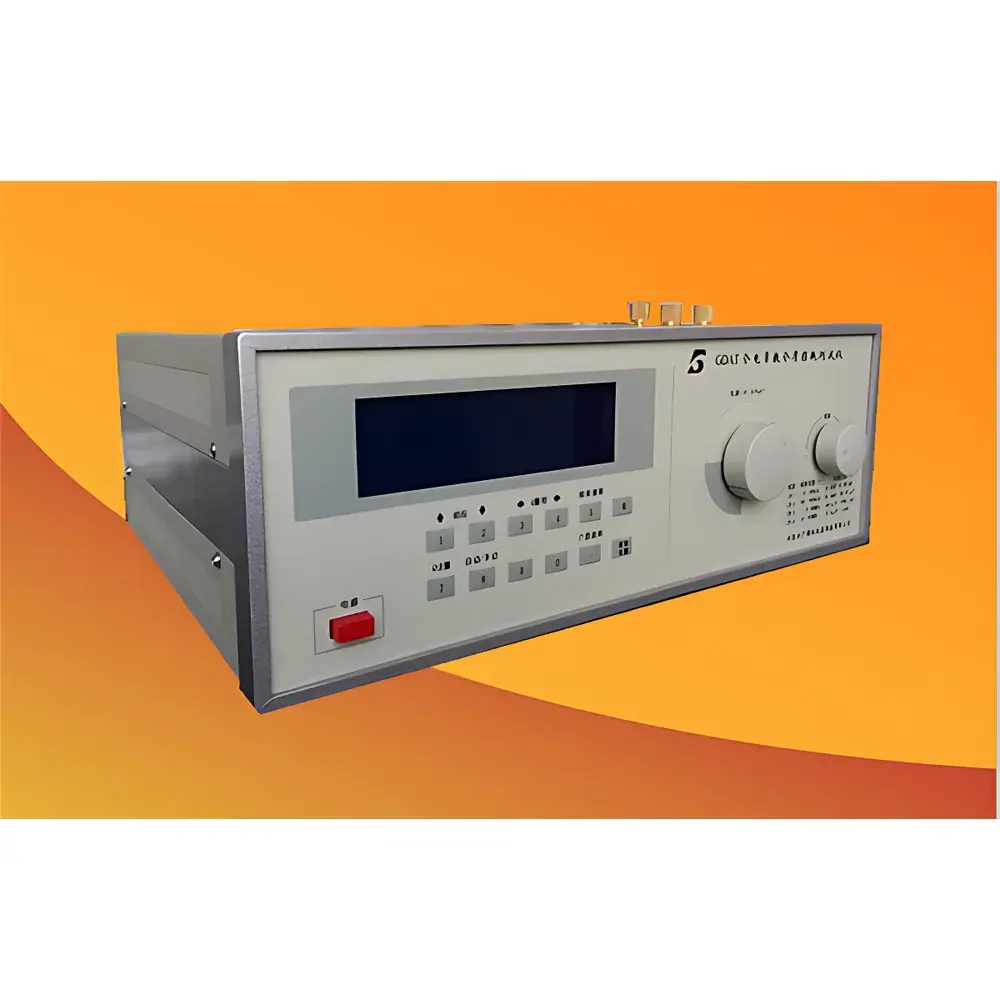
North Guangjingyi G-DAT-A Dielectric Constant and Loss Tangent Analyzer
| Brand | North Guangjingyi / All Precision Instrument |
|---|---|
| Origin | Beijing, China |
| Manufacturer Type | OEM Manufacturer |
| Product Origin | Domestic (China) |
| Model | G-DAT-A |
| Price | USD 2,800 (FOB Beijing) |
| Standards Compliance | GB/T 1409–2006, ASTM D150–18, IEC 60250:1969 |
| Frequency Range | 20 kHz – 60 MHz / 200 kHz – 160 MHz |
| Parallel-Plate Electrode Diameter | Φ38 mm or Φ50 mm (selectable) |
| Electrode Spacing Adjustment Range | ≥15 mm |
| Micrometer Resolution | 0.001 mm |
| Fixture Loss Tangent (tanδ) | ≤4×10⁻⁴ at 1 MHz |
| Q-Factor Measurement Range | 2–1023 |
| Main Capacitance Tuning Range | 30–500 pF or 18–220 pF |
| Capacitance Accuracy | <1% or ±1 pF |
| Frequency Display Accuracy | ±(3×10⁻⁵ × f) ±1 digit |
| Fixture Plug Pitch | 25.00±0.01 mm |
Overview
The North Guangjingyi G-DAT-A Dielectric Constant and Loss Tangent Analyzer is a precision high-frequency impedance measurement system engineered for the quantitative characterization of insulating polymeric and elastomeric materials under RF and microwave-relevant electric fields. It operates on the fundamental principle of series-resonant Q-meter methodology, wherein the test specimen—inserted as the dielectric medium between two precision-machined parallel-plate electrodes—is integrated into a resonant LC circuit with a high-Q inductor (LKI-1 series). By measuring shifts in resonance frequency and quality factor (Q) before and after sample insertion, the system computes both the complex permittivity (ε* = ε′ − jε″) and dissipation factor (tanδ = ε″/ε′) in accordance with internationally recognized standards including GB/T 1409–2006, ASTM D150–18, and IEC 60250. Unlike broadband impedance analyzers or low-frequency LCR meters, this system delivers traceable, high-sensitivity measurements specifically optimized for the dynamic dielectric response of rubber, thermoplastic elastomers, PVC compounds, silicone rubbers, and other non-conductive bulk polymers at frequencies up to 160 MHz—enabling accurate prediction of signal loss, thermal stability, and electromagnetic compatibility behavior in real-world applications.
Key Features
- Modular architecture integrating BH916 precision parallel-plate test fixture, GDAT-series digital Q-meter, LKI-1 high-stability inductor bank (9 coils), and embedded tanδ auto-calculation firmware
- Dual-frequency-range operation: 20 kHz–60 MHz and 200 kHz–160 MHz, selectable via hardware configuration and calibrated per IEC 60250 Annex A
- Interchangeable electrode sets (Φ38 mm and Φ50 mm) with micrometer-driven spacing control (≥15 mm range, 0.001 mm resolution) for precise thickness normalization and edge-effect minimization
- Fully digital Q-meter interface with LCD display of real-time parameters: Q-value, resonant frequency (f), main tuning capacitance (C), inductance (L), and resonance trend indicator
- Direct Digital Synthesis (DDS) RF source with frequency accuracy of ±(3×10⁻⁵ × f) ±1 digit and ultra-low phase noise (<–110 dBc/Hz @ 10 kHz offset)
- Integrated automatic tanδ calculation engine eliminating manual interpolation, lookup tables, or post-processing—results compliant with GLP data integrity requirements
- Fixture-specific calibration certificate included; tanδ residual of ≤4×10⁻⁴ at 1 MHz ensures minimal systematic error contribution from the measurement cell itself
Sample Compatibility & Compliance
The G-DAT-A system is validated for solid, flat, non-porous dielectric specimens with thicknesses ranging from 0.1 mm to 12 mm—ideal for vulcanized rubber sheets, extruded plastic films, molded polymer components, and laminated composites. Specimens must exhibit surface planarity within ±2 µm and electrical resistivity >10¹² Ω·cm to ensure valid field distribution across the electrode gap. The BH916 fixture’s rigid aluminum housing, gold-plated brass electrodes, and temperature-stable PTFE spacers meet ASTM D150 Section 7.2 requirements for mechanical reproducibility. Full compliance with GB/T 1409–2006 Annex B (parallel-plate method) and IEC 60250 Clause 5 (Q-meter technique) is documented in the factory calibration report. System-level validation supports 21 CFR Part 11-compliant audit trails when paired with optional PC-based data logging software (sold separately).
Software & Data Management
The GDAT Q-meter hosts an embedded microcontroller executing proprietary firmware that performs real-time acquisition of resonance parameters and executes IEEE Std 100–2007-compliant tanδ and ε′ calculations per ASTM D150 Equation 5. All raw Q, C, f, and L values are timestamped and stored in non-volatile memory with 16-bit resolution. Optional USB-to-serial interface enables export of CSV-formatted datasets—including measured Q, calculated tanδ, ε′, ε″, and electrode separation—for integration into LIMS or statistical process control platforms. Firmware revision logs, calibration date stamps, and operator ID fields support ISO/IEC 17025 traceability. No third-party drivers or runtime dependencies are required; the system operates as a standalone instrument with zero software installation overhead.
Applications
- Quality control of EPDM, NBR, SBR, and silicone rubber formulations for automotive sealing systems
- Development of low-loss dielectric substrates for high-frequency PCB laminates and antenna housings
- Accelerated aging studies correlating tanδ drift with crosslink density changes in vulcanized elastomers
- Regulatory submission support for medical-grade polymer biocompatibility dossiers (ISO 10993-12)
- Material screening for 5G millimeter-wave packaging where ε′ stability across 1–10 GHz bands is critical
- Academic research on dipole relaxation mechanisms in amorphous thermoplastics (e.g., PC, PS, ABS) using frequency-sweep protocols
FAQ
What standards does the G-DAT-A system comply with?
It conforms to GB/T 1409–2006, ASTM D150–18, and IEC 60250:1969 for high-frequency dielectric measurements using the Q-meter method.
Can the system measure thin films below 0.2 mm thickness?
Yes—when used with the Φ38 mm electrode set and sub-micron micrometer adjustment, it supports thicknesses down to 0.1 mm, provided samples are mechanically stable and free of voids.
Is NIST-traceable calibration available?
Factory calibration includes NIST-traceable reference capacitors and inductors; full metrological certification (with uncertainty budget) is available as an optional service.
Does the system support temperature-controlled measurements?
The base configuration is ambient-only; however, the BH916 fixture is compatible with third-party environmental chambers (e.g., Linkham TS1500) via custom mounting brackets (available upon request).
How is measurement repeatability ensured across operators?
The one-touch zero function, digital micrometer readout, and automated tanδ computation eliminate subjective interpretation—typical RSD for ε′ is ≤0.8% across five replicate measurements under controlled lab conditions.



