
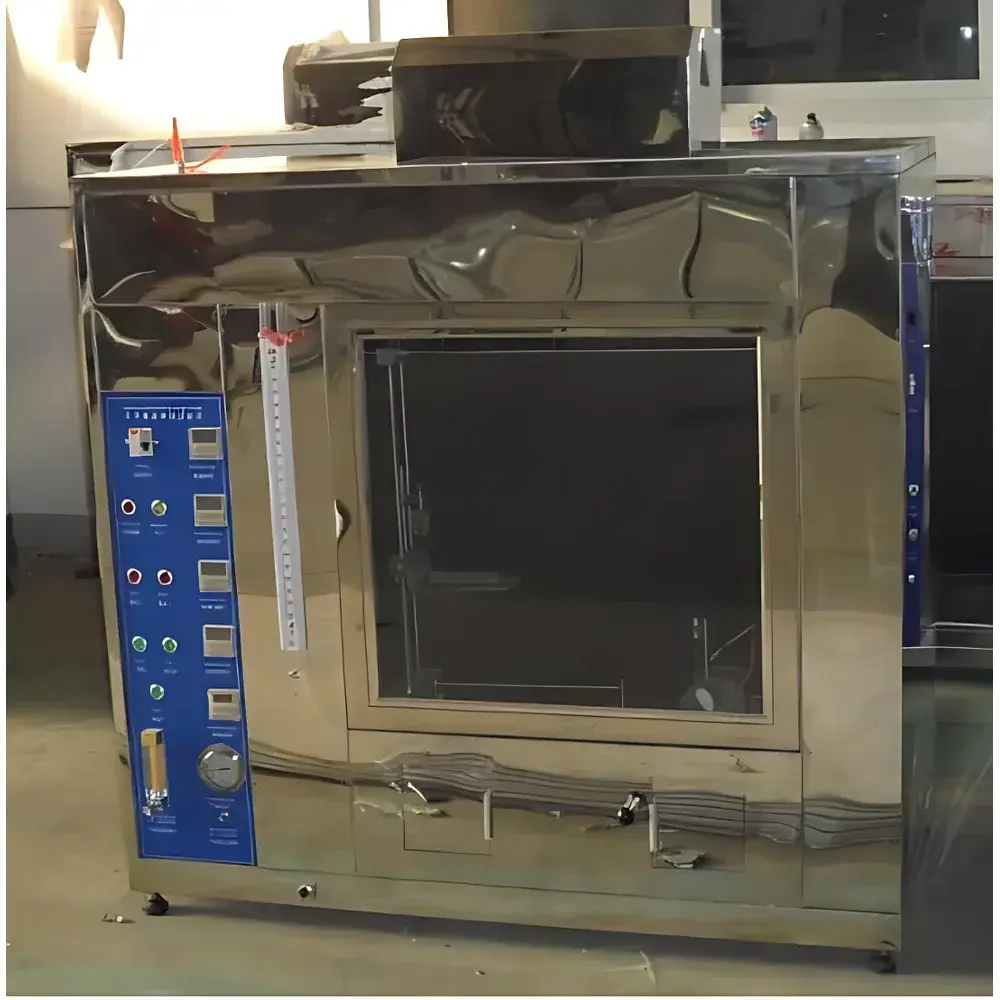
English Product Name
| Brand | Beiguang Jingyi / All Precision Instrument |
|---|---|
| Origin | Beijing, China |
| Manufacturer Type | Direct Manufacturer |
| Country of Origin | China |
| Model | CZF-5 |
| Price | USD 2,200 (FOB Beijing) |
Overview
The Beiguang Jingyi CZF-5 Horizontal & Vertical Combustion Tester is a precision-engineered instrument designed to evaluate the flammability behavior of solid non-metallic materials—including thermoplastics, thermosets, elastomers, insulating composites, and foam polymers—under standardized flame exposure conditions. It operates in strict compliance with key international fire safety test protocols, including GB/T 2408–2008 (equivalent to IEC 60695-11-1:1999) for horizontal and vertical burning tests, and GB/T 10707–2008 for rubber combustion performance assessment. The device employs a calibrated Bunsen burner with interchangeable circular and stainless-steel fish-tail nozzles, delivering controlled 50 W flame energy using methane (98% purity) or natural gas (37 MJ/m³ ±1 MJ/m³). Test specimens are mounted horizontally or vertically and subjected to precisely timed flame applications; evaluation metrics include afterflame time, afterglow time, extent of char propagation, droplet formation, and ignition of underlying cotton indicator. The apparatus supports UL 94 classification (V-0, V-1, V-2, HB, 5V, HF-1, HF-2, HBF) and is widely deployed in R&D laboratories, quality control departments, and certification bodies serving the electrical, electronics, lighting, appliance, and packaging industries.
Key Features
- Adjustable Bunsen burner with precise 0°, 20°, and 45° flame-angle positioning (±0.5° repeatability), featuring fine-tuned vertical travel (~150 mm) and dual-nozzle interchangeability
- Dual-axis motorized specimen holders: horizontal and vertical clamps with independent XYZ translation (±0.1 mm resolution), plus flexible sample fixture compatible with curved or irregular geometries (ATLAS-style linear guides)
- Integrated digital timing system: flame application duration (1.0–999.9 s), afterflame/afterglow measurement (1.0–999.9 s), and programmable cycle count (1–9999 cycles)
- Gas delivery subsystem with certified Japanese pressure gauge and U.S.-sourced Dwyer manometer for real-time differential pressure monitoring at burner inlet
- Automatic ignition module with spark-gap electrode and fail-safe gas cutoff logic; remote handheld controller for hands-free operation during hazardous phases
- Explosion-proof LED lighting compliant with IEC 60079-0; sealed centrifugal exhaust fan maintaining >0.75 m³ test chamber volume under negative pressure (ISO 5659-2 compliant enclosure integrity)
- Modular electrical architecture: YOTO time relays, Autonics counters, Omron PLC-grade relays, and industrial-grade current meters—all traceable to NIST-calibrated references
Sample Compatibility & Compliance
The CZF-5 accommodates standard rectangular specimens per UL 94 and IEC 60695: 125 ±5 mm length × 13.0 ±0.5 mm width, with thickness ranging from minimum process specification up to 13.0 mm (edges chamfered to ≤1.3 mm radius). It accepts rigid, semi-rigid, and flexible substrates—including laminated insulation films, molded enclosures, wire jacketing, and packaging foams—via configurable fixtures. Regulatory alignment includes full functional equivalence to ASTM D635, ASTM D3801, ISO 9772, ISO 9773, and EN 60695-11-10. Optional integrated thermocouple probe (K-type, ±1.5 °C accuracy) enables surface temperature profiling during flaming and smoldering phases, supporting GLP-compliant data logging per FDA 21 CFR Part 11 requirements when paired with validated software.
Software & Data Management
While the base unit operates via embedded microcontroller with front-panel LCD and tactile keypad, optional PC-based control software (Windows 10/11 compatible) provides audit-trail-enabled test sequencing, parameter locking, electronic signature capture, and PDF report generation. All timing events, gas pressure readings, and operator inputs are timestamped and stored locally on encrypted SD card (2 GB included). Data export formats include CSV, XML, and structured PDF with embedded calibration certificates. The system supports 21 CFR Part 11 user-role assignment (Administrator, Technician, Reviewer), electronic audit trail review, and password-protected configuration changes—meeting GMP/GLP documentation standards for regulated manufacturing environments.
Applications
This tester serves as a core qualification tool for material suppliers and OEMs validating flame-retardant formulations prior to component integration. Typical use cases include: comparative screening of halogen-free vs. brominated flame retardants in polyolefins; verification of V-0 rating for PCB substrate encapsulants; assessment of drip resistance in polyamide housings for power tools; fire hazard evaluation of lithium-ion battery pack insulation layers; and regulatory submission testing for CE marking (EN 60335-1), UL recognition, and CCC certification. In packaging R&D, it supports development of flame-resistant corrugated board liners, metallized film laminates, and anti-static cushioning foams used in hazardous goods transport.
FAQ
What flame sources are supported?
Methane (98% purity, 50 W nominal heat flux) or natural gas (37 MJ/m³ ±1 MJ/m³); both require external cylinder regulation and inline filtration.
Is the test chamber volume compliant with ISO 5659-2?
Yes—the internal volume exceeds 0.75 m³ with black matte interior finish and forced-draft ventilation ensuring uniform thermal boundary conditions.
Can the system perform sequential multi-cycle tests without manual intervention?
Yes—fully automated execution of up to 9999 flame-on/flame-off cycles with programmable dwell intervals and automatic specimen repositioning.
Does the instrument meet UL 94 V-0/V-1/V-2 classification requirements?
Yes—hardware geometry, burner calibration, timing resolution, and specimen mounting conform to UL 94 Edition 7 (2022) Annex A specifications.
Is third-party calibration documentation provided?
Each unit ships with factory calibration certificate traceable to CNAS-accredited metrology lab (certificate number and expiry date printed on rear panel label).






