
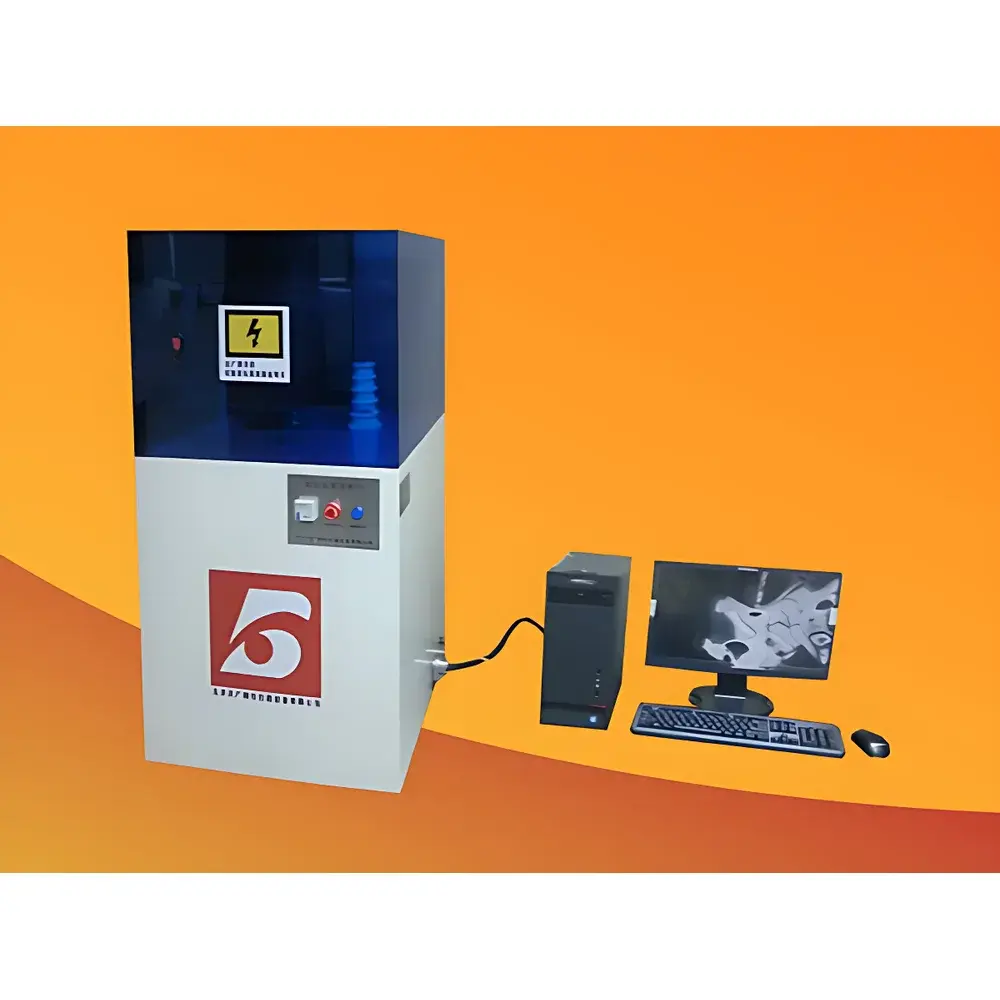
North Guang Precision Instruments C-50 Dielectric Breakdown Tester
| Brand | North Guang Precision Instruments |
|---|---|
| Origin | Beijing, China |
| Manufacturer Type | Direct Manufacturer |
| Model | C-50 |
| Maximum Output Voltage | 50 kV (AC/DC) |
| Compliance | GB/T 1408.1–2006, GB/T 1695–2005, GB/T 3333, HG/T 3330, GB 12656, ASTM D149 |
| Input Voltage | AC 220 V |
| Power Rating | 30 kVA |
| Voltage Regulation Range | 0–200 kV (AC), 0–200 kV (DC) |
| Ramp Rate Adjustment | 0.01–10 kV/s (programmable) |
| Test Modes | AC/DC — Ramp, Step, Hold (Dielectric Withstand) |
| Electrode Sets | Two Φ25 mm × 25 mm |
| Dielectric Medium | Air or Insulating Oil |
| Response Time of Overcurrent Protection | ≤0.05 s |
| Data Acquisition Interface | USB 2.0 (3 MB/s throughput) |
| Control Interface | Bluetooth-enabled remote operation |
| Safety Mechanism | Pneumatic door actuation, automatic zero-return on completion, emergency cutoff |
Overview
The North Guang Precision Instruments C-50 Dielectric Breakdown Tester is an engineered solution for determining the dielectric strength and electrical breakdown voltage of solid insulating materials under standardized industrial conditions. It operates on the principle of controlled voltage ramping—applying a continuously increasing electric field across a specimen until catastrophic dielectric failure occurs, marked by a sharp drop in insulation resistance and measurable conduction current. The system employs a high-voltage transformer with precision-coupled instrument and high-voltage windings, enabling accurate proportional measurement of output voltage via low-voltage instrumentation taps (0–100 V range), eliminating direct high-potential sensing risks. Both AC and DC test modes are supported through internal full-wave rectification using a high-voltage silicon stack; removal of the shorting rod enables DC output while maintaining identical current capability as AC mode due to shared winding architecture. Designed for compliance with major international standards—including ASTM D149, GB/T 1408.1–2006, and IEC 60243—this tester delivers reproducible results essential for quality assurance in polymer, rubber, composite, and electrical insulation manufacturing.
Key Features
- Programmable voltage ramp rate from 0.01 to 10 kV/s, fully adjustable to meet specific material testing protocols.
- Dual-mode operation: AC and DC breakdown testing with three configurable profiles—ramp-up, stepwise increment, and constant-voltage withstand.
- Embedded Siemens-based embedded CPU control unit integrated with PC-hosted software for real-time synchronization, ensuring sub-millisecond command latency and deterministic timing.
- USB 2.0 high-speed data interface (up to 3 MB/s) replaces legacy RS-232, enabling continuous streaming of voltage, current, time, and ramp rate at ≥1 kHz sampling frequency.
- Automated safety interlocks including pneumatic top-mounted door actuation, Bluetooth-enabled remote start/stop, and <0.05 s overcurrent trip response.
- High-fidelity dual-channel acquisition: simultaneous analog capture of scaled instrument-winding voltage and primary-loop leakage current via calibrated shunt sensors.
- Real-time dual-axis curve plotting (voltage vs. time, current vs. time) with automatic breakpoint detection at breakdown onset.
Sample Compatibility & Compliance
The C-50 accommodates standard electrode configurations per GB/T 1408.1–2006: two cylindrical electrodes (Φ25 mm × 25 mm) and one larger electrode (Φ75 mm × 25 mm), all machined to ±0.1 mm dimensional tolerance. Specimens may be tested in ambient air or submerged in insulating oil within the supplied oil bath chamber, allowing evaluation under varied dielectric environments. The system supports testing of elastomers (per GB/T 1695–2005), capacitor paper (GB 12656), cable paper (GB/T 3333), and insulating varnishes (HG/T 3330). All hardware and firmware adhere to electromagnetic compatibility (EMC) Class B requirements and incorporate galvanic isolation between high-voltage and control domains. Full traceability is maintained through factory calibration certificates issued by the China Academy of Space Technology and documented GLP-aligned procedures suitable for ISO/IEC 17025-accredited laboratories.
Software & Data Management
The proprietary Windows-based control suite provides comprehensive test lifecycle management: protocol definition, real-time monitoring, automated pass/fail classification, and report generation compliant with 21 CFR Part 11 audit trail requirements. Each test session logs timestamped voltage, current, elapsed time, ramp rate, and environmental metadata (e.g., medium type, electrode ID). Data exports support CSV, PDF, and XML formats; comparative analysis tools enable side-by-side overlay of up to eight curves with color-coded differentiation. All raw datasets are stored with immutable file hashing to prevent post-hoc tampering. Optional digital signature integration allows authorized personnel to electronically sign reports prior to archival or regulatory submission.
Applications
This instrument serves critical roles in R&D and QC labs across multiple sectors: formulation validation of epoxy resins and silicone encapsulants; certification of aerospace-grade polyimide films; qualification of battery separator membranes; incoming inspection of transformer board and motor winding insulation; and compliance verification for medical device housings subject to IEC 60601-1 dielectric requirements. Its ability to replicate service-stress conditions—including transient overvoltage scenarios and prolonged DC bias exposure—makes it indispensable for accelerated life modeling and failure mode analysis in high-reliability applications.
FAQ
What standards does the C-50 comply with?
It conforms to GB/T 1408.1–2006, GB/T 1695–2005, GB/T 3333, HG/T 3330, GB 12656, and ASTM D149.
Can the system perform both AC and DC breakdown tests?
Yes—DC output is achieved via internal full-wave rectification; AC/DC current capacity remains identical due to shared transformer winding design.
Is remote operation supported?
Yes—Bluetooth transceiver pair enables wireless start/stop and emergency shutdown from distances exceeding 10 meters.
How is measurement accuracy ensured?
Voltage is measured via the transformer’s instrument winding (0–100 V), scaled precisely per turns ratio; current is sensed directly in the high-voltage loop using calibrated shunt resistors.
What safety features are included?
Pneumatically actuated interlocked enclosure, automatic zero-return after test completion, <0.05 s overcurrent cutoff, insulated gloves and floor matting included, and redundant hardware/software kill switches.



