
HCP PPLN Bulk Crystals (Periodically Poled Lithium Niobate)
| Brand | HCP (Longcai Technology) |
|---|---|
| Origin | Taiwan |
| Model | PPLN |
| Crystal Type | Periodically Poled Lithium Niobate (LiNbO₃) |
| Poling Period Range | 4.5 µm – 35 µm |
| Transparency Range | 350 nm – 5000 nm |
| Damage Threshold | >1 GW/cm² (1064 nm, 10 ns, 10 Hz) |
| Curie Temperature | 1140 °C |
| Refractive Index (1064 nm) | nₑ ≈ 2.19, nₒ ≈ 2.28 |
| QPM Structure Options | Uniform, Multi-Period, Fan-Out (Continuous Tuning), Chirped, Cascaded |
| Coating Options | AR/HR coatings available from UV to MIR |
| Substrate Orientation | Z-cut or X-cut configurable |
| Standard Dimensions | 5 × 5 × 0.5 mm³, 10 × 10 × 0.5 mm³, 10 × 10 × 1.0 mm³ (customizable) |
Overview
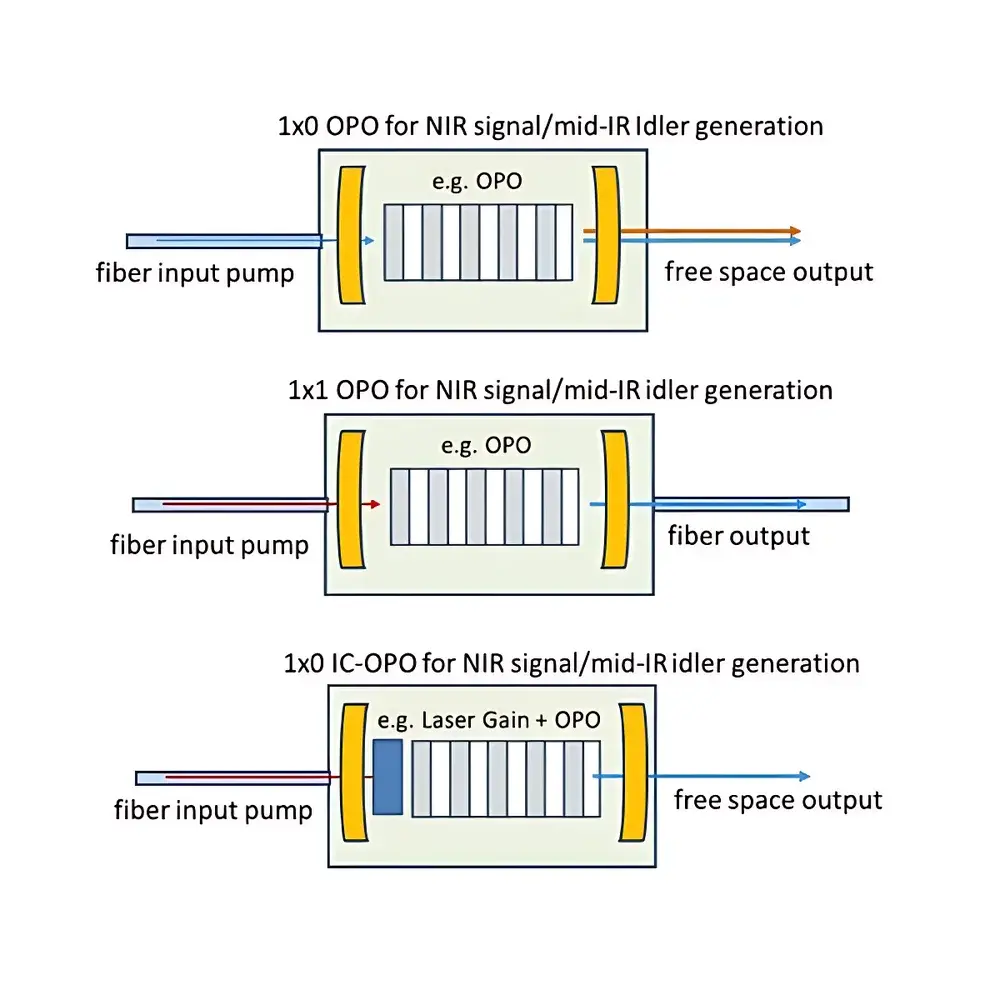
HCP PPLN Bulk Crystals are high-quality, periodically poled lithium niobate (LiNbO₃) nonlinear optical materials engineered for quasi-phase-matched (QPM) frequency conversion in laser systems. Leveraging the large nonlinear coefficient (d33 ≈ 27 pm/V) and broad transparency window of congruent LiNbO₃, these crystals enable efficient second-harmonic generation (SHG), sum-frequency generation (SFG), difference-frequency generation (DFG), optical parametric amplification (OPA), optical parametric generation (OPG), and optical parametric oscillation (OPO) across spectral regions spanning ultraviolet (UV) to mid-infrared (MIR). The periodic poling process establishes a precisely controlled domain inversion grating—typically defined by lithographic patterning and electric-field poling—which compensates for phase mismatch between interacting waves, thereby maximizing conversion efficiency under collinear or non-collinear beam geometries.
Key Features
- Ready-to-use inventory with over 150 standardized poling period configurations, supporting rapid prototyping and system integration without lead-time delays.
- Multiple QPM structural architectures: uniform-period gratings for fixed-wavelength conversion; multi-period arrays for discrete tunability; fan-out (fan-shaped) domains enabling continuous wavelength tuning via transverse beam translation; chirped gratings for spectral broadening or pulse compression applications; and cascaded structures (e.g., SHG + SFG or SHG + DFG) for multi-stage nonlinear processes.
- High optical homogeneity and low propagation loss (<0.05 dB/cm at 1064 nm), verified by interferometric inspection and transmission mapping.
- Thermally stable domain structure—retains poling integrity up to 200 °C during operation, compatible with oven-controlled temperature-tuning setups for fine wavelength adjustment (typical tuning coefficient: ~0.1 nm/°C near 1550 nm).
- Available in standard Z-cut or X-cut orientations, with optional custom crystallographic alignment for specific phase-matching conditions (e.g., type-0 or type-I interactions).
- AR/HR anti-reflection or high-reflection dielectric coatings available from 350 nm to 5000 nm, deposited via ion-beam sputtering for low absorption and high laser-induced damage threshold (>1 GW/cm² at 1064 nm, 10 ns pulse width).
Sample Compatibility & Compliance
HCP PPLN crystals are compatible with common continuous-wave (CW) and pulsed laser sources including Nd:YAG (1064 nm), Ti:sapphire (700–1000 nm), fiber lasers (1550 nm, 1060 nm), and OPO-pumped systems. All crystals undergo full traceable metrology—including poling period verification via SEM cross-section analysis and diffraction efficiency calibration using reference SHG measurements—and conform to ISO 10110 optical component specifications for surface quality (scratch-dig ≤ 20–10), flatness (λ/8 @ 633 nm), and parallelism (<10 arcsec). Batch documentation includes individual crystal certificates of conformance, refractive index data per Sellmeier equation, and thermal expansion coefficients for system-level thermal modeling.
Software & Data Management
While PPLN crystals are passive optical components, HCP provides a downloadable PPLN QPM Calculator Suite (Windows/macOS/Linux) that implements rigorous coupled-wave theory to predict phase-matching angles, effective nonlinear coefficients, acceptance bandwidths, and walk-off-limited interaction lengths for user-defined pump/signal/idler wavelengths, crystal orientation, temperature, and poling period. The software supports export of tabulated data in CSV format and integrates with MATLAB and Python APIs for automated experimental control. All crystal lot data—including poling uniformity maps and coating spectral reflectance curves—are archived in a secure, audit-ready database compliant with GLP principles and accessible upon request for FDA 21 CFR Part 11–aligned validation workflows.
Applications
- Visible-to-MIR laser source development: e.g., 1064 nm → 532 nm (SHG); 1550 nm + 1064 nm → 630 nm (SFG); 1064 nm → 3400 nm (DFG).
- Quantum optics: generation of entangled photon pairs via spontaneous parametric down-conversion (SPDC) in fan-out or chirped PPLN waveguides or bulk chips.
- Spectroscopic sensing: compact DFG-based MIR spectrometers for gas detection (CH₄, CO₂, NH₃) operating between 2.5–5 µm.
- Ultrafast optics: chirped PPLN for broadband OPA gain shaping and post-compression of few-cycle pulses.
- Frequency comb extension: octave-spanning supercontinuum generation seeded by OPOs pumped in PPLN-based cavities.
FAQ
What is the maximum operating temperature for sustained QPM performance?
Standard HCP PPLN crystals maintain stable domain inversion up to 200 °C; for long-term thermal cycling above 150 °C, we recommend thermally diffused (TDPPLN) variants with enhanced domain stability.
Can you supply PPLN crystals with custom poling patterns beyond fan-out or chirped designs?
Yes—we support fully mask-defined arbitrary 2D poling layouts (e.g., vortex, segmented, or multiplexed gratings) using electron-beam lithography for advanced nonlinear beam engineering.
Do you provide waveguide-integrated PPLN devices?
While this listing covers bulk crystals, HCP also manufactures ridge-loaded and proton-exchanged PPLN waveguides with confinement losses 100 %/W·cm².
Is coating durability tested under high-repetition-rate ultrafast irradiation?
Yes—AR coatings are qualified per ISO 21254 for laser-induced damage threshold (LIDT) at 1 kHz, 350 fs, and specified wavelengths; test reports available upon NDA.
How is poling period uniformity verified across the crystal aperture?
Each crystal undergoes scanning electron microscopy (SEM) line-scan analysis across ≥5 locations, with reported RMS period deviation <±0.2 % of nominal value, included in the certificate of conformance.



