
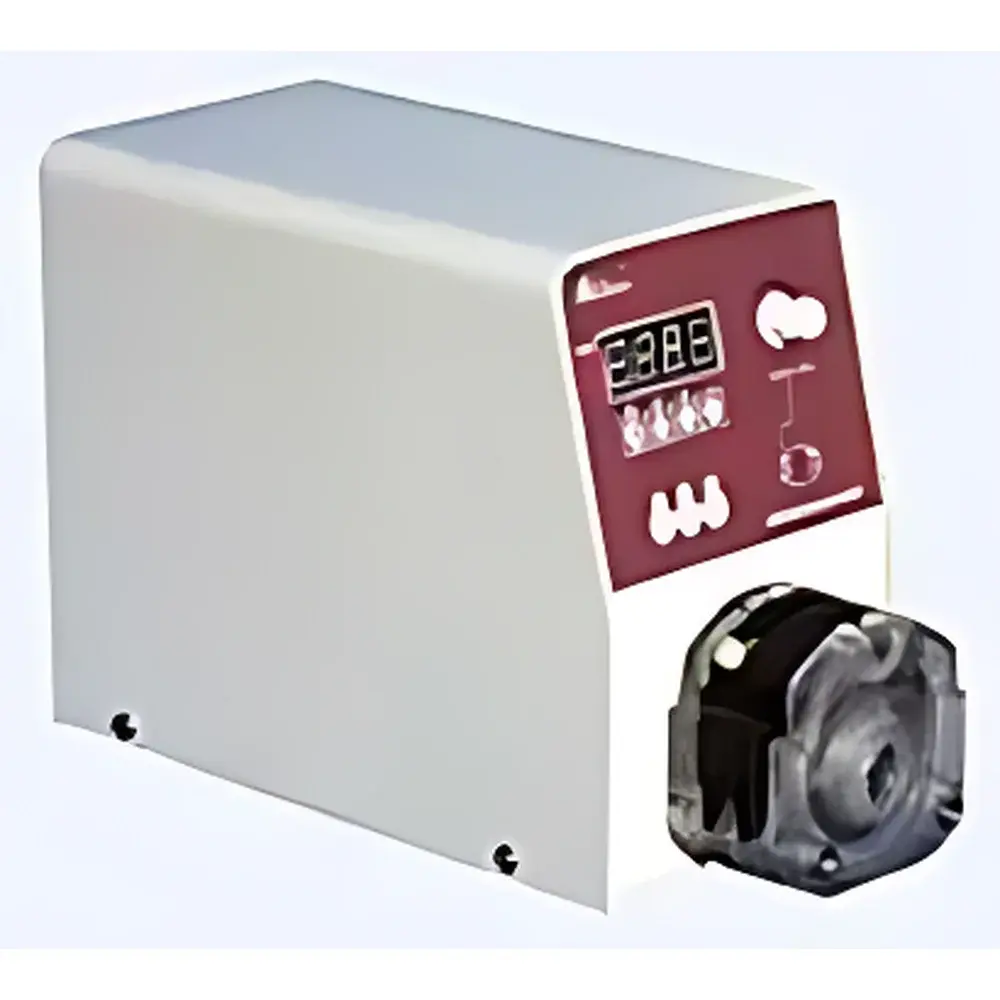
Autosense ATP-3200 Peristaltic Pump
| Brand | Autosense |
|---|---|
| Model | ATP-3200 |
| Flow Rate Range | 0.25–2060 mL/min (dependent on tubing size) |
| Speed Range | 1–460 rpm, continuously adjustable |
| Speed Resolution | 0.1 rpm |
| Speed Stability | ≤ ±0.3 rpm |
| Tubing Compatibility | 14#, 16#, 25#, 17#, 18# (Pharmed®/Norprene®-equivalent silicone or thermoplastic elastomer tubing) |
| Max Fluid Pressure | 1.5 kg/cm² (≈147 kPa) |
| Operating Temperature | –10°C to 100°C (fluid), 0°C to 50°C (ambient) |
| Relative Humidity | <80% RH |
| Power Supply | 220 V ±15%, 50/60 Hz |
| Power Consumption | 150 W |
| Dimensions (W×H×D) | 120 × 230 × 270 mm |
| Net Weight | 5.5 kg |
| Direction Control | Forward/Reverse |
| Display | 4-digit LED, showing speed and flow (for three standard tubing sizes) |
| External Interface | TTL/RS-232-compatible control port for programmable automation |
| Compliance | Designed for GLP-compliant lab environments |
Overview
The Autosense ATP-3200 is a precision-engineered peristaltic pump designed for continuous, contamination-free fluid transfer in analytical, bioprocessing, and quality control laboratories. It operates on the fundamental principle of peristalsis—mimicking physiological fluid transport by sequentially compressing flexible tubing via rotating rollers or shoes mounted on a rotor. This positive-displacement mechanism ensures zero contact between the pump’s mechanical components and the conveyed fluid, eliminating risk of cross-contamination, seal leakage, or chemical incompatibility issues common in diaphragm or piston pumps. The ATP-3200 is particularly suited for applications requiring repeatable volumetric delivery, shear-sensitive media handling (e.g., cell suspensions, enzymes, or polymer solutions up to 2000 cP), and integration into automated sampling or dosing workflows.
Key Features
- Multi-tubing compatibility with dedicated, precision-machined pump heads for 14#, 16#, 25#, 17#, and 18# tubing—optimized to maximize tube life and minimize occlusion-induced fatigue.
- Dual- or quad-head configuration support: up to four independently controllable pump heads can be mounted on a single drive base, enabling parallel or cascaded flow paths without additional controllers.
- Instant start/stop response (<50 ms rise/fall time) ensures high temporal resolution in timed dispensing, fraction collection, or titration protocols.
- Pulse-dampening architecture: when two pump heads are operated with 180° phase offset, pulsation amplitude is reduced by >70% compared to single-head operation—critical for HPLC mobile phase delivery or cell culture perfusion.
- Integrated 4-digit LED display shows real-time rotational speed (1–460 rpm, 0.1-rpm resolution) and calibrated flow rates for three preconfigured tubing inner diameters—eliminating manual conversion tables.
- Smooth, brushless DC motor with closed-loop feedback control delivers stable speed output (≤ ±0.3 rpm deviation under load), even during viscosity fluctuations or pressure backpressure up to 147 kPa.
- TTL and RS-232 communication interface enables seamless integration with LabVIEW, PLCs, or LIMS platforms for scheduled, event-triggered, or sensor-feedback-driven operation.
Sample Compatibility & Compliance
The ATP-3200 conveys fluids exclusively through user-supplied, chemically resistant tubing—commonly platinum-cured silicone, Pharmed BPT, or Tygon® formulations—ensuring full compatibility with aggressive solvents, acids, bases, and biological matrices. No wetted metal parts exist in the fluid path, satisfying ISO 8573-1 purity class 0 requirements for sterile gas/liquid handling when paired with appropriate tubing certifications. The pump meets IEC 61010-1 safety standards for laboratory electrical equipment and is engineered for use in environments compliant with Good Laboratory Practice (GLP) and current Good Manufacturing Practice (cGMP). When connected to validated software with electronic signature and audit-trail functionality, it supports regulatory submissions under FDA 21 CFR Part 11 and EU Annex 11.
Software & Data Management
While the ATP-3200 operates as a standalone instrument, its bidirectional serial interface allows full remote control—including speed setpoint, direction, run duration, and pause/resume commands—via ASCII command protocol. Third-party drivers are available for MATLAB, Python (PySerial), and National Instruments LabVIEW. For regulated environments, the pump may be embedded within a validated system architecture where all operational parameters, runtime logs, and error events are timestamped, digitally signed, and stored in tamper-evident databases. Firmware updates preserve calibration integrity and maintain traceability to NIST-traceable speed reference standards.
Applications
- Automated sample introduction for ICP-OES, AAS, and ion chromatography systems
- Controlled reagent addition in titrators and kinetic assay platforms
- Perfusion feeding in mammalian cell bioreactors and microfluidic organ-on-chip devices
- Continuous extraction and leaching in environmental soil/water analysis
- Fraction collector synchronization in preparative HPLC and SEC systems
- In-line dilution and standard preparation in clinical chemistry analyzers
- Calibration solution delivery in online water quality monitoring stations
FAQ
What tubing sizes are supported, and how is flow rate calibrated?
The ATP-3200 accommodates standard peristaltic tubing sizes 14#, 16#, 25#, 17#, and 18#. Flow calibration is factory-performed using gravimetric measurement per ISO 5725-2, with linear compensation applied for each tubing ID. Users may perform field verification using certified volumetric flasks and analytical balances.
Can the pump handle viscous or particulate-laden fluids?
Yes—tested performance extends to Newtonian fluids up to 2000 cP at 25°C. For slurries or suspensions, tubing selection must prioritize abrasion resistance (e.g., Norprene® LFT); maximum particle diameter should not exceed 25% of tubing inner diameter.
Is external triggering supported for synchronized operation?
Yes—the TTL input accepts 5 V logic pulses for start/stop control, while the RS-232 port enables full parameter readback and dynamic speed modulation based on external sensor inputs (e.g., pH, conductivity, or UV absorbance signals).
How is maintenance performed, and what is the expected tubing lifetime?
Routine maintenance consists solely of visual inspection and periodic roller lubrication (every 2000 hours). Tubing lifetime depends on speed, pressure, and chemical exposure; typical service life ranges from 100–500 hours under continuous 100 rpm operation with aqueous buffers.
Does the unit comply with electromagnetic compatibility (EMC) directives?
Yes—it conforms to EN 61326-1:2013 for laboratory equipment, including radiated and conducted emission limits (Class B) and electrostatic discharge immunity (IEC 61000-4-2, Level 3).



