
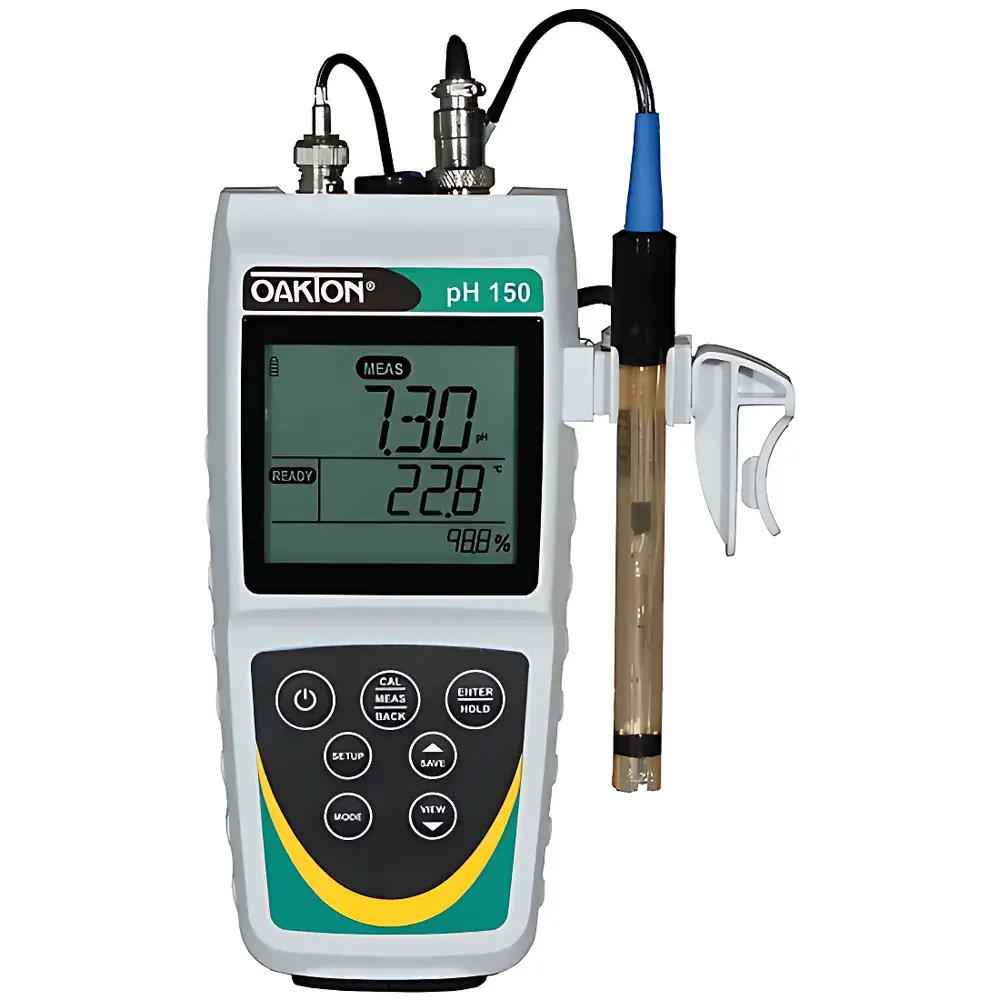
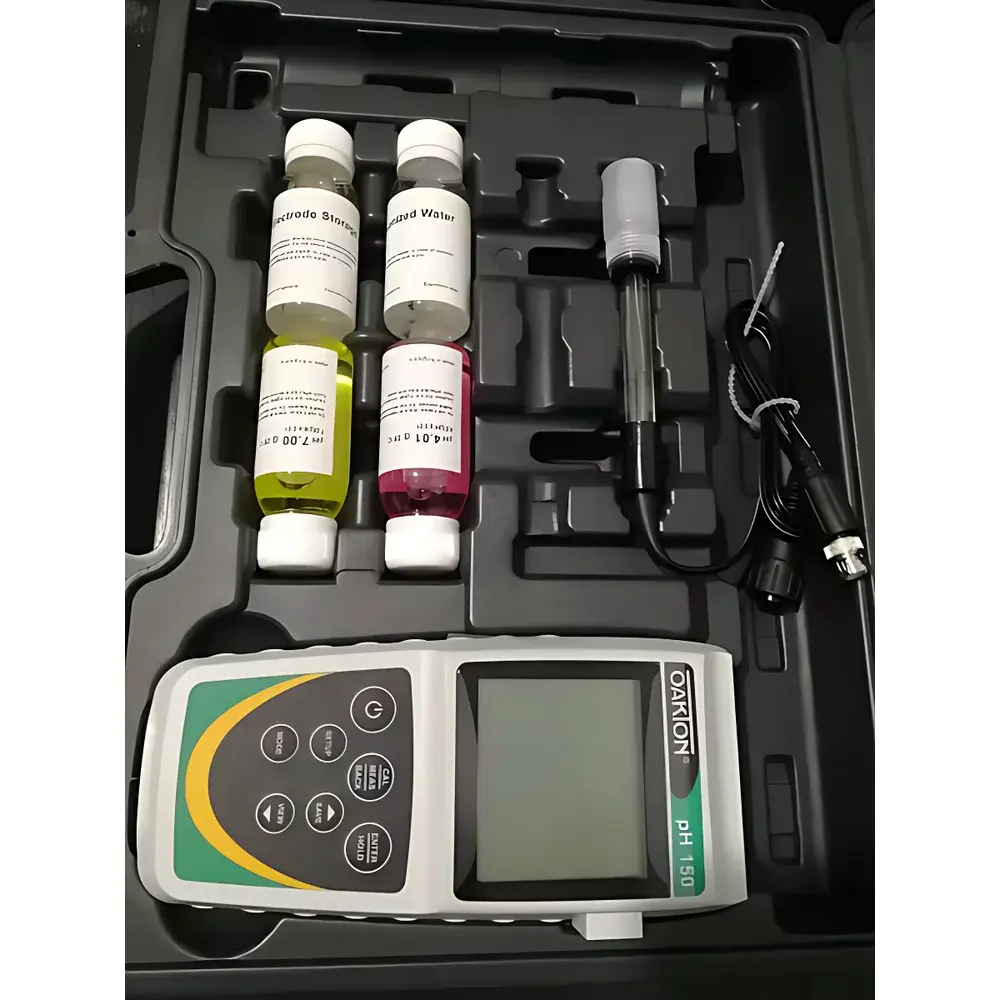
Oakton PH150 Portable Waterproof pH Meter
| Brand | Oakton |
|---|---|
| Origin | USA |
| Model | PH150 |
| Instrument Type | Portable/Handheld Water Quality Analyzer |
| Measured Parameters | pH, Temperature |
| pH Range | –2.00 to 16.00 |
| pH Resolution | 0.01 |
| pH Accuracy | ±0.01 |
| Calibration Points | Up to 6 (US, NIST, DIN buffer sets) |
| mV Range | ±2000 mV |
| mV Resolution | 0.1 mV |
| mV Accuracy | ±0.2 mV or ±0.5% of reading (whichever is greater) |
| Temperature Range | –10 to 110 °C |
| Temperature Resolution | 0.1 °C |
| Temperature Accuracy | ±0.5 °C |
| Temperature Calibration Offset | Adjustable in 0.1 °C increments |
| ATC | Automatic or Manual |
| IP Rating | IP67 |
| Display | Triple-line LCD (pH/mV, temperature, calibration slope %) |
| Data Storage | 150 manually stored datasets + calibration log |
| Battery Life | Up to 700 hours (2 × AA) |
| Optional AC Adapter | 09376-01 |
| Dimensions | 20 × 8.3 × 5.7 cm |
| Weight | 0.5 kg |
Overview
The Oakton PH150 Portable Waterproof pH Meter is an engineered solution for field and laboratory-based water quality assessment where reliability, ruggedness, and regulatory-compliant measurement integrity are essential. Designed around a dual-sensor electrochemical principle—combining glass electrode pH sensing with integrated thermistor-based temperature detection—the PH150 delivers traceable, stable measurements under variable environmental conditions. Its core architecture adheres to fundamental potentiometric measurement theory: the Nernst equation governs pH response, while automatic temperature compensation (ATC) applies real-time correction using either built-in or external temperature probes. The instrument’s IP67-rated enclosure ensures full submersion resistance (up to 1 m for 30 minutes), making it suitable for wastewater outfalls, surface water sampling, aquaculture monitoring, and industrial effluent verification—environments where dust ingress, splash exposure, or incidental immersion are routine operational risks.
Key Features
- Rugged IP67 waterproof and dustproof housing certified to IEC 60529 standards, validated for continuous outdoor deployment and wet-lab use.
- Triple-line LCD display showing simultaneous pH (or mV), temperature (°C/°F), and calibration slope percentage—enabling immediate verification of electrode health and measurement stability.
- Intelligent auto-buffer recognition across three standardized pH buffer families: US (4.01, 7.00, 10.01), NIST (4.01, 6.86, 9.18), and DIN (1.68, 4.01, 6.86, 9.18, 12.45)—reducing calibration errors and operator dependency.
- Up to six-point pH calibration capability with programmable buffer sequence logic, supporting both single- and multi-point verification per ASTM D1293 and ISO 10523 protocols.
- Extended data logging: stores 150 manually triggered measurement records, each timestamped with pH, mV, temperature, and calibration metadata—including date, buffer IDs, and slope/offset values.
- Comprehensive diagnostics suite: electrode status indicator, mV offset adjustment for ORP standardization, pH diagnostic mode, stability “Ready” signal, smart averaging algorithm (configurable 2–60 sec), and Hold function for transient sample capture.
- Power flexibility: operates on two standard AA alkaline batteries (700-hour typical life) or optional AC adapter (Cat. No. 09376-01), eliminating downtime during extended campaigns.
Sample Compatibility & Compliance
The PH150 is validated for aqueous matrices including freshwater, seawater (with appropriate electrode conditioning), wastewater, drinking water, cooling tower fluids, and process streams with conductivity >20 µS/cm. It complies with key regulatory frameworks governing environmental testing: EPA Method 150.1 (pH measurement in natural waters), ASTM D1293-22 (Standard Test Method for pH of Water), and ISO 10523:2022 (Water quality — Determination of pH). Its calibration traceability aligns with NIST-traceable reference materials, and its data integrity features—including non-erasable calibration logs and battery-level auditing—support GLP documentation requirements. While not 21 CFR Part 11–certified out-of-the-box, audit trails generated via manual export meet baseline FDA inspection expectations for field-deployed instruments in pre-GMP settings.
Software & Data Management
Data retrieval is performed manually via front-panel navigation; no proprietary software or USB interface is included. All 150 stored readings—including pH, mV, temperature, calibration history, and instrument status flags—are accessible directly on-device and may be transcribed for LIMS integration or spreadsheet analysis. Each dataset includes implicit contextual metadata: measurement timestamp (derived from internal clock), calibration validity window, and electrode slope (%). For laboratories requiring electronic data capture, third-party serial-to-USB adapters (e.g., FTDI-based RS232 converters) can interface with legacy terminal emulators to extract ASCII-formatted logs—though Oakton does not provide driver support or validation documentation for such configurations.
Applications
- Field-based ambient water quality surveys (rivers, lakes, estuaries) per USGS NWIS or EU WFD reporting guidelines.
- Wastewater treatment plant influent/effluent monitoring, including compliance checks against NPDES permit limits.
- Aquaculture and hydroponic system management, where rapid pH drift detection prevents biological stress events.
- Industrial pretreatment verification for electroplating, food processing, and pharmaceutical manufacturing discharge points.
- Educational laboratory instruction in environmental chemistry, emphasizing electrode theory, calibration rigor, and uncertainty propagation.
- Emergency response scenarios (e.g., chemical spill assessment) where portability, rapid startup (<10 sec), and battery longevity are operationally decisive.
FAQ
Does the PH150 support GLP-compliant data archiving?
It maintains an immutable on-device calibration log and timestamped measurement history, satisfying foundational GLP record-keeping requirements—but lacks electronic signature, audit trail encryption, or user-role access control required for full GLP/GMP validation.
Can the meter perform ORP measurements with accuracy traceable to standard redox buffers?
Yes: the ±2000 mV range and 0.1 mV resolution enable direct ORP quantification; mV offset adjustment allows zeroing against Zobell’s or Clarke’s solutions per ASTM D1129.
Is automatic temperature compensation active during mV-only measurements?
No—ATC is applied exclusively to pH calculations. For mV measurements requiring thermal correction, manual temperature input or post-processing alignment is necessary.
What electrode types are compatible with the PH150?
Any standard BNC-output combination pH/ATC electrode (e.g., Oakton PCSTest3, Thermo Scientific Orion 9107BNMD) or separate pH + temperature probe pair meeting ANSI/ISA S84.01 electrical safety thresholds.
How frequently should calibration be performed in routine field use?
Per ASTM D1293, calibration before each sampling session—and after every 10–15 measurements in variable matrices—is recommended; the built-in calibration alarm provides visual reminders at user-defined intervals.







