
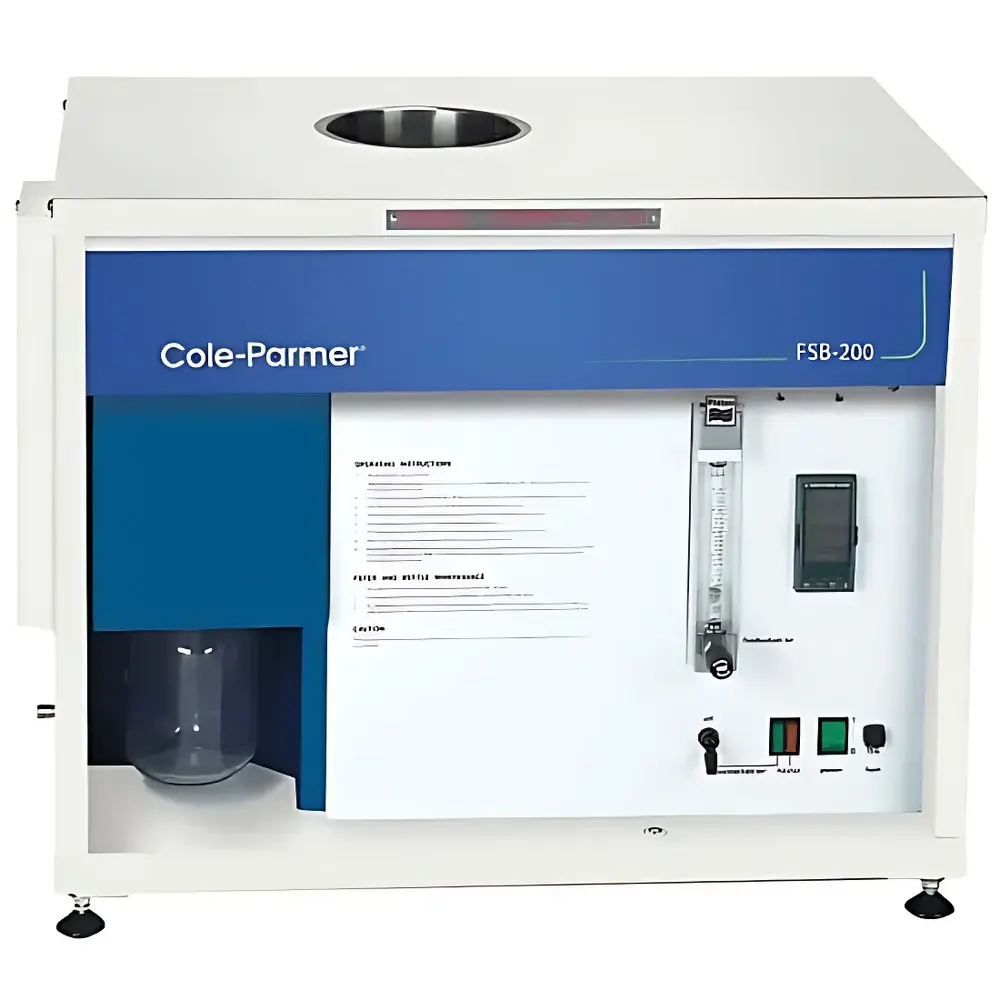
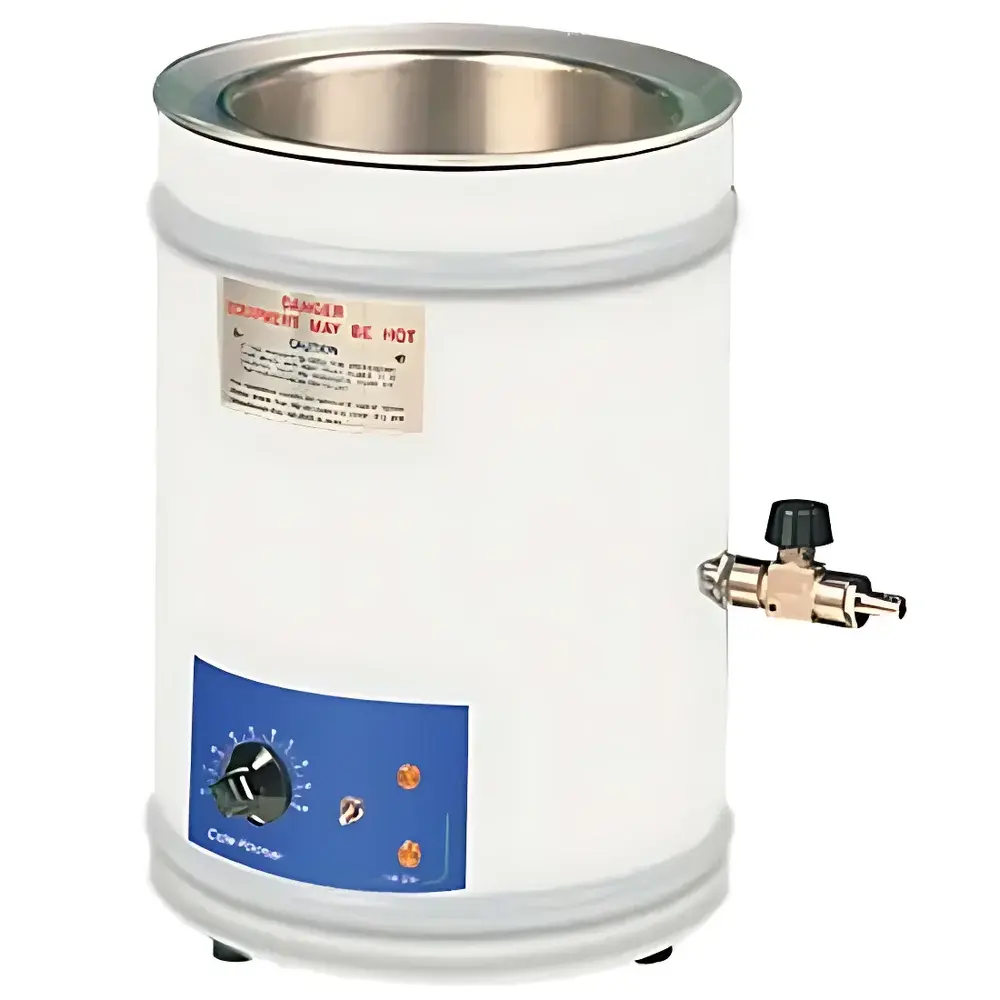
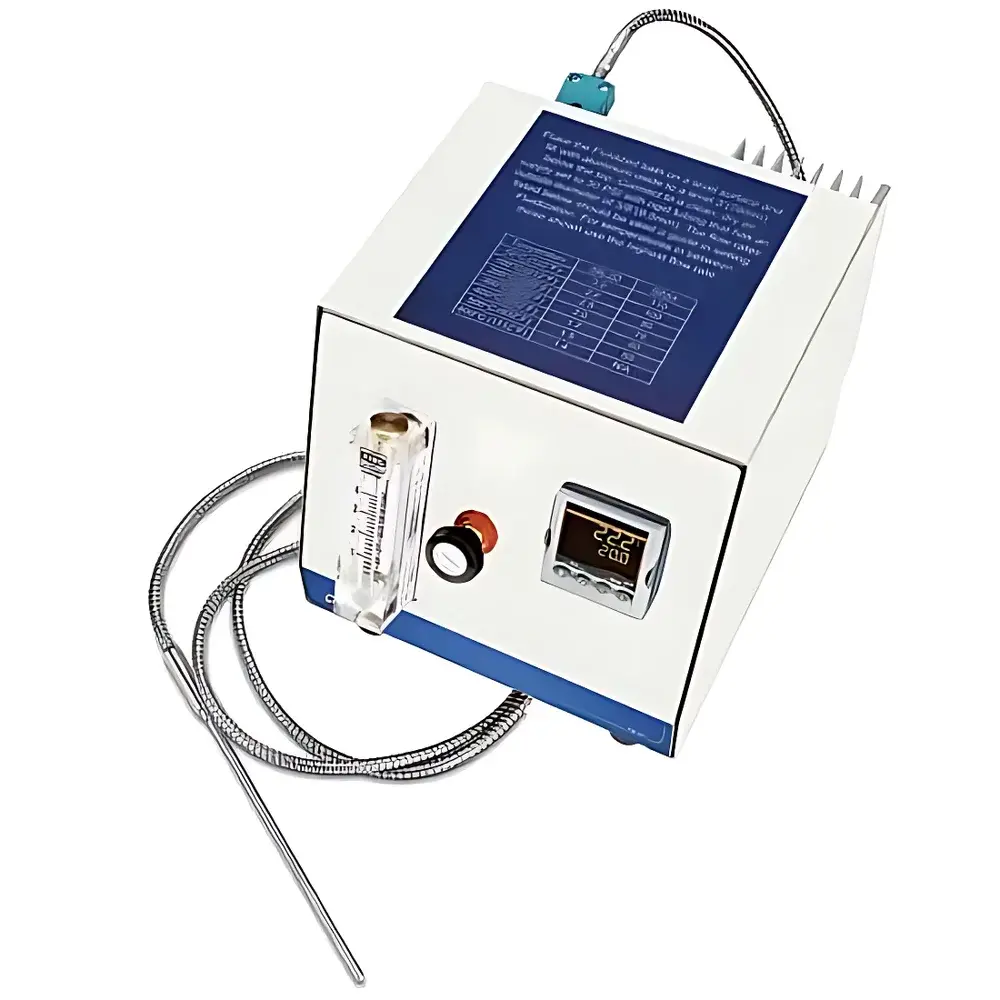
Cole-Parmer FSB-200 Series Fluidized Aluminum Oxide Bath
| Brand | Cole-Parmer |
|---|---|
| Origin | USA |
| Manufacturer Type | Authorized Distributor |
| Product Origin | Imported |
| Model | FSB-200 |
| Temperature Range | 50°C to 600°C |
| Temp Stability | ±1°C |
| Max Operating Temp | 600°C |
| Heating Time (20°C → Max) | 105 min |
| Cooling Time to 200°C | 330 min |
| Air Pressure | 21 kPa (3 psi) |
| Max Air Flow | 57 L/min |
| Power Input | 4000 W (240 V) |
| Al₂O₃ Media Mass | 32 kg |
| Chamber Dimensions (Dia × Depth) | 228 × 350 mm |
| External Dimensions (Dia × H, excl. outlet) | 385 × 695 mm |
| Shipping Weight | 59 kg |
| Safety Features | Insulated outer casing, stainless steel inner chamber, pressure-loss interlock switch, thermal insulation |
Overview
The Cole-Parmer FSB-200 Series Fluidized Aluminum Oxide Bath is an engineered thermal platform that utilizes fluidization physics to deliver rapid, uniform, and controllable heat transfer across a wide operational range (50°C to 600°C). Unlike conventional oil baths, molten salt baths, or forced-air ovens, this system suspends inert, high-purity aluminum oxide (Alundum®) particles in a low-velocity upward gas stream—typically compressed air or nitrogen—creating a pseudo-liquid medium with exceptional thermal homogeneity and responsiveness. When heated, the fluidized bed achieves near-instantaneous thermal equilibrium; heat transfer occurs via direct solid–solid conduction and convective gas flow, eliminating cold spots and minimizing thermal gradients. This principle enables precise temperature calibration of irregularly shaped sensors—including thermocouples, RTDs, and thermistors—where immersion depth or geometry precludes use in liquid baths. The system is also widely deployed in QC/QA laboratories for controlled thermal processing of metallic components, polymer degradation studies, stress-relief annealing, and reaction calorimetry under inert atmospheres.
Key Features
- Stainless steel inner chamber with full thermal insulation and cooled outer surface for operator safety and energy efficiency
- Integrated pressure-loss safety interlock that automatically de-energizes heating elements if airflow drops below 21 kPa (3 psi)
- Two model variants: FSB-200-D (up to 600°C) and FSB-200-240 (up to 500°C), both compliant with IEC 61000-6-3 EMC standards
- Optional FSB-200 Series Temperature Controller featuring Type K thermocouple input, 3-mode PID algorithm, dual setpoint programming, and ±0.1°C offset calibration
- Modular design supports integration with accessories including stainless steel sample baskets (F7807), splash flanges (F1116), and dust containment systems (FFB08DS1)
- RS-232 interface available on FSB-200-P-AC variant for automated process logging and remote parameter adjustment
Sample Compatibility & Compliance
The FSB-200 accommodates a broad spectrum of sample geometries—from micro-sensors (3 mm diameter) to large tooling assemblies—via optional probe racks (FFB08PR1/PR2) and perforated stainless steel baskets (F7759, F7807). Its dry, non-corrosive aluminum oxide medium eliminates risks associated with salt contamination, hydrolysis, or thermal decomposition of organic bath fluids. As such, it meets critical requirements for ISO/IEC 17025-accredited calibration labs performing thermometer verification per ASTM E74 and ISO 17032. When used with nitrogen purge and dust containment, the system supports GLP-compliant sensor calibration workflows requiring particulate-free environments. All electrical components comply with UL 61010-1 and CE marking directives for laboratory equipment.
Software & Data Management
While the base FSB-200 operates as a standalone analog-controlled unit, the optional FSB-200-P-AC model integrates digital control firmware supporting RS-232 serial communication. This enables bidirectional data exchange with external SCADA or LIMS platforms for audit-trail generation, temperature profile logging, and alarm event timestamping—essential for FDA 21 CFR Part 11 compliance in regulated pharmaceutical and medical device manufacturing. The controller’s dual-setpoint function allows users to define ramp-hold-cool sequences programmatically, while its auto-compensating airflow algorithm dynamically adjusts gas flow rate to maintain ±0.01°C stability during extended dwell periods at target temperature. Calibration records—including date, operator ID, reference standard ID, and deviation values—can be exported in CSV format for traceability.
Applications
- Primary and secondary temperature sensor calibration in metrology labs, especially for non-standard geometries unsuitable for stirred liquid baths
- Thermal cleaning of polymer residues from molds, extrusion nozzles, and injection tooling—achieving carbonization without oxidation or warping
- Controlled annealing and stress-relief heat treatment of NiTi shape-memory alloys and Pt-W coil assemblies in R&D settings
- Exothermic/endothermic reaction monitoring in FB-08 series reactors, where uniform wall temperature ensures kinetic reproducibility
- Thermal cycling validation of semiconductor packaging materials and wire-bond reliability under accelerated aging protocols
- Material-specific curing studies (e.g., epoxy resin crosslinking kinetics) requiring precise isothermal holds between 100°C and 450°C
FAQ
What inert gases are compatible with the FSB-200 series?
Nitrogen and argon are fully supported; helium may be used but requires recalibration of flowmeter scaling due to differing viscosity and density.
Is the aluminum oxide media reusable?
Yes—Alundum® particles retain structural integrity over repeated thermal cycles up to 600°C; however, periodic sieving and removal of charred organics is recommended after heavy polymer cleaning loads.
Can the FSB-200 replace a salt bath in nitriding processes?
No—it provides convective/conductive heating only and does not supply reactive nitrogen species; it serves as a precision thermal soak stage prior to or following true nitriding furnaces.
What is the minimum required air supply quality?
Oil-free, desiccated air at ≤5 µm particulate filtration and dew point ≤−40°C is mandatory to prevent clogging of the porous distribution plate and ensure long-term fluidization stability.
Does the system support NIST-traceable calibration?
Yes—the optional FSB-200 Series Temperature Controller accepts certified Type K reference probes and includes user-accessible offset correction, enabling in-house verification against NIST-traceable standards per ISO/IEC 17025 Clause 6.5.
Related Products



