
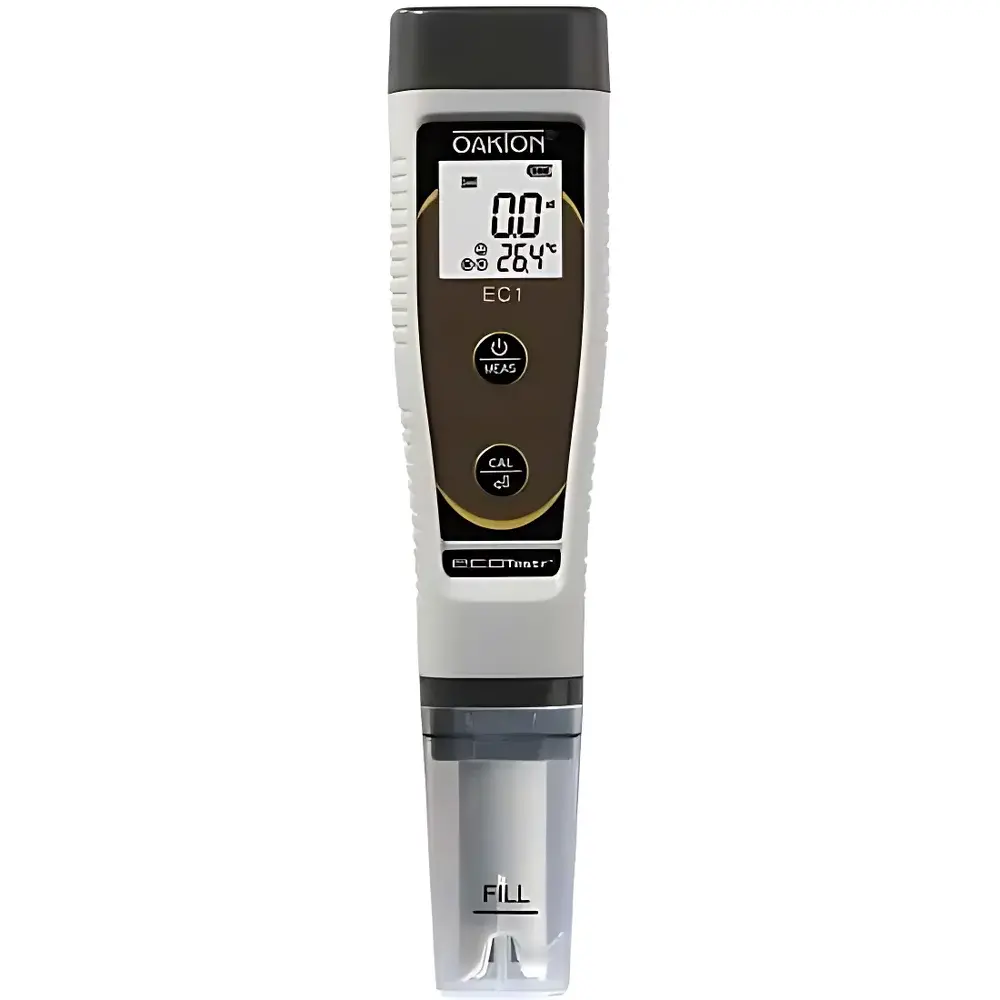
Oakton EcoTestr EC1 Waterproof Pocket Conductivity Tester
| Brand | Oakton |
|---|---|
| Origin | USA |
| Model | EC1 |
| Portability | Pen-style |
| Conductivity Range | 0–20.00 mS/cm |
| Temperature Range | 0–50 °C (32–122 °F) |
| Accuracy | ±1% full scale |
| Conductivity Resolution | 0.1 µS/cm, 1 µS/cm, 0.01 mS/cm |
| Temperature Resolution | 0.1 °C/°F |
| Temperature Accuracy | ±0.5 °C (±0.9 °F) |
| IP Rating | IP67 |
| Battery Life | 400 hours |
| Power Source | 4 × AAA batteries |
| Auto-off | After 8 minutes idle |
| Dimensions | 17.8 × 4.0 × 3.1 cm (7 × 1.5 × 1.25 in) |
| Floatable Housing | Yes |
| Display | Dual-line LCD with stability, calibration, and battery indicators |
Overview
The Oakton EcoTestr EC1 Waterproof Pocket Conductivity Tester is a field-deployable, handheld electrochemical instrument engineered for rapid, reliable measurement of electrical conductivity, total dissolved solids (TDS), and salinity—simultaneously compensated and displayed with temperature. Based on two-electrode AC conductometric principles, the EC1 applies a low-frequency alternating current across a fixed-cell-constant electrode to minimize polarization effects and ensure stable readings across varying ionic strengths. Its ruggedized, floatable IP67-rated housing enables operation in demanding environments—including freshwater monitoring, aquaculture systems, hydroponic nutrient management, and wastewater pre-screening—where exposure to moisture, dust, or accidental submersion is routine. Unlike benchtop meters requiring dedicated calibration stations, the EC1 integrates sensor hydration, calibration, and sample immersion into a single ergonomic workflow via its integrated fill-line cap—a design feature aligned with ASTM D1125 and ISO 7888 standards for field-conductivity practice.
Key Features
- IP67-certified housing: Fully dust-tight and submersible up to 1 meter for 30 minutes; buoyant design prevents loss during aquatic sampling.
- Dual-line LCD display: Shows primary parameter (e.g., conductivity in mS/cm) and secondary parameter (e.g., temperature in °C) simultaneously, with real-time icons indicating measurement stability, calibration status, and battery level.
- Auto-ranging resolution: Switches between 0.1 µS/cm, 1 µS/cm, and 0.01 mS/cm based on measured value—ensuring optimal readability without manual range selection.
- Integrated hydration/cap system: Cap features an internal fill line serving as both calibration cup and sensor hydration chamber, reducing cross-contamination risk and eliminating need for external vessels.
- Self-diagnostic firmware: Performs automatic electrode integrity checks during startup and calibration; alerts user to fouling or open-circuit conditions via display code.
- Automatic temperature compensation (ATC): Uses built-in NTC thermistor (±0.5 °C accuracy) with linear or non-linear (NaCl-based) compensation algorithms per user selection.
- Low-power architecture: Delivers up to 400 hours of continuous operation on four standard AAA alkaline cells; auto-power-down after 8 minutes of inactivity complies with IEC 60068-2-14 environmental endurance protocols.
Sample Compatibility & Compliance
The EC1 is validated for aqueous solutions with conductivity values between 0.00 and 20.00 mS/cm—covering typical ranges for drinking water (0.05–0.8 mS/cm), surface water (0.1–2.0 mS/cm), brackish estuaries (5–15 mS/cm), and concentrated nutrient solutions (<20 mS/cm). Its polymer-junction reference electrolyte resists clogging and chloride poisoning, ensuring consistent performance in high-organic or high-suspended-solid matrices. The instrument meets CE marking requirements for electromagnetic compatibility (EN 61326-1) and safety (EN 61010-1). While not 21 CFR Part 11 compliant due to its standalone, non-networked architecture, its calibration log (1-point or 2-point, using 1413 µS/cm or 12.88 mS/cm KCl standards) supports GLP-aligned documentation when paired with lab notebook entries. All materials contacting samples comply with USP Class VI biocompatibility testing.
Software & Data Management
The EC1 operates as a fully autonomous, embedded-system device with no onboard data logging or USB/Bluetooth connectivity. Measurement values are intended for direct visual readout and manual transcription—making it suitable for routine QC checks, field surveys, and educational use where audit-trail generation is managed externally. Calibration events are not timestamped or stored internally; however, the dual-line display explicitly confirms successful calibration via “CAL OK” indicator and flashes the standard used (e.g., “1413” or “1288”). For laboratories requiring electronic records, integration with external digital loggers or mobile apps via camera-based OCR capture is feasible under controlled lighting conditions.
Applications
- Environmental monitoring: Rapid assessment of stream, lake, and groundwater conductivity as a surrogate for ionic load and anthropogenic contamination.
- Aquaculture & aquarium management: Real-time tracking of salinity shifts and osmotic stress indicators in recirculating systems.
- Horticulture & hydroponics: Verification of nutrient solution strength prior to delivery, preventing over- or under-fertilization.
- Drinking water verification: On-site screening of post-treatment conductivity to detect membrane failure or disinfectant carryover.
- Academic instruction: Hands-on demonstration of ionic mobility, Kohlrausch’s law, and temperature dependence of conductivity in undergraduate chemistry labs.
FAQ
Does the EC1 support GLP-compliant calibration records?
No—the EC1 does not store calibration timestamps, operator IDs, or standard lot numbers. Users must maintain external calibration logs per GLP requirements.
Can the EC1 measure seawater (≈50 mS/cm)?
No—it is rated only to 20.00 mS/cm; seawater exceeds its upper limit and may trigger saturation error or inaccurate compensation.
Is the electrode replaceable or serviceable?
Yes—the entire sensor module (electrode + temperature sensor) is a field-replaceable unit (Oakton P/N: EC1-SENSOR); no soldering or recalibration is required post-replacement.
What is the recommended calibration frequency?
Daily for critical applications; before each use in variable-field conditions; or per ASTM D1125 guidelines—whichever occurs first.
Does the EC1 require electrode storage solution?
No—the integrated cap maintains hydration with deionized water; long-term dry storage is permissible but requires 30-minute rehydration before first use.




